If you grew up on Alisa, Aquarium, DDT or Kino, Oblachny Kray may feel like another planet: Arkhangelsk, home tape recorders, a heavy sound. Yet the paths of these bands really crossed — at Andrey Tropillo's studio, on shared stages, in shared company. Here the crossings are collected in one place. Everything comes from Sergey Bogaev's memoir and archive publications; the assessments belong to the authors of the sources, and where there is more to read, a link stands beside it.

Aquarium: January 1982 in Arkhangelsk
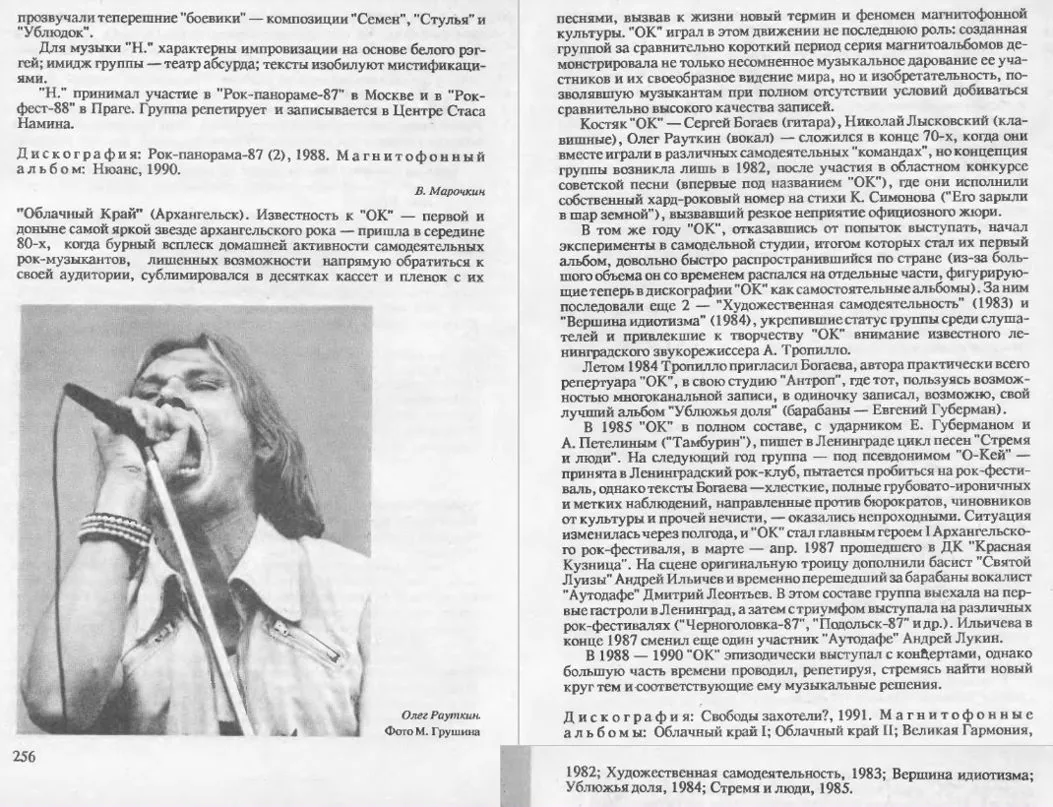
In January 1982 Aquarium came to Arkhangelsk together with the sound engineer Andrey Tropillo. Bogaev recalls that it was a band "unknown to us until then" (chapter 3). The Leningraders were played the just-recorded "Tayny lesa": as it is retold, the recording struck them by its originality and unusual approach to recording. Tropillo left Bogaev a phone number — and in 1984 that number came in handy: that is how Oblachny Kray ended up in Leningrad, at Tropillo's studio (chapter 5).
The drummer Evgeny Guberman, who had played in Aquarium before (and, by Bogaev's words, in Zoopark), played on "Ublyuzhya dolya" (1984) and on "Stremya i lyudi" (1985). For "Stremya i lyudi" Boris Grebenshchikov (designated a foreign agent in Russia) lent a guitar and the musicians of Strannye Igry lent keyboards and bass: for the first time Oblachny Kray had professional instruments.
Alisa and Konstantin Kinchev
In 1984–1985 Oblachny Kray and Alisa recorded at the same studio: while Alisa worked on "Energiya", Bogaev made "Ublyuzhya dolya" and then "Stremya i lyudi"; chapter 6 even has "a double coffee for Kinchev" (chapter 6, part 2). Seeing Alisa live at the start of its career, Bogaev, who by his own account did not take in Russian-language music, was overwhelmed: "But when I heard Alisa, I understood: we are not alone here on Earth." That concert, he writes, echoed in him throughout the work on the next album (chapter 6, part 1).
In 1987 the roles reversed. At the V rock festival in Arkhangelsk Alisa was among the headliners invited from Leningrad on Bogaev's advice; some of Alisa's musicians slept in Oblachny Kray's studio at the Krasnaya Kuznitsa culture palace, and Bogaev sat at the mixing desk (how it went; the same day through the eyes of a sound assistant). In the autumn of 1987 Oblachny Kray and Autodafe went to Leningrad for a concert at the LDM in the same programme as Alisa, and in the winter of 1988–89 they went once more, on a return visit (about Autodafe; chapter 1).
DDT and Yuri Shevchuk
Bogaev met Yuri Shevchuk in the backstage control room of that same concert, where Tropillo was recording the performances: in the middle of the company stood a man with a bottle of port; in Arkhangelsk Bogaev had heard "Periferiya" (chapter 6). DDT's saxophonist Mikhail Chernov ("Uncle Misha") played on "Stremya i lyudi"; by his recollection, Oblachny Kray was "truly a real cool rock band" and Sergey an outstanding musician (about "Stremya i lyudi"). When "Svobody zakhoteli?" was being recorded, DDT's musicians helped: Igor Dotsenko lent the bass drum and the keyboard player Andrey Muratov lent a keyboard (chapter 9).
Kino, Zoopark, Televizor
The same equipment on which Tropillo recorded Bogaev was used for Zoopark's "Belaya polosa", Kino's "Nachalnik Kamchatki" and Aquarium's "Den serebra" (so the review of "Stremya i lyudi" on Zvuki.Ru puts it: the review). In those days Bogaev, by his words, got to know "all the main bands of the Leningrad rock club — Televizor, Zoopark and Kino"; Viktor Tsoi and Guryanov dropped in at a party (chapter 6, part 2).
Podolsk-87
On 11–13 September 1987 Oblachny Kray played the festival in Podolsk — together with DDT, Nautilus Pompilius, Zoopark, Kalinov Most, Brigada S, Televizor and others (about the festival and the DVD). Dmitry Leontiev recalls that the band was put up together with Kalinov Most: Dmitry Revyakin "played his songs alone with a guitar. And it was such a wonderful night"; and after the performances they spent time with Mike Naumenko and Zoopark (the interview).
Nol, Gradsky and others
Fyodor Chistyakov and Nol knew Oblachny Kray: by Bogaev's account the guys from Nol were waiting for the album (chapter 6); in 1987, by the magazine "ROKSI", Chistyakov called Bogaev and Zharikov of "DK" "our fathers in music" (about Nol's visit to Arkhangelsk). Alexander Gradsky, by the authors' accounts, played "Kostya Perestukin" in his radio programme "45 minutes in the Sunday studio" (the essay of "MK").
Where to start listening
- "Tayny lesa" (1982) — the recording that surprised Aquarium in 1982.
- "Ublyuzhya dolya" (1984) — the first Leningrad album, Tropillo's studio, Guberman on drums.
- "Stremya i lyudi" (1985) — the band's best-known tape album, with Mikhail Chernov's saxophone.
- "Svobody zakhoteli?" (1990) — the Melodiya vinyl record.
- Concert in Podolsk (1987) — a live recording from "the Soviet Woodstock".
The rest is in Bogaev's memoir, written in the first person, and in the story of the band's friends in Arkhangelsk.
Sources: Sergey Bogaev's memoir "From the history of the band" (chapters 1, 3, 5, 6, 9); the albums' pages and articles of this site by the links; the interview of Igor Borodin and Dmitry Leontiev; the review of "Stremya i lyudi" on Zvuki.Ru; the essay of "MK v Arkhangelske" (2011).