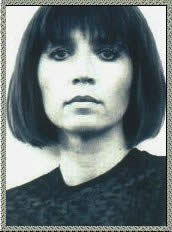
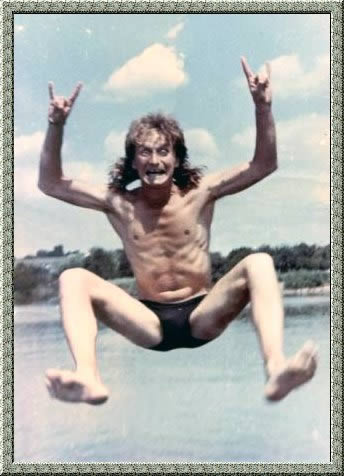
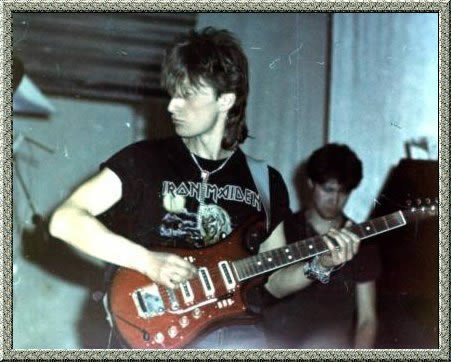
In early June 1995, Olya really bailed me out, saving me from absolute stagnation. During those days, Tropillo was supposed to go to France and Germany for two weeks on some important business of his. As I already mentioned, the premises housing the studio belonged to the Institute of Psychoanalysis. It was already '95, and the space had been occupied since '89; to this day, Andrei had somehow managed to pay absolutely nothing to the institute's director, Comrade Reshetnikov. It was the sixth year of this so-called "lease," even though a term and a monthly rent amount had been agreed upon, yet no money had ever been paid.
In early June 1995, Olya really bailed me out, saving me from total stagnation. In those days, Tropillo was supposed to go to France and Germany for two weeks on some important business of his own. As I already mentioned, the premises housing the studio belonged to the Institute of Psychoanalysis. It was already 1995; the space had been occupied in 1989, and to this day, Andrei had somehow managed to pay absolutely nothing to the Institute's director, Comrade Reshetnikov. It was the sixth year of this so-called "lease," even though a timeframe and a monthly rate had been agreed upon, but not a dime had ever been paid.
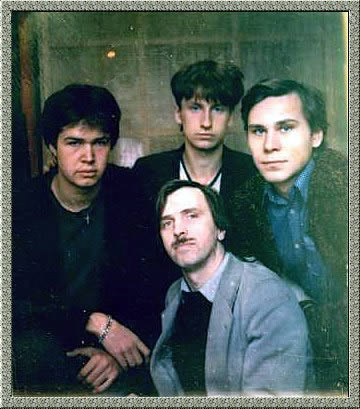
The administration hears the noise, figures out exactly what's going on, and sends the electrician over again. He disconnects my wire once more and tosses it down. That evening, I hook it back up. Eventually, the electrician wrapped my "Ariadne's thread" around his elbow and carried it off to who knows where... And I should mention, that wire was no ordinary one—it was rated for heavy-duty 380-volt loads. I didn't have anything like it, and it was the absolute only wire kept in the studio. I called Tropillo in a panic: "I'm leaving right now, but tomorrow the money will be transferred to the Institute's account, both for the rent and the electricity—you can count on it, just sit tight."
There was no way I could sit still. If Andrey hadn't left town, he could have sorted things out. The administration's mood had partially rubbed off on me. The director had issued a strict warning: if we hooked up to the power one more time, they would call the police and throw us and our equipment out into the street. I was acting as the watchman, so I took the brunt of the scolding. I tried to pipe up, saying something like, "Don't worry, the money will come through tomorrow..." but the director just laughed in my face. As he walked away, he kept going on about what he thought of Tropillo, our music, all of Russian-language rock, and exactly where we all belonged...
Needless to say, the money wasn't transferred the next day. Or the day after that, either. And my electric kettle and electric razor—everything proved to be useless junk in a situation like this. No one was coming in to record, and there was no money. Within a week, I had become completely scuzzy—it was horrifying. Dirty, unshaven, looking like a homeless man, weak from hunger... so what was I supposed to do? I walked over to the guys' places, anyone I could reach on foot—no one was home. In this scorching heat, they were all out at their *dachas* living the hippie life. Pershina was in England, Tropillo was in Germany, and I was in deep shit.
– "And where do you think you're going, Sergei Ivanovich? Whoa! Look at the state of you... ugh," Olga sniffed at my clothes. – "Well, it's like this," I answered, looking down dejectedly. "No electricity, no money, I haven't eaten in six days, I can't even heat water to wash myself, and I don't have the money for a public bathhouse... basically, I'm rotting alive here... so I'm going to sell this hot plate." – "What?? You're going to the market looking like *that*??? A cop will pick you up in two seconds, don't you get that?? Drop your junk, let's go, come with me."
Pershina had just gotten off the train, dropped off her bags, and came straight to me. A beautiful, stylishly and expensively dressed, luxurious woman, she led me down the street and even took my arm. It was quite a sight: a beauty and a beast, a foreigner and a homeless man walking down the street, while police officers tugged at each other's sleeves and radioed in, saying, "Look at this scene..." Passersby were turning their heads.
We walked to the metro, rode to Udelnaya, transferred to a commuter train, and arrived in the village of Shuvalovo – a sort of St. Petersburg Montmartre. Various artists and musicians had founded a small settlement there: scorning the modern conveniences of high-rise apartment buildings, they settled within the city limits in private houses. It was to one of these houses that we had come, to Olya's friends: Kostya Razumanov, his wife, and daughter. Diana had been a ballerina – she danced at the Mariinsky and the Music Hall, but having grown weary of the meager salary and the harassment from the "New Russian" upstarts, she quit, devoting herself to family life and raising her daughter, Masha, far from the hustle and bustle of the city.
Tropillo arrived and transferred a small sum to the Institute's account, though not the full amount. They let us in, with the stipulation that the outstanding debt had to be paid in full within two weeks. After my rehabilitation in Shuvalovo, I threw myself back into the fray, my inner state significantly renewed. Over the course of two weeks, we somehow managed to finish recording all the instruments very quickly. I convinced Pershina that there was no need to pile on heaps of sloppy tracks, but rather to radically erase anything doubtful and finally move on to mixing. Olga, too, was utterly exhausted from the whole recording process; she relied entirely on my intuition and wasn't disappointed... by the end of summer, a large portion of the album was already finished.
Andrey told me that Olga had said she was very pleased with our collaboration, that she should have been sent straight to me, and that she would absolutely write her next album with me... oh, the horror! Do not see a note of ingratitude in my cry — I remind you that I slaved away for Pershina for a year absolutely free. I was on Tropillo's payroll — listed as a sound engineer at the Lutheran organization, my employment book was kept there. You could wait for this salary for a month or two, or even longer, whereas one-off gig jobs were paid, as they say, right on the spot. Because of Olga, I was deprived of any gig work: after me, someone else would come to work with someone — and they got paid, right in front of me doing the exact same thing, while I went hungry. Therefore, I was terribly frightened by the prospect of a second album and begged Tropillo to stall this whole thing by any means possible. A new album, "Love for Life," was already taking shape in the depths of my mind, and my hands were itching to get to work on it.
I was surprised; we seemed to know each other, but he didn't recognize me. "Come in," I said, opening the door for him. He was dressed completely unlike Yury Shevchuk and, looking closer, I realized: he just looked like him. A velvet green jacket with shiny gold buttons. Gold glasses on the bridge of his nose. "And who are you, exactly?" I asked. "I'm an old friend of Olya's. I heard she was recording and came to visit. I live right nearby, those are my windows over there," he pointed. Deep in the courtyard wells of Petrogradka, the windows of his apartment shone brightly.
We introduced ourselves. It was Olya's friend from her youth, Sergey Kiryanov, chairman of the Union of Industrialists and Entrepreneurs of St. Petersburg. Through some back channels, he had purchased an apartment right across from us, which wasn't listed anywhere — it didn't even have an address. He used it for clandestine purposes. Sometimes he would provide this accommodation to people who needed to hide somewhere. And often, various people simply lived there — in particular, the actor Lenya from the movie *Bandit Petersburg* had been spotted there. The very one Pevtsov had a conflict with and then went and killed, for which his buddies reproached him, saying, "Why did you do him in? He was a stand-up guy."
We used to hang out there quite often—to mingle with a different crowd, snack on little sandwiches, and drink Smirnoff, which the host preferred. And so, one day in the second half of June, right around the time Shamil Basayev attacked Budyonnovsk and seized the hospital, we were sitting up working, seeing Pershina off on her trip with another urgent overnight report. If earlier Olga could have canceled her trip just in case, this time they were traveling as a group, and this time it was strict: seven AM, plane, train station. And then Sergey shouts to us through the open windows: "Hey! Beatles! Come on over, all of you! What are you doing?" — "Well," we reply, "we're on the night shift, we have to finish by morning, Olya is leaving." — "Then let's send her off! Olya! O-olya! It's my birthday, guys, come on over, all of you!"
He just couldn't make peace with his loneliness. And we simply couldn't keep him company. The plane was inexorably departing for London in the morning. We politely declined and kept sitting there working, and then we went out to the kitchen for some tea. Suddenly—*ping-zing*—bouncing off the stone wall, a metal ball rolled across the floor. *Ping-zing*—a second one. It was perfectly clear: the dear entrepreneur was shooting at us. He had plenty of all kinds of weapons—he was a collector. He kept his arsenal right there, and, feeling quite tense, I asked him through the window opening: "What's wrong with you, Seryoga, have you completely lost your mind? What the hell are you shooting at?" — "Well, since you won't listen to good advice, what else am I supposed to do? I'm going to smoke you out of there."
I was genuinely scared. Out of the corner of my eye, I had once seen Sergey's collection, and it had everything—sabers, knives, yataghans... right down to a grenade launcher, or so it seemed to me at the time. In any case, he certainly had the means to smoke us out, of that I had no doubt whatsoever. That's why I got so thoroughly spooked. And he didn't let up: having finished playing with his pneumatic toy, he picked up a seven-shot pump-action shotgun loaded with large buckshot. "Still haven't changed your minds?" demanded a now quite drunk Seryoga menacingly. — "No," I reply, "if only you knew how much we'd love to come over, eat some caviar and lampreys in oil; have some vodka... oh come on, really now, huh?" — I was doing everything I could to calm his irritation. But my long nighttime tirade was interrupted by an incredibly loud blast... he fired the pump-action shotgun at the downpipe, turning it into a sieve. Do I even need to say how deafeningly loud that was in the well-like courtyards of Bolshoy Prospekt P.S. at three in the morning? It felt like the sky had fallen down on us. Olya and I hit the floor.
The whole horror of the situation was compounded by the fact that in those days, the entire police force had been put on full combat alert. In our neighborhood, the sirens of their cars instantly began wailing around the entire perimeter. The courtyard we were in was mostly abandoned. It was impossible to tell right away where the shooting was coming from. But Sergey wouldn't let up. He clicked the charging mechanism: "Well, did I convince you? Are you coming over to my place?" — "Are you crazy, Seryoga? The cops are about to storm in, snipers, and they'll shoot you... what the hell are you doing?" — "Who's gonna sto-o-orm in? I'll show them," Sergey boasted, "no one's gonna find u-us," and he fired at the pipe again, and then once more.
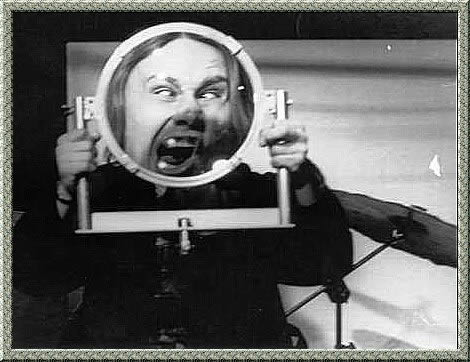
Down below, car doors were already slamming, and we could hear the heavy thud of boots on the rooftops. We turned off the light and the radio that was playing in the kitchen. Our shooter hid in his window. We sat down at the table, sipping our tea... and suddenly Sergey reappeared in his window holding some cylindrical object: "What's written here, no idea..." he muttered, twirling the shiny gizmo in his hands, trying to figure out how it worked. I immediately remembered: there's a gadget in the navy, sort of like a flare gun, but extremely powerful. It's designed to signal ships in heavy fog. Once activated, it roars up to a height of five hundred meters and explodes there, producing a massive flash of light and sound. Someone had gifted it to him in my presence once, and I had talked to the giver, who told me all about it.
Seryoga kept twirling this contraption in his hands, and suddenly it went off with a massive bang... and flew straight into our window. Blinding us with sparks and deafening us with its screech, a glowing orb flew into the kitchen and began bouncing off the walls. It slammed into the door, ricocheted into the hallway wall, smacked against the floor, and darted out the open door, straight toward the security grate... where it exploded with a terrifying, deafening whistle, blowing out all the glass in the stairwell. Olya and I, genuinely shell-shocked, shook the gray dust and soot off ourselves.
A thick, heavy silence fell, broken by a drunken voice: "Well? Is everyone still alive?" – at which point, completely throwing caution to the wind, I start screaming every curse word in the book at our birthday boy. – "Look, guys, I'm sorry, I just misjudged it, and plus I ran out of everything..." – And then I look over and see him twirling a smaller flare gun in his hands: "Alright, one last salute," – he sticks his head out the window and fires a red flare upward – the signal to attack. – "Turn off the lights, you idiot," – I hiss at him in a loud whisper, – "the snipers are going to take you out right now."
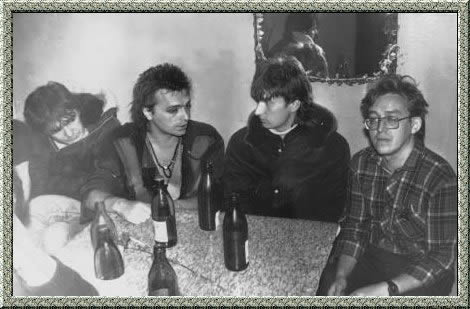
In the morning, I saw him, looking cheerful in a white shirt. He told me that while looking through binoculars that night, he had seen two special forces guys on the roof – they were examining his windows through the scopes of their rifles. Literally the very next day, to be safe, he hauled his entire weapon museum out to his dacha. And we never did finish mixing our song. Olga flew off to London. Nothing was going to change that. We were already finishing the album anyway. It was a rock opera that Boris Grebenshchikov came up with while riding a tram.
There used to be a route in Leningrad that crossed the entire city in two hours. The opera was called "In the Embrace of Denim." Olga Pershina had decided to bring it to life alongside St. Petersburg rock musicians and myself, acting as the sound engineer. Olga had always been a free spirit who loved a good time, but one fine day something happened to her. She suddenly became a terribly religious woman—she found faith, right down to the very depths of her soul. If her vocabulary had previously included swear words, they suddenly and completely vanished in an instant. Drinking became strictly forbidden. Even the slightest hint of alcohol on my breath at work would trigger a fit of rage. That was definitely taking it too far.
And one day, Olga stepped up to the microphone, folded her hands, and prepared to sing. I gave her the cue to start, the music began playing, I moved my chair, its leg caught on a cable, the cable pulled my guitar, and it fell onto the carpet: "Fuck!" I exclaimed, forgetting to turn off the studio intercom. Oh, the horror! I had sworn, and right during a recording session, no less... Olga burst into tears, started taking valerian drops, and threw a tantrum. She eventually managed to calm down, but the recording session was ruined. As she was leaving, she strictly forbade me from having even a hint of alcohol on my breath the next morning. I simply couldn't take that kind of pressure anymore—the resentment completely overwhelmed me.
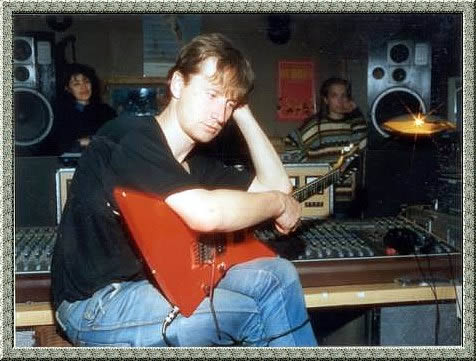
Well, how could anyone influence me? I recorded Olga for free for a whole year. If I managed to scrape together anything for bread during that time, I boldly turned it into wine—what else was I supposed to do in such a situation? Olga had to back down. Tropillo told her straight: if you want non-drinking sound engineers, work with them, shoot the breeze with them, do whatever you want. But if you want Bogaev, you'll have to tolerate the booze breath.
Besides, despite her foreign capital, Madame Perry didn't pay me. Just once, out of the kindness of her heart, she forked over a hundred bucks, and that was it for an entire year of this kind of work. Well, she also treated me to a bathhouse visit, so a big thank you for that. But otherwise—absolutely nothing, really. Two albums: "Songs on Religious Themes" and this one, "In the Embrace of Jeansie"—having recorded these labors of love, we ended our difficult relationship to our mutual joy. Both albums were released in England by rock photographer Natasha Vasilyeva on her label, "White Horse."
For Special Radio
September 2008
Related materials:
Original article: https://specialradio.ru/art/id382/