I dreamed of Leningrad. I could no longer stay in Arkhangelsk for long—I had started getting used to traveling to Piter. I was drawn to this magical state of intense work and socializing with advanced colleagues. Some kind of rock life was boiling over in my hometown, but after Piter, it naturally felt more disjointed and sparse. So, at the very first financial opportunity, I boarded a plane and flew to Tropillo. That is how I ended up at the 3rd Rock Club Festival in late 1984. Using his technical equipment, Andrei Tropillo organized the recording of all the concerts onto two "Tembr" tape recorders, which had stood at Vishnya's place when I lived with him during the recording of the previous album. To ensure smooth tension at double speed, Andrei installed foreign motors into the Soviet tape recorders; they were twice the size of the original ones, so the devices lacked their bottom covers, as well as their side panels: they were just two splayed-out frames. All of this, including the mixing console and some effects processors, was set up in a large room adjacent to the concert hall. The signal from all the microphones was split into the main hall's console and Tropillo's console via two large "cables".
I had come here straight from the plane. Andrey showed me the concept behind his invention, explained the setup, and then suddenly darted off to handle some organizational issues. The room was closed off and partitioned; spectators weren't allowed in. Only certain musicians and the operators who were helping Andrey remotely on stage could stay in this makeshift control room. A small group of people huddled in the corner; someone called out to me and invited me into the circle. In the center of the group, I saw a young, intellectual-looking guy in glasses, holding a bottle of portwine dusted with sawdust. "Meet," they said, "this is Yura Shevchuk." We introduced ourselves, though we already knew of each other. In Arkhangelsk, I had heard the album *Periphery* and really liked it. Well, maybe not absolutely loved it, but against the backdrop of everything else out there, I liked it a lot. The bottle was opened, glasses were brought over, and we clinked them to our acquaintance.
In the lobby, display boards featuring the works of Leningrad photographers hung on the walls. You could feel an actual art process at work here—everything looked incredibly unusual to the untrained eye. In one large, nearly life-sized photograph stood two guys with such expressions on their faces that I intuitively knew I would definitely like their music. I stepped closer and read the caption: "Alisa." I became very intrigued. On the concert poster were Kinchev and Zadery, radiating such raw energy... They were frozen in a shared impulse, and I remember feeling a pang of envy that even their photo radiated such profound unity. The pictures looked like they were taken at some Western rock concert.
I dropped by Tropillo. I asked when "Alisa" was going to perform—I was terrified of missing it. The festival had a classic atmosphere: some bands played practically just for themselves and their friends, while the entire audience scattered around the lobby and into the far corners. People huddled in clusters—some drinking, some smoking, some telling tall tales. The place was packed to the rafters. Other performances drew a packed, sold-out crowd in the hall, with people sitting in the aisles and on top of each other. That was roughly the atmosphere that took over when it was Alisa's turn. Everyone—from the lobby, the cafe, the bathrooms, from every nook and cranny and utility room—was sucked into the hall as if by a giant vacuum cleaner.
The first to take the stage, wearing war paint, was Slava Zadery, the band's founder. He was asked to play a sound check from the mixing console; he played a bass riff and growled some biting lines into the microphone—and right then, my jaw dropped. "Wow," I thought, "so *this* is Alisa..." But I hadn't seen anything yet. The rest of the musicians gradually began to take the stage, thickening the wave of sound emanating from the amps with their presence. Kinchev came out last, and the hall roared ferociously. It was the first time I had ever heard that sound. Never before had I participated in such an event; I hadn't even imagined something like this was possible. Everyone just "knew" it was going to be awesome, but no one had seen Kinchev before, and the crowd's reaction to this debut left me stunned.
I stood there, hypnotized by Kostya's mastery. He struck me as a python gazing at a packed hall of rabbits, deciding where to begin. I couldn't make out the words because of the poor sound system and the insane screaming all around... but Kostya's delivery! The performance flowed effortlessly in a single breath and left an indelible impression on me. To be fair, the port wine I had drunk with Shevchuk also had a highly favorable effect. I've already mentioned that I didn't listen to any Russian-language music, and generally speaking, nothing that Tropillo was recording at the time evoked any emotions in me. But when I heard Alisa, I realized: we are not alone here on Earth. The event fired me up to such a degree that I wanted to immediately grab an instrument and start recording. I knew what the next Oblachny Krai should sound like, and that concert echoed within me throughout the entire process of working on the album.
But back then, I had only come for the day, and after the concert ended, I headed straight to the airport. I stuffed all my carry-on luggage with Pepsi—it had only just appeared back then, and going to Arkhangelsk from Moscow or Leningrad without bringing back some Pepsi would have been the height of absurdity. I flew back and immediately sat down that night to write a letter to Rautkin—saying, look, Oleg, we aren't the only ones on this planet rocking out. I described to him in detail how I had seen Alisa and what had been going on in the hall. I had trouble falling asleep; thoughts of the new album wouldn't leave me alone. A new benchmark had emerged, and I didn't want to fall short of the miracle I had witnessed in Leningrad—I wanted to do it even better. But where? How? We didn't even have a place to rehearse.
The solution presented itself: I was called into the factory's Komsomol committee. Our secretary, Yakov Popovenko (now an owner of factories, newspapers, ships, and radio frequencies), suggested I take charge of providing our local cell with cultural and mass leisure activities. In other words, I was entrusted with running the discos again, and to carry out this simple task, I went to see the club's new director, who happened to be a woman. And, more importantly, this woman was married to some high-ranking police official.
The previous director had thrown us out on the instigation of the committee members—I had mentioned this earlier. Yasha advised me to go speak with her. I went in and explained the situation... Her response was: "Of course, no problem, here is your equipment, everything is intact, take it!" The junk handed over to my jurisdiction—and that was exactly how I viewed our gear after recording at Tropillo's—didn't exactly stir up a storm of emotions, but it was a room! It beat playing at home with a guitar plugged into a tape recorder. I was overjoyed, and from that moment on, Kolya and I worked literally day and night. We recorded rough drafts and sent them off to Oleg in Ukraine. It was like "boxing by correspondence": people play chess by mail, so we were developing our future album the same way. And although our songs were always written on the spot during recording, we did a certain amount of prep work—discussing and arguing.
What worried me most was this: all the members of popular Leningrad bands who recorded with Andrey had magnificent instruments, while I had a Ural guitar and a three-string bass—and even those were on the factory's inventory. I called Tropillo and voiced my concerns. He reassured me, saying that all we needed to provide were fresh, new ideas, and he would figure out what to realize them on. And so, in early summer 1985, having accrued a solid number of days off and some money, I went on vacation.
I went alone at first to record all the guitar parts to a metronome in advance, so we could overdub everything else on top of them later. I flew in and went straight to Vishnya's place. He surprised me with some rearranging in his apartment, brought on by the acquisition of a new (or rather, very old) professional MEZ-62 tape recorder, which took up exactly a quarter of all the free space in his room. On the way, I stopped by the supermarket in the neighboring building; we had a bite to eat, and I hurried to Tropillo to report my arrival and adjust our plan of action. We needed just a few things: a guitar for me, a bass guitar, and some keyboards—by the time Lyskovsky arrived. As for the drum kit, it was owned by the only musician in Leningrad capable of joining our outfit—Zhenya Guberman.
On my way from Vishnya's, I visited the supermarket again, knowing that Tropillo never had any money and, like any young man, was always hungry and wouldn't mind grabbing a bite to eat. I wasn't wrong—Andrey pounced on everything at once. He bombarded me with a barrage of technical information about the new equipment acquired for the studio, speaking fast, endlessly, and incomprehensibly. But at that moment, I was truly only concerned about the most pressing issue: the guitar question. I needed a proper instrument with a vibrato; guitars without one just wouldn't work for me. Andrey went out to make a call from the teachers' lounge, which had a city telephone. A short while later, rapid footsteps echoed down the hall—Tropillo never walked, he literally ran everywhere. "Well, there, I told you! We're going to Grebenshchikov's—he has a new guitar, exactly the kind you need, and he's ready to lend it to you."
At the time, Boris and his family lived on Sofya Perovskaya Street. We sped over and went into the entranceway. A legendary entranceway, the king of all entranceways—it had even been used as a film set, and I had heard about it back in Arkhangelsk, but I had never seen anything like it before. More precisely, I had seen entranceways covered in writing and scribbles by various degenerates, but I had never seen one covered in declarations of love for a single person. And, despite the outward signs of total hippiedom, I noted to myself that there wasn't even a hint of a "heavy" atmosphere. "It's weird that no one is here yet," Andrey observed, reading the surprise on my face. He added, "Imagine what it's like here in the evenings."
Boris opened the door and invited us inside. It was a grim communal apartment with an endless corridor stretching off into the distance, and Boris lived in a tiny closet of a room, separated from the kitchen by a thin plywood partition. I was surprised—after all, I had grown up in the modernized housing of Comrade Khrushchev—but despite the low ceilings and tiny space, that had been separate housing with hot water.
Boris was home alone, or rather, he was the one in charge. Underfoot toddled his two-year-old son, Gleb, and Boris tried his best not to let the boy out of his arms while we were there. Gleb constantly babbled away in a language only he understood, while Boris answered him in English. Tropillo immediately jumped into a debate with him on the feasibility of talking to a chair in the language of the table. Grebenschikov presented his arguments, and a conversation ensued that had little to do with the reason for our arrival. One word led to another, and Boris brought out the coveted guitar and handed it to me. He didn't use a tremolo bar, but I asked him to be sure to find one, and BG was surprised that there were still old fogies around who used them. Having gotten what I needed, we headed back to the studio. "What else do you need?" Andrey asked on the way. "A FUZZ!" I replied. "Nobody says that anymore," Andrey corrected me. "They say 'distortion,' or 'overdrive.'" "I don't give a shit," I was starting to get a little annoyed. "Fuzz or no fuzz, the main thing is that it buzzes hard."
We returned to the studio, grabbed a bite, and Tropillo ran off to the teachers' lounge to make a call, leaving me to get used to the instrument. Very quickly, Andrey managed to find everything necessary: the effects pedals, keyboards, and bass were promised by Strannie Igri, who had just recently purchased all of it. I stayed behind to master Borya's instrument, while Tropillo flew over to the Rock Club, where he had arranged to meet the Sologub brothers about pedals. A very short time later, he returned and poured out a real treasure from his bag—a guitarist's dream: a Boss Overdrive, a Boss Flanger, and a Boss Compressor. If I had been familiar with the dumb American exclamation "wow" at the time, I definitely would have used it right then. To top it off, with the words "and you should like this," he pulled out a final red Boss Octaver—and he wasn't wrong, I must say.
When I turned it on, I immediately realized—this was exactly what I had been missing. Tropillo understood that I needed to get used to all this gear; I sat quietly in my headphones for a few days, acclimating. The pilgrimage of musicians was endless—Tropillo was constantly recording someone, and it never stopped for a single day. I noodled away in my corner, discovering more and more new playing techniques with these foreign devices, since it's a well-known fact how much they refine your sound. For me, the main drive to compose had always come from the sound itself; it was what charged me with the energy that generated new riffs and melodies in my head. To this day, I still can't understand how composers write music in their heads? How they score the parts for each instrument in sheet music, and only later, only during a live performance, can they hear what they've written. For me, the voice of the instrument always came first: however it sounds, that's what you end up playing.
I had to go fetch the bass guitar myself. Tropillo made the arrangements, and I headed out to the absolute furthest metro station to meet Grisha Sologub. I didn't have to wait long before a familiar silhouette appeared, sans guitar. Grigory looked rather worse for wear. "Sorry I'm late, we watched VHS tapes all night... have you heard of the band Duran Duran? Well, I'd heard a lot of their stuff, but never seen them... but yesterday we watched them... now *those* guys can play!!... We'll never reach that level," Grigory philosophized.
"Come on, we'll play even better," I retorted, to which Grisha shook his head with equal philosophical depth: "Well, maybe, maybe... You know, the guitar is nearby, not far, but what we really need right now is some beer. You don't mind, right? How do you feel about it, you don't mind? Let's grab some beers." Grisha looked at me in search of understanding. I understood completely. What business could you possibly take care of in the morning before having a beer? We walked up to a kiosk; there was no line, which made Grisha happy. I got a small cup, and Grisha immediately got two. We started talking about the recording: "What instruments do you play? Aha... and the guitar? Oho! Greben lent his precious new Squier? Wow! Well, you can't say no to Tropillo, obviously. So, you've already recorded everything, and only the bass is left. Alright, we'll go to my place now and get it. We bought one, it's called a Fender Precision." Having finished his beer and noticeably improved his mood, Grisha started rushing. A couple of buildings down, we arrived somewhere, and they brought out a hard case containing exactly what I needed so badly. We got on the metro, and each of us went our separate ways.
At the studio, we opened the case: a beautiful instrument lay before us, the kind I had only ever seen in pictures. This wasn't some Soviet bass guitar or a homemade knockoff; I was burning with anticipation. We plugged it in through a BOSS compressor—oh, the miracle, the sound was stunning. Tropillo was called to the teachers' lounge to take a phone call—it was Lyskovsky from Arkhangelsk. Come on over, I told him, everything's ready. Literally three or four hours later, I stepped out onto Panfilov Street by the taxi stand on Sredneokhtinsky to wait for Nikolai. He showed up a few minutes later—how was the trip? Fine. We went up to the studio, set our things down, and Tropillo immediately sent us to fetch the keyboards, back to Stranniye Igry again. Just like that, everything happened in a single day. Their rehearsal space was located on Mars Field, in the Lenenergo building. The front desk guard gave us directions. We walked down the long corridors in the indicated direction, and as Kolya and I got closer to our destination, a thumping low-frequency rumble grew louder, signaling that we had practically arrived.
The venue for Strannye Igry was packed – beyond our wildest dreams. Nikolai Gusev, the band's keyboardist, greeted us with: "Ahh, is this our friends from Arkhangelsk? Well then, take a look, here's the instrument. Who's the keyboard player?" Lyskovsky absorbed the quick verbal user manual on the fly, while I examined the exotic foreign amps, branded cables, and jacks. Thanking Nikolai from the bottom of our hearts, as well as the entire band of Strannye Igry, we lugged the massive "Elektronika" unit outside and, barely managing to catch a cab, stuffed it into the trunk. I spent the rest of the day intently mastering the bass, while Kolya tackled the keyboards. We decided to record at night, because during the day Tropillo's place had constant foot traffic – people kept distracting us – but at night, it was just right.
Over the recorded metronome track and this guitar-and-keyboard magnificence, we very quickly laid down Huberman's parts – extremely convincingly and literally in just one night. We had been waiting for him to return from a tour with one of the bands he was playing with at the time. He arrived, we played the tracks for him, he recorded a few takes, and then suddenly: bam – it was all done. However, I ended up playing drums on two tracks myself, simply because I love the process and the instrument so much. I'm like Suvorov: "Of all musical instruments, the drum is my absolute favorite." I picked the two simplest songs: "From Brains to Brains" and "Intergalactic Conglomerate" and hammered out the drums on them. And I played very strictly, seriously, and with such an intense facial expression that it actually touched Huberman and Tropillo. "Now that is a genuine, homegrown Russian talent!" Zhanya said to Andrey, watching me through the double studio window.
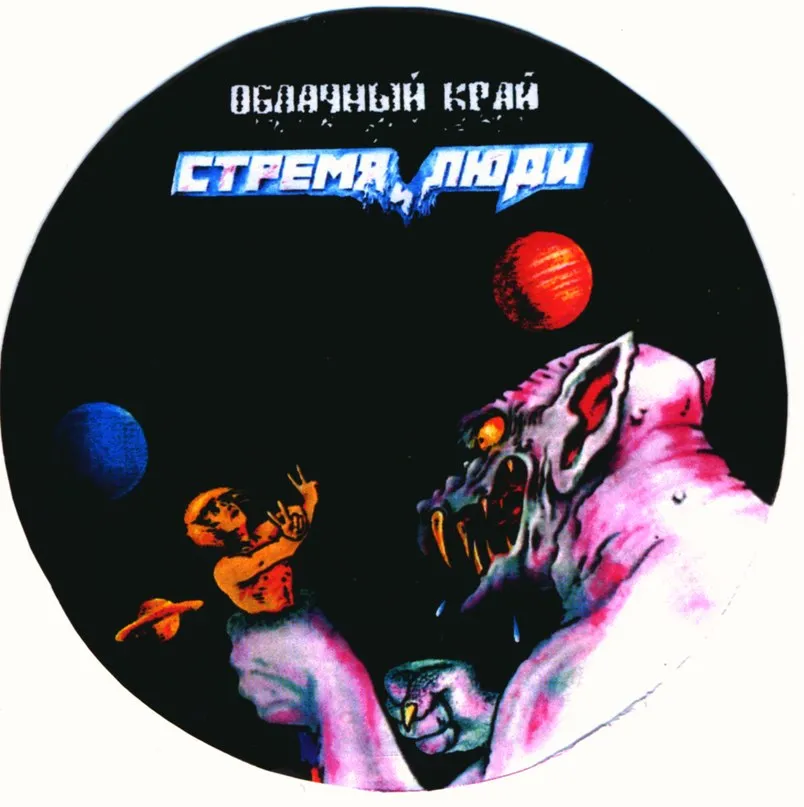
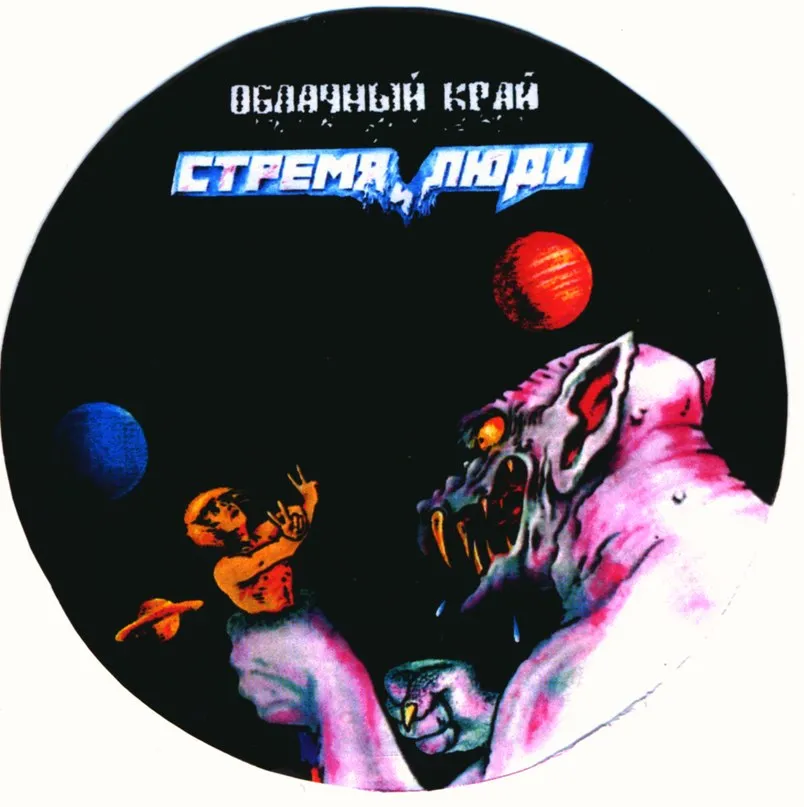
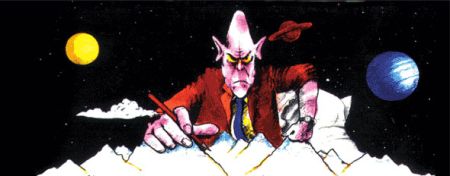
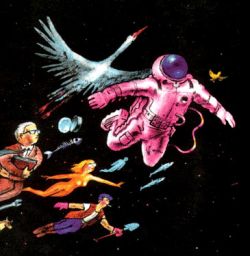
When the question of artwork came up, I called Alexei Bulygin in Arkhangelsk in advance—he's my friend from the Avtodaffe band, a wonderful musician and artist. I described the upcoming album, the title, and read him some of the lyrics; essentially, I gave him a direction, and Alexei very quickly painted an actual picture for the cover. Back then, everything was done quickly in general. I don't know why; maybe we were just young. Literally a few days later, he delivered the painting to us in Leningrad. We were blown away—what an absolute bullseye. Practically everything was ready. Fully finished backing tracks without vocals or lyrics, but the cover was already done, and consequently, the title was too—"Stremya i Lyudi" (Stirrup and People).
Recorded by Alexei Vishnya
For Specialnoe Radio
Related materials:
Original article: https://specialradio.ru/art/id159/