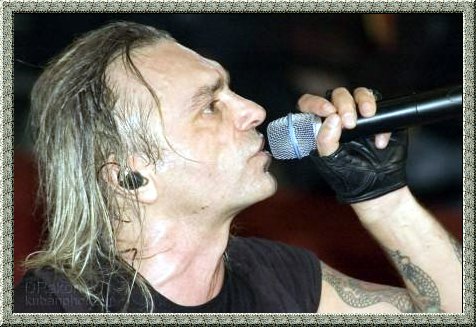
The main task remained: to find our dear Oleg Yuryevich Rautkin, who, as usual, spent the summer drifting across the vast expanses of our country, and tracking him down was a real problem. had gone with his Kharkov Institute of Physical Education student construction brigade to Siberia. The brigade returned, but without Rautkin. He had gotten lost somewhere. Later we learned that during his travels through Siberia, Oleg had somehow crossed paths with the poet Andrei Voznesensky and ended up hanging out with him in a hotel room in either Krasnoyarsk or Novosibirsk. Voznesensky was doing poetry readings in cities across Siberia, which was where Rautkin ended up; and since Oleg is a renowned connoisseur and expert in poetry, they quickly found a common language. Anyway, we set up information traps for Rautkin, and finally, a call came to the teachers' lounge—from Ukraine. Rautkin was ready to leave 'right now.' However, tickets were hard to come by. Oleg only managed to fly out a week later—during which time we had the opportunity to do some final sweeping.
Intergalactic Conglomerate
Mother of Order
The main task remained: to find our dear Oleg Yuryevich Rautkin, who, as usual, spent the summer drifting across the vast expanses of our country, and tracking him down was a real problem. He had gone with his Kharkov Institute of Physical Education student construction brigade to Siberia. The brigade returned, but without Rautkin. He had gotten lost somewhere. Later we learned that during his travels through Siberia, Oleg had somehow crossed paths with the poet Andrei Voznesensky and ended up hanging out with him in a hotel room in either Krasnoyarsk or Novosibirsk. Voznesensky was doing poetry readings in cities across Siberia, which was where Rautkin ended up; and since Oleg is a renowned connoisseur and expert in poetry, they quickly found a common language. Anyway, we set up information traps for Rautkin, and finally, a call came to the teachers' lounge—from Ukraine. Rautkin was ready to leave 'right now.' However, tickets were hard to come by. Oleg only managed to fly out a week later—during which time we had the opportunity to do some final sweeping.
While I was finishing the lyrics and waiting for Rautkin, Troppillo started working with Alisa on the album 'Energia'. Essentially, our recordings happened in parallel. Kinchev had arrived from Moscow; that was when he and I first met. It was in the control room, where I was practically living at the time. Our acquaintance began with a venture out into the world. Troppillo invited us to a nearby cafe (which now bears the strange Karelian name 'Vorksla'). Personally, I had always been indifferent to coffee and didn't know the difference between bad and good, or a single and a double. But Andrey said they brewed excellent coffee here, so couldn't you, Seryoga, get Konstantin and me a double coffee each, because we could barely scrape together enough for a single, let alone a double... It was an amazing time—I was like a rich little Buratino...
We decided to continue working that night while Kostya got up to speed with the situation. We stepped out of the cafe, and some drunk guy aggressively accosted me, asking us to chip in for a bottle. I had already shifted into a comfortable stance to wind up a punch and smack him in the face if necessary, but he, apparently anticipating the turn of events, instantly changed his expression and began rather pitifully begging us to spare just a little bit so he wouldn't die. I pulled all the visible change from my pocket and dropped it into his palm. The three of us walked to the studio, each lost in thought. Finally, Troppillo broke the lingering silence: 'Yeah, that was nicely done, well done. I really thought you were going to slug him just now. But you didn't.' 'Well, how else?' I asked, 'What's the big deal?' 'It says a lot about you, you just don't realize it yet because of your youth.' Getting that kind of praise from Troppillo was pleasant; he was usually stingy with such things.
He brought an absolute marvel of technology—an imported guitar processor. You couldn't just call it a standard effects pedal; it was a complex device that combined several functions and was called, for some reason, a Korg guitar synthesizer. 'Look,' Andrey said, 'fate has practically dropped this into your lap—you can saturate the album with wonderful, trendy new sounds!' Lyapin was also full of praise for the device, saying it opened up incredible possibilities for a guitarist, and even left it with us for the whole day. I poked around with it, even tried to incorporate it into a few things, but it soon became clear that the digital synthesizer was inferior to Boss pedals. It just wasn't as powerful as an analog pedal. So, none of it ended up in the album. Troppillo was surprised but conceded when he heard the difference. We didn't say anything to Lyapin, of course.
The weekend arrived. Kinchev was heading back to Moscow, and we decided to take a little break from the studio. Troppillo invited Rautkin and me to his place on Ispolkomskaya Street and decided to throw a feast. He had just been paid, and he handed Oleg and me money so we could buy vodka from taxi drivers—exactly enough for two bottles at black-market prices. We went outside—it was one in the morning, the streets completely empty—no people, no cars. We stood there for about fifteen minutes, and suddenly, an empty taxi drove by. The driver didn't have any vodka, but we decided to take a ride to the other end of the city, to the dormitory of the Shipbuilding Institute. We had a lot of fans there—the brother of Kolya Lyskovsky studied there. The place was famous because you could always find something there at any hour. They were thrilled to see us; they immediately improvised some snacks, rolled out their reserves, and gave Rautkin a guitar.
And, as always, that meant a party lasting several hours. With the money Troppillo gave us, we bought not two, but four bottles, and in the morning, full and drunk, we finally returned. The door was opened by a haggard-looking Troppillo. All night, he and his sister had been calling nearby police stations and morgues, searching for news about two out-of-town assholes who had left the house at one in the morning and never returned. Andrey was most surprised by our intact state; he hadn't expected to see us alive, let alone carrying a bag of vodka and all sorts of snacks. That's how we spent our weekend—a heavy workweek lay ahead.

Rautkin quickly got into the process; nothing needed to be explained to him. He listened to the backing track, mumbled something to himself—blah-blah-blah, blah-blah-blah—then stepped up to the microphone and said he was ready. I said, 'Let's do a practice run without recording.' He said, 'No, record it right away.' I hit record, and Rautkin unleashed such a charge of power and energy on Troppillo and me that we practically fell off our chairs. 'No,' Andrey said, 'he'll never sing it like that again.' When Rautkin finished, he asked if he should sing it again. But the result had stunned us so much that we immediately gave him the next song. He sang that one on the first take too.
The sad story, a song about a Komsomol activist's love for a girl of easy virtue, hadn't struck me the way it turned out—Oleg brilliantly stepped into the role, and everyone in the studio—Guberman and Troppillo—was impressed by the performance. We sang some songs together, just the two of us, like 'Conglomerate' or 'Super-Chukcha'—our timbres complemented each other perfectly. Our duet reached its peak in the song 'Mother of Order.' We built a beautiful counterpoint there, which delighted Troppillo; he was probably remembering our recent adventure and thinking that he hadn't gotten involved with us scoundrels for nothing.
Boris Grebenshchikov occasionally dropped by the studio to check on how things were going. I'd tell him, 'Don't worry, Boris, the treasure is safe.' I just didn't want to give the instrument back until we had mixed everything—you never know. From time to time, Slava Zaderiy appeared; needless to say, he was a popular guy—the founder of Alisa. But Slava didn't really care for the actual recording process. He would occasionally rush in like a hurricane, deliver rapid-fire information about where he had just come from and where he was racing off to next, and fly out. This manner couldn't help but affect the quality of the bass tracks he performed. Alisa brought in another bassist—Pyotr Samoylov. First, he re-recorded one track, then a second, and then a third. Eventually, none of the bass tracks played by Slava remained, and Zaderiy himself was no longer in the band either.
It was during those days that the friendship between Oblachny Krai and Alisa was born. Since Kinchev wasn't a local either, he was constantly in the studio with us. Even though he always had a place to spend the night, he preferred not to leave the workplace. As soon as he was exhausted, he would go rest in the spots we had already warmed up. Kostya and I are kindred spirits, and we've managed to maintain this relationship over all these years. In those days, we met all the main bands of the Leningrad Rock Club—Televizor, Zoopark, and Kino. It was impossible to sit in the studio all the time, but we were also afraid to go too far from home. We were saved by the close proximity of the Vishnya House, where Kinchev and I once met Tsoi.
We walked in, and a party was being prepared—snacks were on the table, bottles were set out. Then there was a ring at the door, and Tsoi and Guryanov walked in. They were also preparing to record the album 'Eto Ne Lyubov' (This Is Not Love) and decided to celebrate the occasion, and there we were. A wonderful party; I remember the guitar passing from hand to hand all evening, and everyone sang their own songs. And I must say—oh, what songs they were, and what people had gathered. Only now, looking back, do I think about how amazing it was—so many people in one room, all of them legends. At that time, just as Kinchev sang, we were together. We were united by one great common cause, and the cementing foundation of it all was the Troppillo Studio.
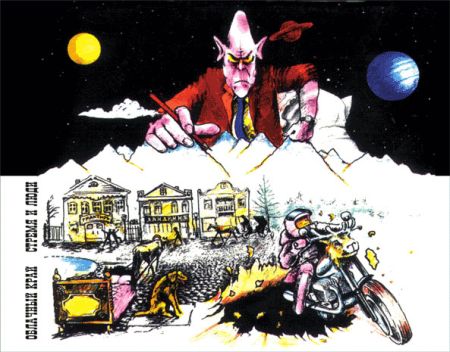
One day, Guberman invited us over for lunch. We had just finished recording all the drums, caught a taxi, and I put the folder with the album artwork on the rear shelf. We pulled up on Saltykov-Shchedrin Street (now Kirochnaya Street) and got out of the car. Suddenly, a terrible thought struck me like lightning—something was missing from my hands. The sweater I was carrying was there, but the folder was gone... damn it! Our artwork was gone, already fading into the distance. My mood was irretrievably lost. It was so offensive to lose something so stupidly, like an idiot. Such artwork... to draw it, send it by plane to Leningrad, and then I... In short, I wanted to shoot myself and die. 'Come on, don't worry,' Guberman reassured me. 'I'll find your folder for you.' I refused to believe it, but Zhenya dedicated a month to visiting every single one of the city's ten taxi depots. And finally, a miracle! One of the taxi drivers remembered us; he had taken the folder home. They arranged a time, and Guberman met him to retrieve the precious lost item.
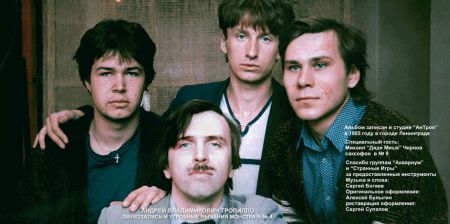
As we approached the end, Andrey Troppillo's mood progressively improved, as evidenced by his famous asymmetrical mustache, which bristled more and more, as seen in the photograph I took in those days. I was a big photography enthusiast, and my camera was literally called 'Lubitel' (Amateur). It was a Soviet-made medium-format camera that I always carried around with me like a bona fide photojournalist.
Many of the songs were already finished, and Troppillo often played them for his closest friends who dropped by the studio. In particular, he had a friend—a girl named Lyuba Mikhailova. She was an interesting, enthusiastic, and very delicate young lady. Troppillo was constantly teasing her, pestering her with his jokes and pranks. She designed clothes and was always talking about the latest fashion trends, which we couldn't care less about. However, her visits were always associated with a bottle of some good dry wine. Lyuba was a passionate fan of French cuisine, so along with the dry wine, she invariably brought cheese, white bread, and grapes. We listened to the fashion news very attentively, nodding our heads in unison, devouring cheese sandwiches, washing them down with dry wine, and pretending to be fascinated by what she was talking about. Her appearances were a ray of light, a French light, in our Russian vodka-and-herring kingdom.
Once, during one of these moments, some young guys came into the studio and called Troppillo out into the corridor. A minute later, he returned and said that these were his students from an acoustics and sound recording club, and they wanted to meet us. To this, Rautkin declared smugly, 'Well, bring them in, let them take a look.' The guys walked in; they were noticeably younger than us. It later turned out that this was Fedy Chistyakov and the group Nol. They were also big fans of OK and were eagerly awaiting the album's release.
Our mood was darkened by the fact that autumn was approaching, our vacation time was up, and I was very afraid that for a ten-day absence, we could be fired under Article 33—which was a very bad article; finding a job afterward would be impossible. Troppillo saved the day this time too, albeit in a highly refined manner: Andrey got Rautkin and me sick leave certificates from the Leningrad Dermatological and Venereal Disease Dispensary. To get two weeks of sick leave, the diagnosis had to be terrible and grim—you can only imagine what kind of diagnosis it was... There was nothing to do but present our sick leave. This elicited immense understanding and deep sympathy from the male staff at the administrations of the enterprises where we worked.

Recorded by Alexei Vishnya
For Special Radio.
June 2005
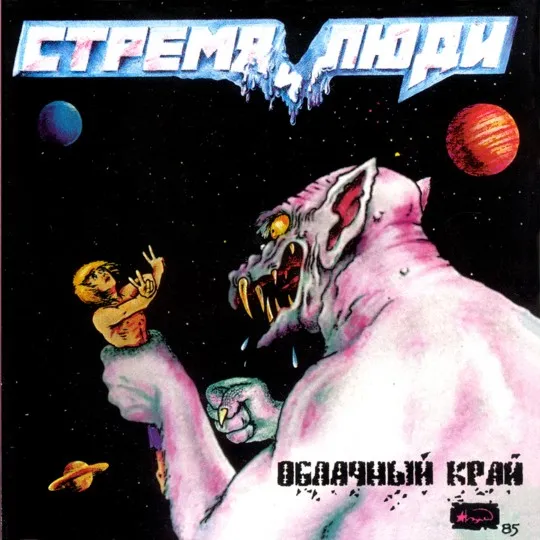
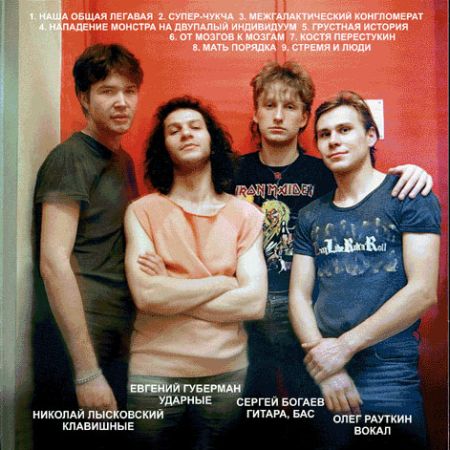
Images and photos from the album 'Stremya i Lyudi' were used
Related Materials:
Original article: https://specialradio.ru/art/id160/