Three months after the death of Sergey Bogaev the Arkhangelsk edition of "MK" printed Boris Govorukha's essay "Our own Oblachny Kray". It opens on a bitter note: Oblachny Kray is "a genuine legend of Russian metal", yet among the people it is "almost forgotten, as is the leader of the band, the Arkhangelsk native Sergey Bogaev". What follows is a tidy survey of the whole history of the band, from the Leningrad recordings to "Ygyatta". We retell it in our own words (the original is on the newspaper's site; reprinting the text is not permitted there) and check it against other sources as we go.
Leningrad: "Ublyuzhya Dolya" and "Stremya i lyudi"
The author dates the "Leningrad" period from the middle of 1984 and calls it the most mature technically. Rautkin was away at that moment, and Bogaev prepared the material with an improvised line-up: he asked Vladimir Budnik of Svyataya Luiza to sing, played guitar and bass himself, and Evgeny Guberman sat behind the drums — in the author's words a famous jazz-rock drummer who had also worked with Akvarium, Televizor and Avgust. At Andrey Tropillo's studio the band recorded at the same time as Alisa, who were making "Energiya" then; "Ublyuzhya Dolya" came out in November 1984 and spread across the whole Union. Many rock fans, Govorukha writes, started their acquaintance with Oblachny Kray with this very album, and its songs long remained the basis of the concert programme.
The album opens with "Soyuz kompozitorov", about a "mighty handful" of elderly suppliers of "high art" of Soviet realism who try to crush any unwelcome amateur activity; in 1984 it sounded especially sharp, because many bands then suffered at the hands of that union and its patrons. Among the notable pieces the author also names "Moy Afganistan". Bogaev for the first time met multichannel equipment — the very kind on which Mike's "Belaya polosa" and Tsoi's "Eto ne lyubov" had been recorded. Tropillo, in the author's words, considered the band a unique phenomenon in Soviet rock and sincerely admired Bogaev's mastery and his guitar style, innovative for hard rock, based on the techniques of Indian instruments.
"Stremya i lyudi" was recorded in the hot summer of 1985 by an incomplete line-up: Bogaev and Lyskovsky. For the first time the instruments were professional — kindly lent by Grebenshchikov and the musicians of Strannye Igry. Rautkin appeared in the studio, and Guberman was on drums again, calling that time one of the brightest of his life; a small part of the drum parts, as Bogaev later reluctantly admitted in interviews, he recorded himself. The hits were "Kostya Perestukin" (a satire on the typical Soviet informer) and "Grustnaya istoriya", about the unhappy love of a Komsomol activist for a prostitute; the author does not skip "Nasha obshchaya legavaya" either. The finale consists of two symphonic pieces: "Stremya i lyudi" (a caravan crossing a desert towards an abstract bright goal) and "Mat poryadka" (a sketch about St Petersburg in the first Russian revolution), treated, as Govorukha writes, in the spirit of Mussorgsky's "Khovanshchina" and Shostakovich's "Heroic Symphony" — with dark riffs and guitar breaks by Bogaev stylised after Blackmore, Wagner and Beethoven at once. In his judgement it is one of the most powerful and varied albums in the history of Russian rock.
Gradsky, the rock club, the festivals
In those years Alexander Gradsky supported the band: by the author's information he played "Kostya Perestukin" in the programme "45 Minutes in the Sunday Studio" on all-Union radio and called Oblachny Kray the only worthy rock band in the country, playing original and professional hard rock that one need not be ashamed to place beside the best Western masters. In 1986 the band, under the short pseudonym "O'Kay", was admitted to the Leningrad rock club but could not perform at the festival: Bogaev's sharp lyrics did not pass the so-called "litovka" (censorship).
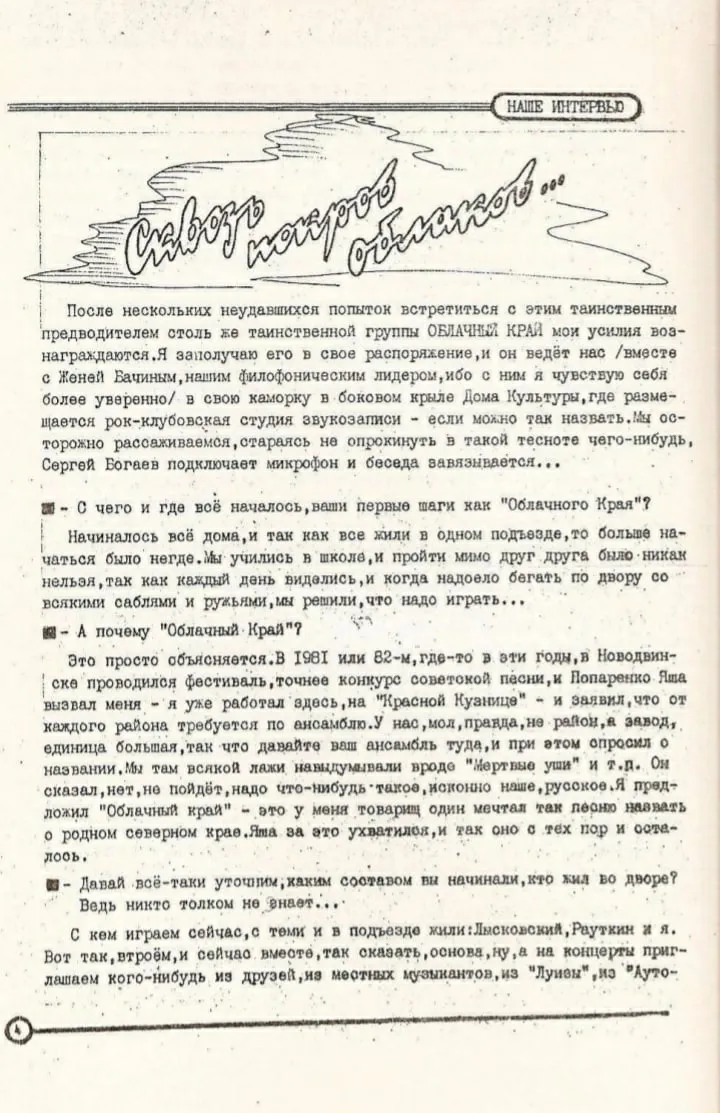
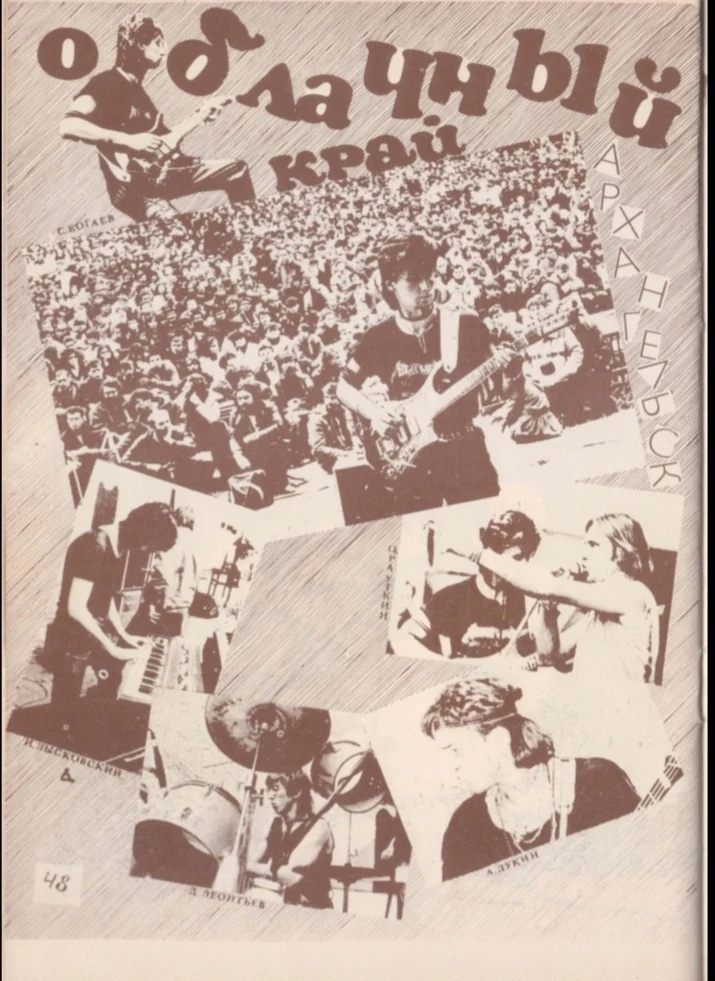
Half a year later everything changed. A rock club opened in Arkhangelsk, and Oblachny Kray became the main heroes of the festival — the band's first full concert in its history (here is how it went). The three founders were joined by the bass player Andrey Ilyichev and, for a time, Dmitry Leontyev on drums. With the same line-up they went to Petersburg and played two concerts with old friends from Alisa, and in September they performed in Podolsk. There, the author writes, the pugnacious, screaming Rautkin swung the microphone stand over his head, and in the finale Bogaev broke two strings and began smashing the guitar before three thousand spectators, like his idol Blackmore (and what Bogaev himself said about those months).
After 1990
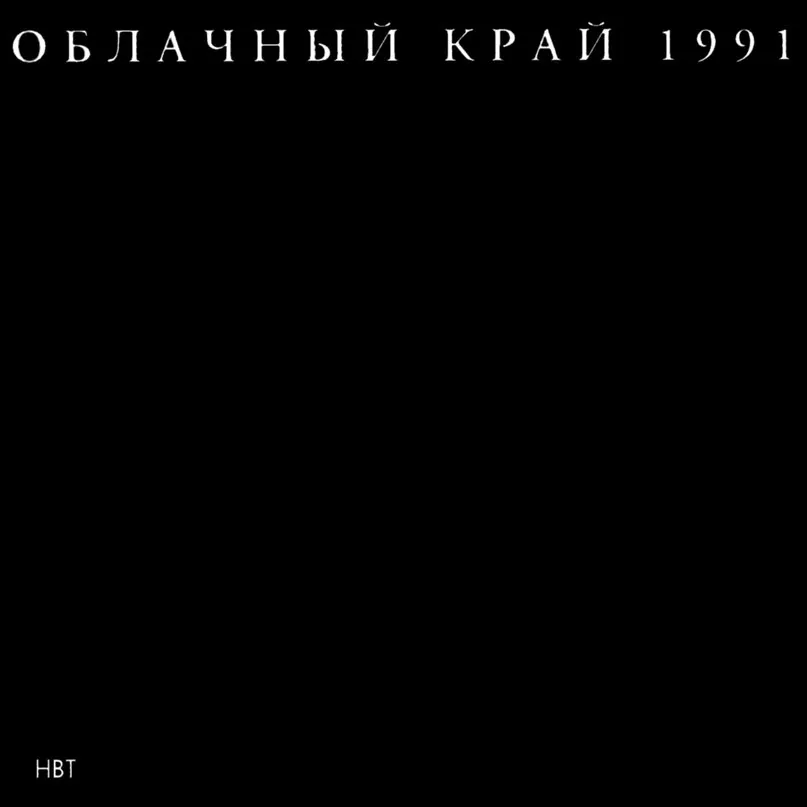
In 1990 Melodiya — again thanks to Tropillo — released the vinyl "Svobody zakhoteli?!" in a beautiful cover by Sergey Supalov. The album sold quite well, the band had a very strong line-up and reached its peak. But in 1991, after recording a new album at Petrostudia in Moscow, the bass player Andrey Lukin tragically died, and the band effectively fell apart: no concerts, no new recordings. Eight years later Bogaev recorded "Lyubov k zhizni" (1999) at the AnTrop studio with session musicians, singing himself; in 2003 came "Patriot" — mature, heavy, moving into modern metal.
From 2007 a complete reissue of all surviving recordings began — from the original master tapes or from copies digitised by Sergey Supalov, "the main keeper of the creative legacy", and some came from Bogaev's personal archives and the AnTrop studio. For the last six years the band worked on "Ygyatta", named after a Yakut river; it came out in December 2010, and its lyrics, Govorukha writes, are largely based on Bogaev's life experience and outlook. Guberman, Tropillo and others helped.
The author ends with what the essay was evidently written for: Bogaev died on 2 June 2011, aged 49. The funeral was sparsely attended, and so far none of the public figures has said aloud a word about the departure of one of the most outstanding guitarists of Russian heavy rock. "Bogaev simply remained faithful to the work of his life," he writes.
What needs a note
The essay is a compressed survey, and on many points it agrees with what we know from Bogaev's own memoir, but some of it is general or debatable. For instance, it begins with the "Leningrad" period and mentions neither Mertvye Ushi, nor the Arkhangelsk albums of 1982–1983, nor "Vershina idiotizma" (January 1984); the five concerts in the band's whole history and the first appearance at the Soviet song contest in 1982 are not reflected either. The figure of "three thousand spectators" at Podolsk is the author's estimate. As for Gradsky calling Oblachny Kray the only worthy rock band in the country, it is better to read it in chapter 5 of Bogaev's memoir, where it is told in detail. And for line-ups and dates it is better to check the members' and albums' pages on our site.
What the author relied on and what we used
Govorukha names his sources: "100 Magnetic Albums of Soviet Rock" (Alexander Kushnir), "Who is Who in Soviet Rock" (Andrey Burlaka), Artemy Troitsky's book on rock in the USSR, the band's official site and Alexey Vishnya's blog. We checked him against Bogaev's memoir on this site (chapter 7, chapter 5), "Rock in the USSR", and the members' and albums' pages. What else was written about the band is on the "Press" page.
The original: Boris Govorukha. "Our own Oblachny Kray" // MK in Arkhangelsk (arh.mk.ru). — 31 August 2011. https://arh.mk.ru/articles/2011/08/31/619322-nash-samyiy-oblachnyiy-kray.html