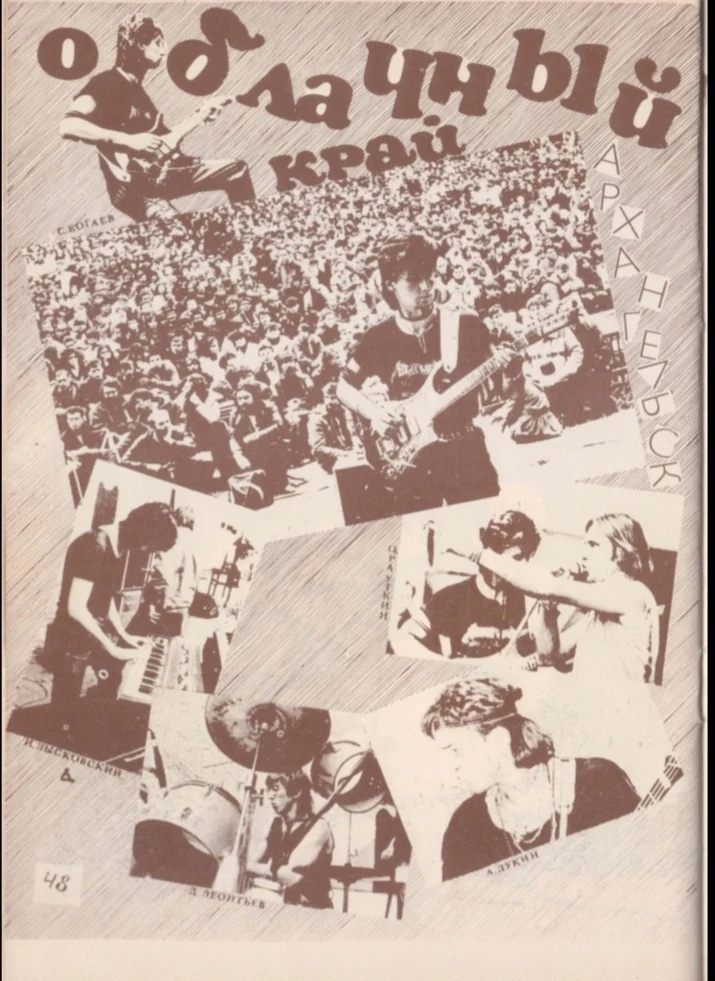
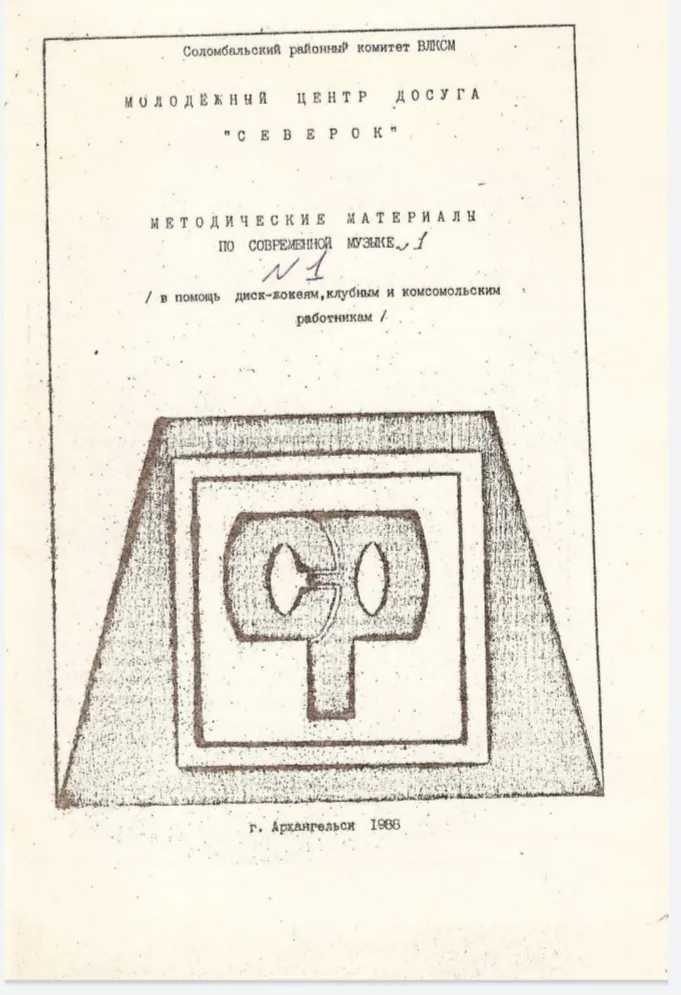
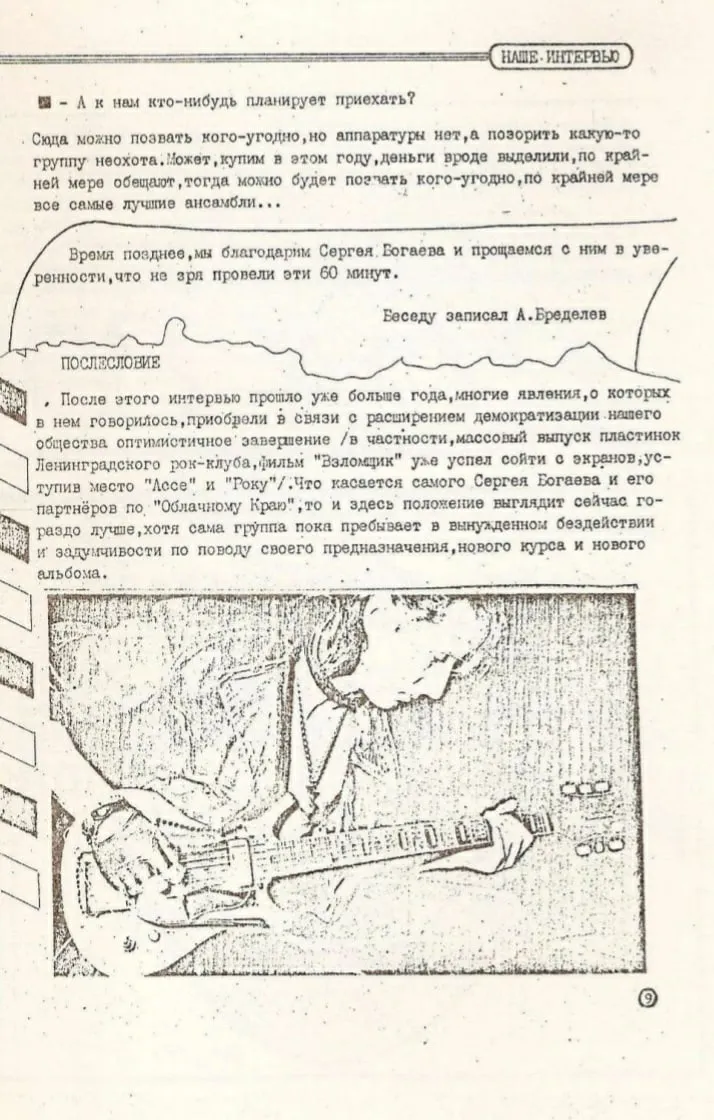
In 1988 the youth leisure centre "Severok" of the Solombala district Komsomol committee published in Arkhangelsk the "Methodological materials on modern music" no. 1 — "to help disc jockeys, club and Komsomol workers". Inside, in the column "Our interview", is a conversation with Sergey Bogaev titled "Through the veils of the clouds...", recorded by A. Bredelev. The scans of the pages were posted in the band's VKontakte community by Vadim Abramovsky (23 September 2020), and this text has not been on the site until now. Bogaev speaks for himself, without newspaper-style retelling, so we retell it in detail and keep the scans so that you can read it yourself.
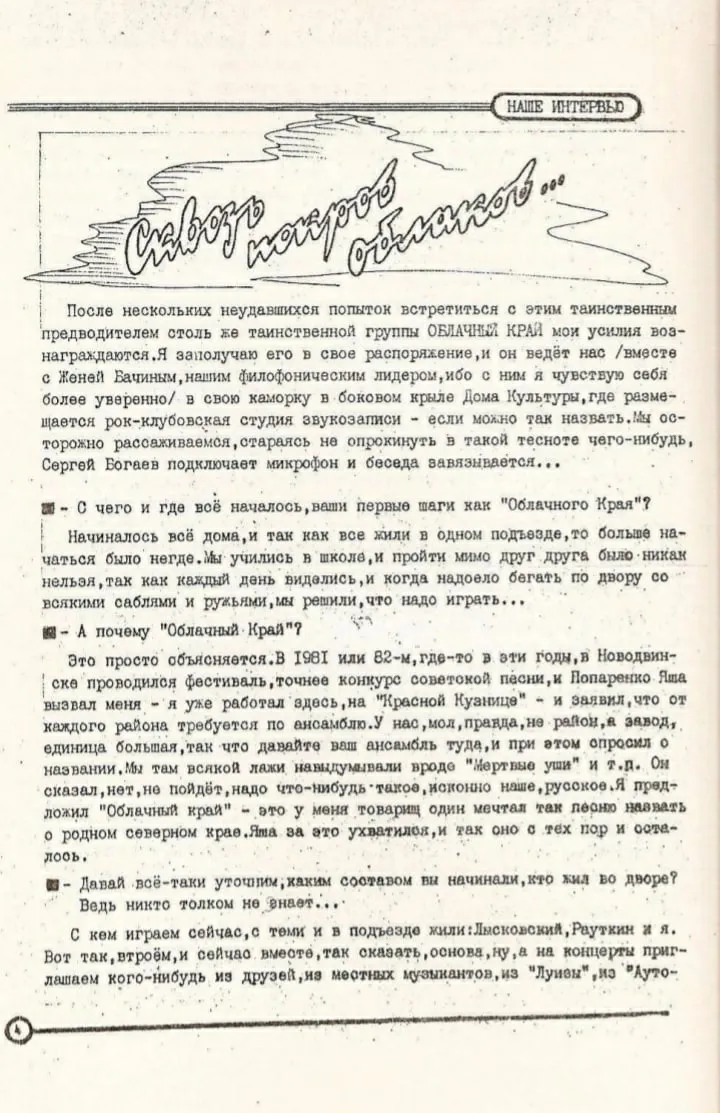
The talk was apparently recorded in 1987: Bogaev says that "it's 1987 out in the yard", and on the last page there is an afterword written when "more than a year had passed since this interview". The conversation lasted about an hour — "we did not spend these 60 minutes in vain" — in his closet in the side wing of the culture palace where the rock-club recording studio was housed ("if you can call it that"): they had to sit down carefully so as not to knock anything over in such a cramped space. The interviewer was accompanied by Zhenya Bachin, "our philophonic leader".
The staircase, Mertvye Ushi and Novodvinsk
How did it all start? "At home, and since all of us lived in one stairwell, there was nowhere else for it to start. We went to school and it was impossible to pass one another by, since we saw each other every day, and when we got tired of running around the yard with all sorts of sabres and guns, we decided that we had to play." And why "Oblachny Kray"? Bogaev tells his version: in 1981 or 1982 a festival, "more precisely a contest of Soviet song", was held in Novodvinsk, and the Komsomol supervisor Yasha Poparenko ("I was already working here, at Krasnaya Kuznitsa") said that every district had to field an ensemble; "we, he said, were not a district but a plant, a big unit", and demanded a name. They came up with "all kinds of nonsense like 'Mertvye Ushi'", but Poparenko said no, it would not do, it had to be something "of our own, Russian". "I suggested 'Oblachny Kray' — a pal of mine dreamed of calling a song that, about the native northern land. Yasha seized on it, and so it has stayed ever since." In other accounts (in "Zombi" and in the Moscow report) the same name is made up "on the way" or suggested by a classmate; what they share is that it had to be quick, "something of our own, native, northern".
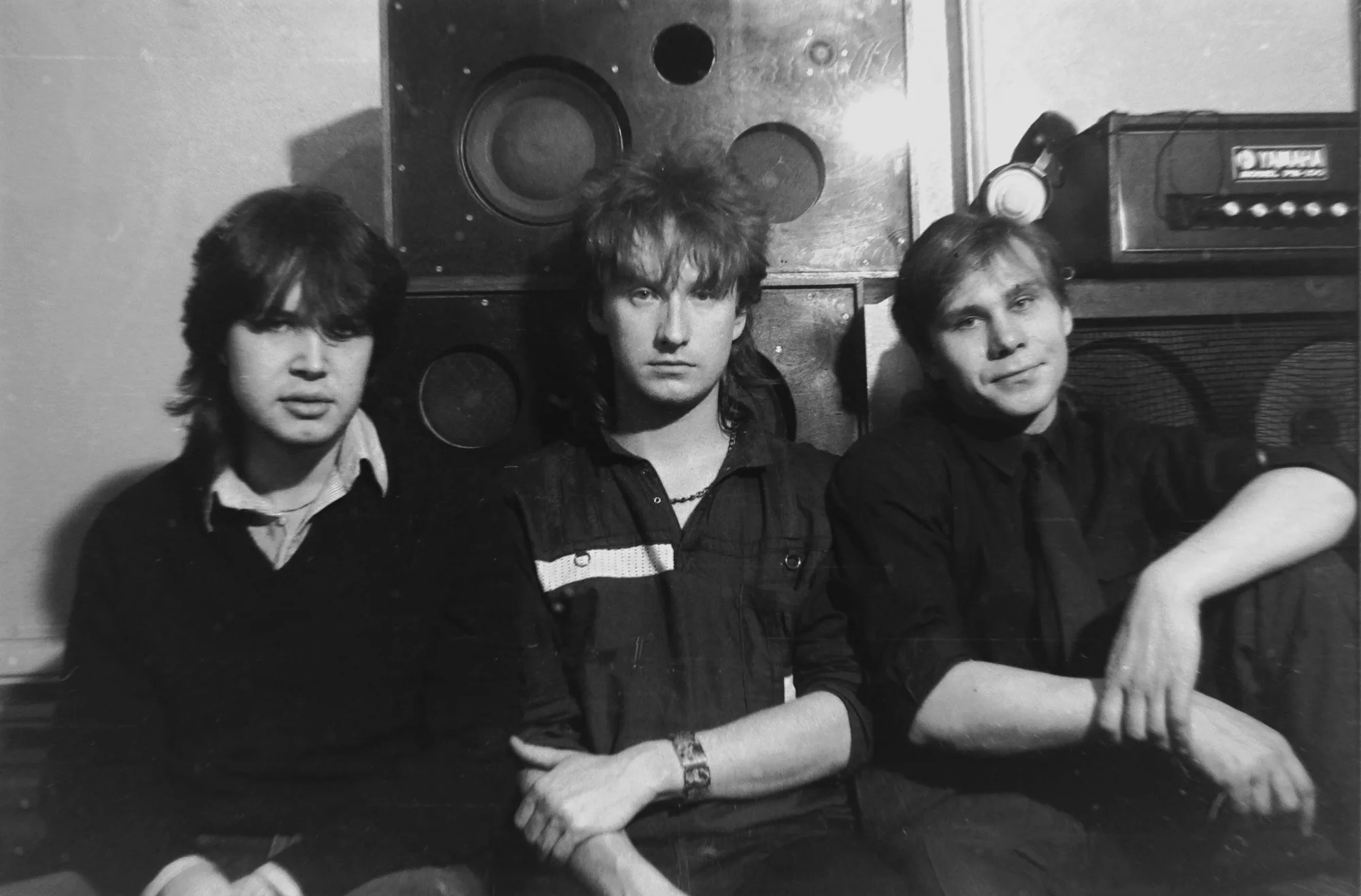
The line-up he names simply: "Those we play with now are those who lived in the same stairwell: Lyskovsky, Rautkin and me. Just the three of us, and still together, the core, and for concerts we invite someone from among friends, local musicians, from Luiza, from Autodafe". And in the studio for two years now Guberman has been working permanently — "Zhenya from Moscow, or rather he is from Leningrad but works in Moscow, played before in Akvarium and Zoopark, a professional drummer; apart from him I do not even know a suitable person". On tastes: what he listened to earlier — Deep Purple and so on — has stayed, and new things in the same direction have been added; if singling out, then Iron Maiden, Accept, Dio, Metallica. "And it does not matter that many people like them; what matters is that I liked them, or rather we did, strange as it is, all at once."
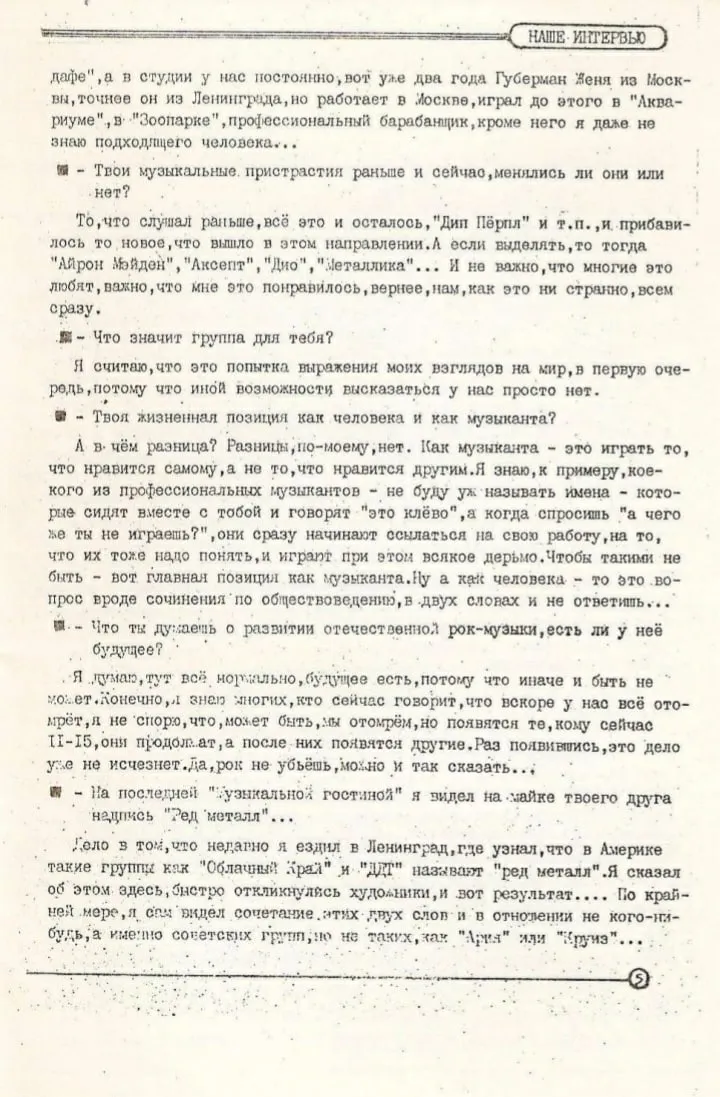
What is the band for him? "An attempt to express my views of the world, first of all because there is simply no other way for us to speak out." His life position? "As a musician — to play what you like yourself and not what others like"; and he recalls "some of the professional musicians" who sit together and say "this is cool", and when asked "then why don't you play it?" refer to their jobs — "and play all sorts of crap at that. Not to be like them — that is the main position as a musician." On the future of Soviet rock: "You cannot kill rock."
On the "Red Metal" T-shirt on his friend: "The thing is that recently I went to Leningrad, where I learned that in America bands such as 'Oblachny Kray' and 'DDT' are called 'red metal'. I said so here, the artists quickly responded, and here is the result...".
Solombala, Leningrad, Moscow
The interviewer asks him to assess the four latest performances: Solombala, two concerts in Leningrad, one in Moscow. "The most normal, I think, was the last one, in Moscow, although nobody shouted or jumped up there, because the people sitting there were of the kind to whom it is just not fitting. But the thing is that I felt we had played all right." In Leningrad the first time they played all right, and the second time "there was no point in meddling": nobody plays with Alisa at all, only Alisa fans came, "a thousand and a half Alisa fans; you would not drive Grebenshchikov (designated a foreign agent in Russia) there with clubs to play in such a version". But they were not whistled at: "in such cases they usually whistle and shout 'off the stage with that muck, give us Alisa!', but here they clapped and shouted 'play more', so there is progress". And in Solombala "nothing could be heard, but the people clapped and shouted 'hurrah'".
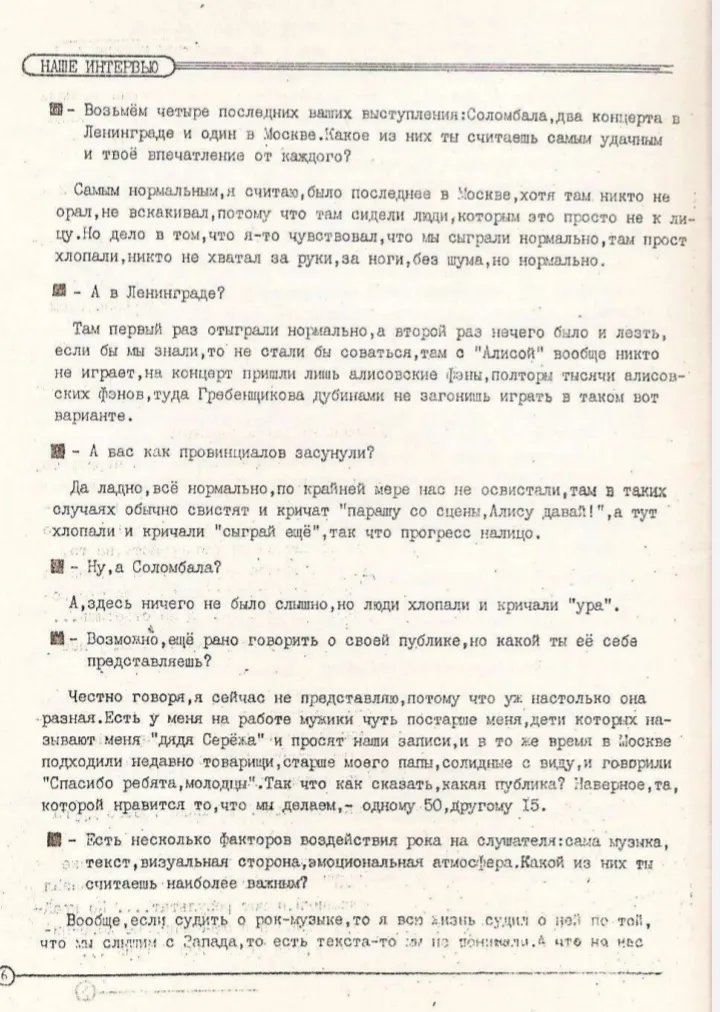
What is their audience? "Honestly, I cannot picture it now, because it is so varied. At work I have guys a bit older than me whose children call me 'uncle Seryozha' and ask for our recordings, and at the same time in Moscow recently some comrades older than my father, solid-looking, came up and said 'Thank you, lads, well done'." What acts more strongly, the music or the text? "The ideal is when both the music and the text act on you at their best."
Plans, the mini-LP and "Stremya i lyudi"
About plans: "The most important thing for us now is recording a new programme, because what everybody hears now is the years 83–85, while out in the yard it is 87." It must be different — "for the better"; it will not turn out like "Stremya i lyudi": "Then we did not find the sound; we thought it would be heavy metal, but we did not manage to get it, so we had to give it up." About the Moscow band "Brigada S", with which they played together: "I liked that band... they seemed so professional to me... perhaps because we played so clumsily?". If it is "new wave", then it is unlike DDT and Alisa; it rather resembles Bravo and Strannye Igry.
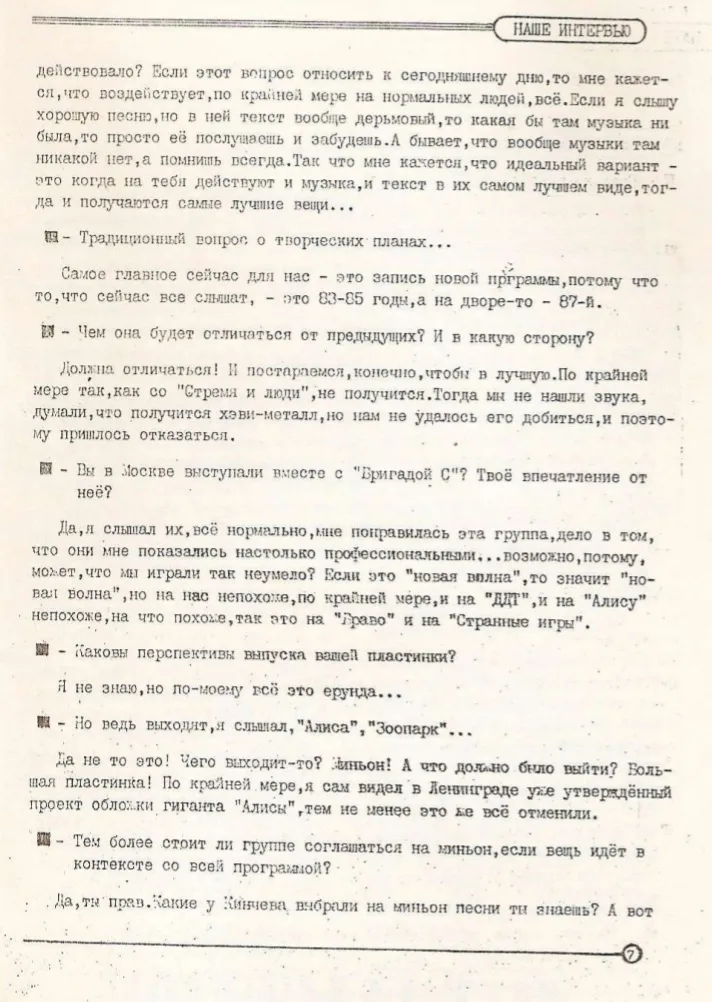
About a record: "I don't know, but in my opinion it is all nonsense." He is told that Alisa and Zoopark are coming out... "That is not it! What is coming out? A mini-LP! And what was supposed to come out? A big record! At least I myself saw in Leningrad the already approved cover project of Alisa's 'giant', yet they cancelled all of it." Is it worth agreeing to a mini-LP then? "Yes, you are right. Do you know which songs Kinchev's people chose for the mini-LP? 'Moye pokolenie' and 'Eksperimentator' did not get in, and those are the coolest songs, so what the hell is it all for? I was talking to him in Moscow just now, and he has the same mood." The same, he adds, goes for the film: "whether we shall live to see it, I don't know".
Blackmore, the censorship and the empty studio
His ideal among guitarists is, of course, Ritchie Blackmore. The interviewer remarks that he often slips up on concert recordings. "I slip up myself /ha-ha-ha/. You understand, it only tells me that he is a living person, and that pleases me so much! All my life I have been persuaded that Jimmy Page plays 70 times better; they prove it to me with all their might, but I do not take to that faith. Complexity, for instance, never appealed to me. I like how he plays: he will play two notes while somebody else plays 22, but those 22 are crap, and his two are cool." And he recalls how Chicherin said of Mozart, whom he adored: "I like any of his pieces just because it is his" — "I can say the same about Blackmore."
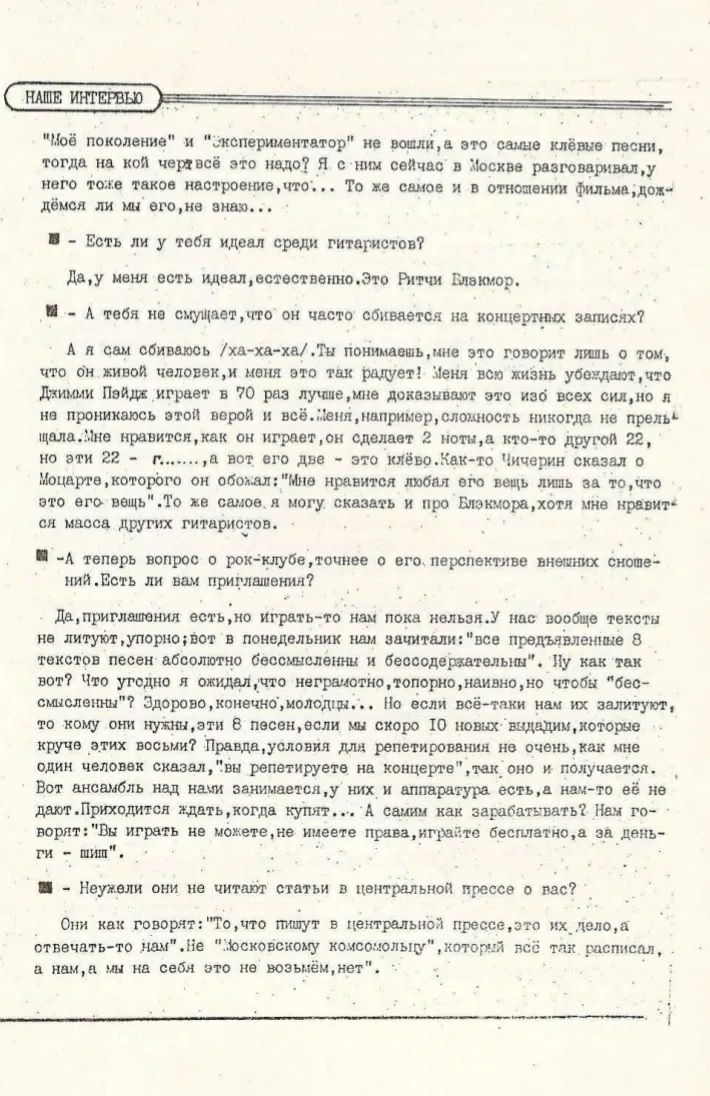
The last questions are about the rock club, and the answers are tough. There are invitations, but "we are not allowed to play yet": the lyrics are "stubbornly not passed; on Monday they read out to us: 'all the 8 song texts presented are absolutely meaningless and empty'". Bogaev had expected anything — "illiterate, crude, naive" — but "meaningless"? "Great, well done... But if they do pass them in the end, who needs these 8 songs if we shall soon put out 10 new ones that are cooler than these eight?" Rehearsal conditions are poor: "you rehearse at the concert", somebody told him, "and so it turns out". An ensemble rehearses above them, with equipment of its own, while they are not given any. "And how do we earn money ourselves? They say: 'You cannot play, you have no right, play for free, and for money — nothing'." And on articles in the central press: "What they write in the central press is their business, but it is us who have to answer. Not 'Moskovsky Komsomolets', which wrote it all up so, but us, and we shall not take it upon ourselves, no."
Invite someone to Arkhangelsk? "You can invite anyone here, but there is no equipment, and we do not want to disgrace some band. Perhaps we shall buy some this year, the money seems to have been allotted, or at least promised, then we shall be able to invite anyone, at least all the best ensembles."
The afterword and a Yakutsk announcement
The afterword, written "more than a year" later, says that much of what was discussed "has received an optimistic ending thanks to the widening of democracy" — a mass release of Leningrad Rock Club records began, the film "Vzlomshchik" has left the screens, giving way to "Assa" and "Rok", and "here too the situation now looks much better". But the band itself "is for now in forced inaction and pensiveness about its purpose, its new course and its new album".
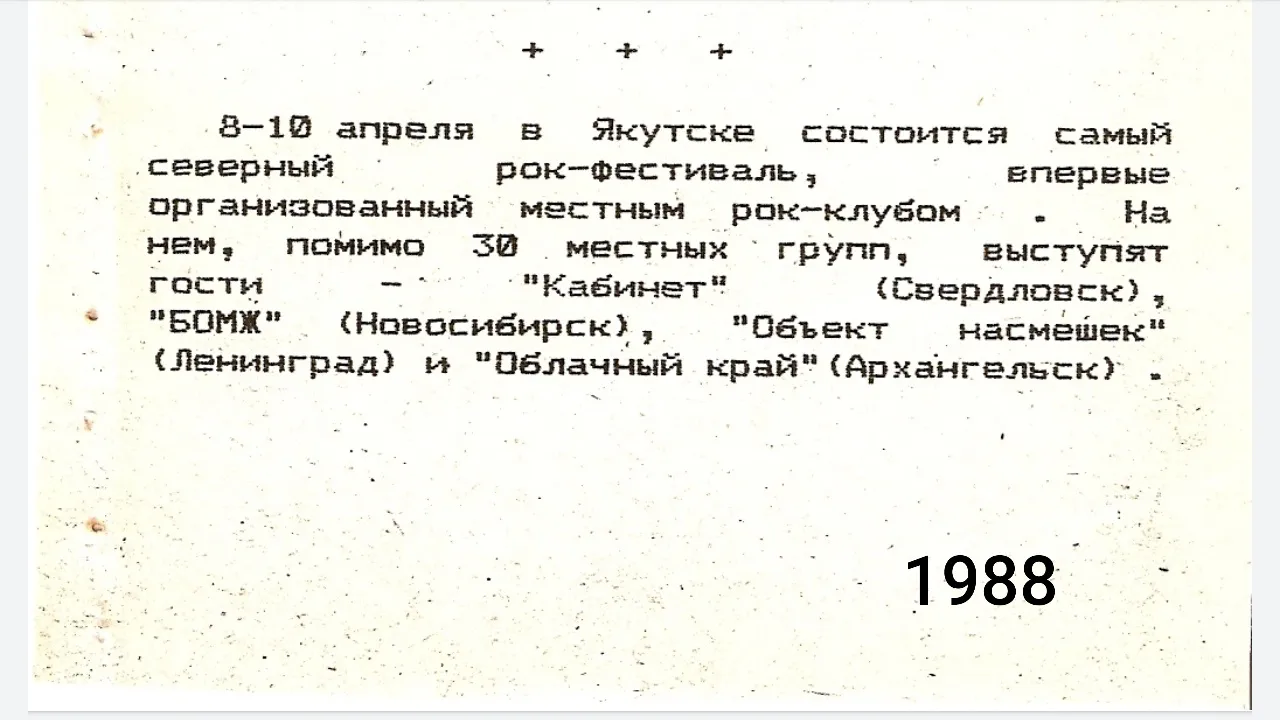
The same year 1988 left one more curious trace: the press announced "the northernmost rock festival", organised for the first time by the local rock club in Yakutsk on 8–10 April, where, besides thirty local bands, "Kabinet" (Sverdlovsk), "BOMZh" (Novosibirsk), "Obyekt nasmeshek" (Leningrad) and "Oblachny Kray" (Arkhangelsk) were to perform. Whether the performance took place we do not know; the scan of the clipping in the community has no source.
Other voices of the time stand beside this interview: the samizdat "Zombi", the Moscow report and Pravda Severa; the festival after which Bogaev was asked about the "four latest performances" is covered here.
What this is: "Methodological materials on modern music" no. 1 (the youth leisure centre "Severok" of the Solombala district Komsomol committee, Arkhangelsk, 1988), "Our interview", pp. 4–9, recorded by A. Bredelev; the scans are from the VKontakte community "Oblachny Kray" (Vadim Abramovsky, 23 September 2020).