Volume 5 of the "Pomor Encyclopedia" (2016) has a separate entry on the band, "Oblachny Kray". Its author is Alexander Mikhailovich Sheptunov, who also made the documentary "Nachalnik Oblachnogo Kraya" ("The Boss of Oblachny Kray", Arkhangelsk Television, 2011). Below is a retelling of the entry, stating what exactly it says; the details of each event are on the pages of this site, with links along the way.
What the entry says
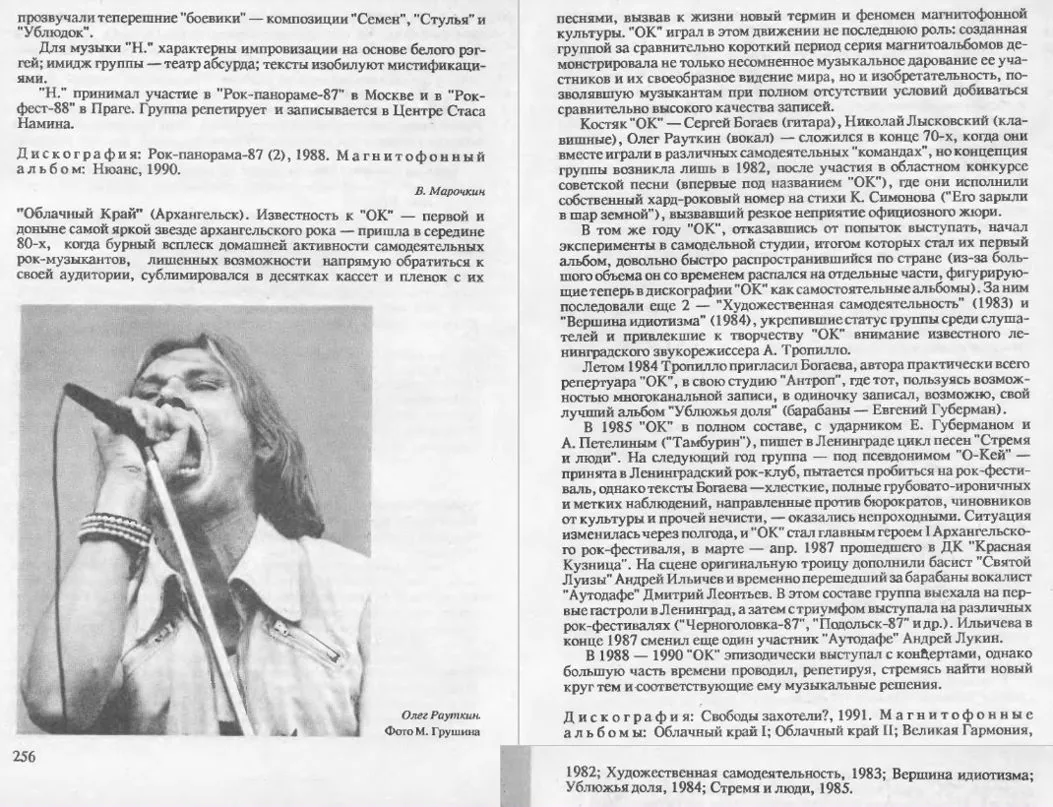
- The beginning. The band was organised in Arkhangelsk in 1978 on the initiative of Sergey Bogaev and Oleg Rautkin. The first line-up also included Igor Lyskovsky (organ, vocals) and Nikolai Lyskovsky (bass guitar). Rehearsals and the recording of the first discs — "Myortvye Ushi" (1978) and "Made in Vaneeva" (1980) — took place in the musicians' flat; in the early 1980s the band rehearsed at the Krasnaya Kuznitsa factory Palace of Culture.
- The first concert was held within the Arkhangelsk region's patriotic song contest in Novodvinsk in November 1981.
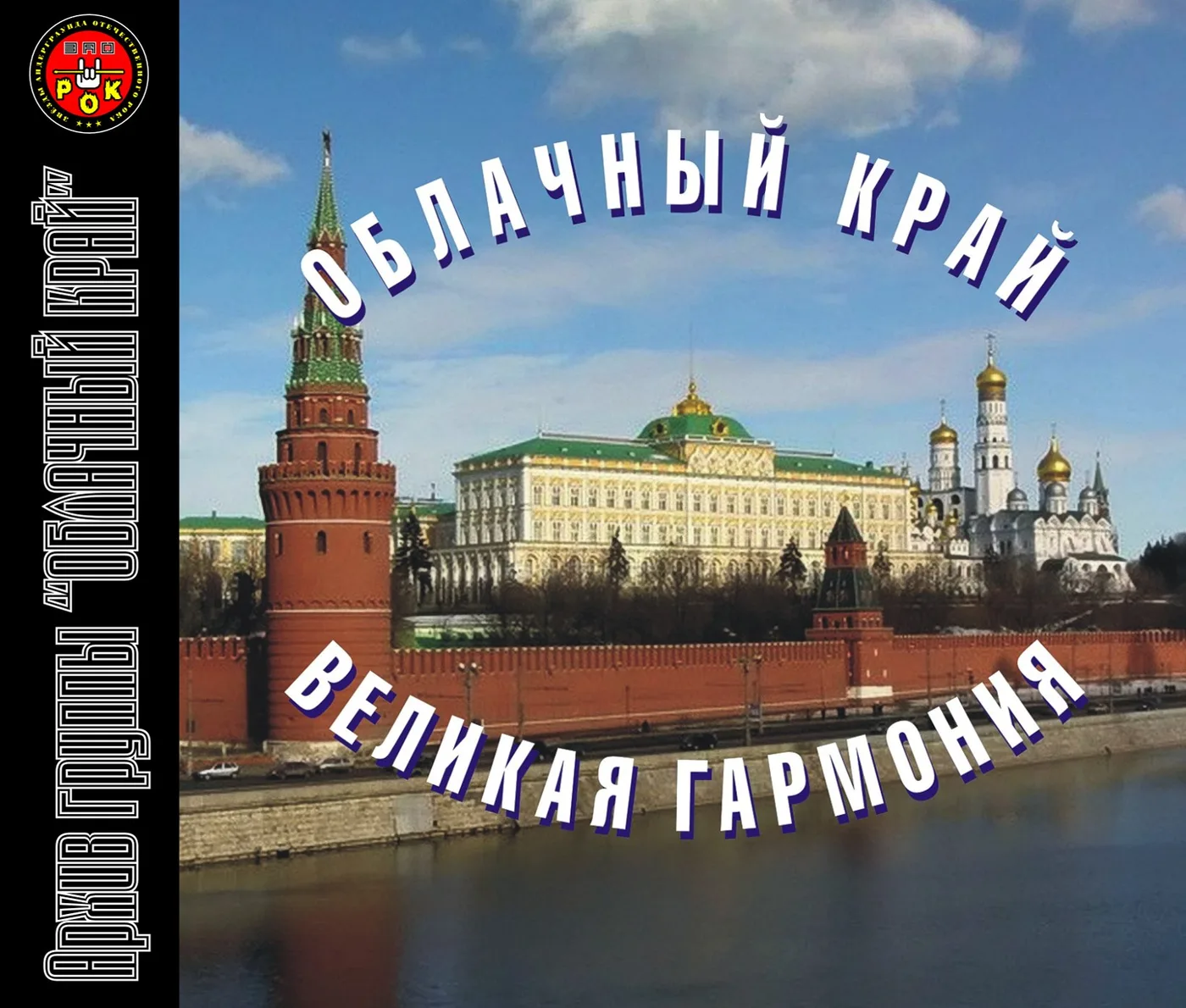
- Recordings. The entry says that "Velikaya Garmoniya" (1982) is considered the first hard-rock album in the history of the USSR. In the author's words, the quality of the first recordings was ahead of its time thanks to Bogaev's constant experiments: he soldered equipment and guitar effects himself and devised new recording methods, including repeated overdubbing and tape-to-tape bouncing. The lyrics were marked by social pathos, sarcasm and mockery of Soviet reality.
- Aquarium and Tropillo. In 1982 the band met the musicians of Aquarium and the sound engineer Andrey Tropillo.
- 1984–1985. Within the anti-rock campaign the band lost its rehearsal space at the Krasnaya Kuznitsa Palace of Culture, "but this could no longer harm the band's fame in the country". New albums began to be recorded at Tropillo's Leningrad studio, with local musicians joining from time to time; the main vocalist then was Oleg Rautkin. In 1985 "Stremya i Lyudi" was recorded — in the author's words, one of the best in the project's discography.
- 1986–1987. In 1986 the band was admitted to the Leningrad Rock Club; in 1987 it took part in the festival "Rock-87" in Arkhangelsk and in the All-Union rock festival in Podolsk, and also gave concerts at the Moscow Power Engineering Institute's Palace of Culture. The Podolsk performance, the author writes, "is considered the band's finest hour"; many newspapers and magazines wrote about it.
- 1991. The new album "Svobody zahoteli?" came out on a Melodiya record. The band's last rehearsal point was a basement room at the Arkhangelsk bus station.
- Petersburg and "Ygyatta". After Bogaev moved to St Petersburg, where he became a staff sound engineer at Tropillo's studio, "Oblachny Kray", in the author's words, became essentially his solo project: he recorded new albums with invited instrumentalists. The last disc, "Ygyatta", took six years to record and came out in 2011; after Bogaev's death the band ceased to exist.
- Significance. The author writes that the importance of Oblachny Kray for the history of Russian rock was stressed by Russian musicians and critics, and that hard rock became for a long time one of the most popular genres in Arkhangelsk. In Andrey Tropillo's opinion, the sound of the band's early albums influenced the formation of the signature sound of the German band Rammstein. A festival of Arkhangelsk rock bands, "Pod Tankom", was held in Bogaev's memory (2011) — the invitation to that evening.
The illustration to the entry shows the line-up (left to right): Nikolai Lyskovsky, Evgeny Guberman, Sergey Bogaev, Oleg Rautkin.
The discography according to the encyclopedia
"Oblachny Kray I. Tayny lesa" (Arkhangelsk, 1982); "Oblachny Kray II. Selkhozrok" (1982); "Oblachny Kray III. Velikaya Garmoniya" (1982); "Oblachny Kray VI. Kh-ya samodeyatelnost" (1983); "Vershina idiotizma" (L., 1984); "Ublyuzhya dolya" (L., 1984); "Stremya i lyudi" (L.: Antrop, 1985); "Svobody zahoteli?" (M.: Melodiya, 1990); "Oblachny Kray" (L., 1991); "Lyubov k zhizni" (L., 1999); "Patriot" (SPb., 2003); "Live in 2007" (SPb., 2004); "Ygyatta" (SPb., 2011). The full list is in the site's discography: it contains more recordings than the encyclopedia does.
Literature cited by the entry
- N. Marina, S. Ilyin. "Severnaya legenda" — Moskovsky Komsomolets, 15 May 1987.
- A. Mezentsev. "Oleg Rautkin: o vremeni i o sebe" — Arkhangelsk, 6 June 1995.
- A. Kushnir. "Oblachny Kray. Stremya i lyudi" — FUZZ, 2001, no. 6, pp. 66–69; also his "100 magnitoalbomov sovetskogo roka, 1977–1991: 15 let podpolnoy zvukozapisi", Moscow, 2003, pp. 200–204.
- A. Alekseev. "Kto yest kto v rossiyskoy rok-muzyke", Moscow, 2009, pp. 377–378.
- A. Makgregor. "Krome prava posledneho vdokha…" — Arkhangelsk, 16 June 2011.
- B. Govorukha, D. Zhavoronkov. "Oni kovali slavu russkogo metalla v Arkhangelske" — Pravda Severo-Zapada, 31 August 2011; B. Govorukha. "Nash samy 'Oblachny Kray': podlinnaya legenda russkogo roka" — Moskovsky Komsomolets v Arkhangelske, 31 August — 7 September 2011.
- S. Bogaev, A. Tropillo. "Russky 'Oblachny Kray' predopredelil zvuchaniye Rammstein": an interview with the portal Zvuki.ru, 22 November 2011.
On the 2003 Izvestia note see Oblachny Kray in the rock encyclopedias.
Source: A. M. Sheptunov, "Oblachny Kray", "Pomor Encyclopedia", vol. 5 (2016); a retelling with short quotations, titles and dates as in the entry. Where the encyclopedia's data differ from other sources on this site (for example, the years of recording and release of albums), the album pages take priority.