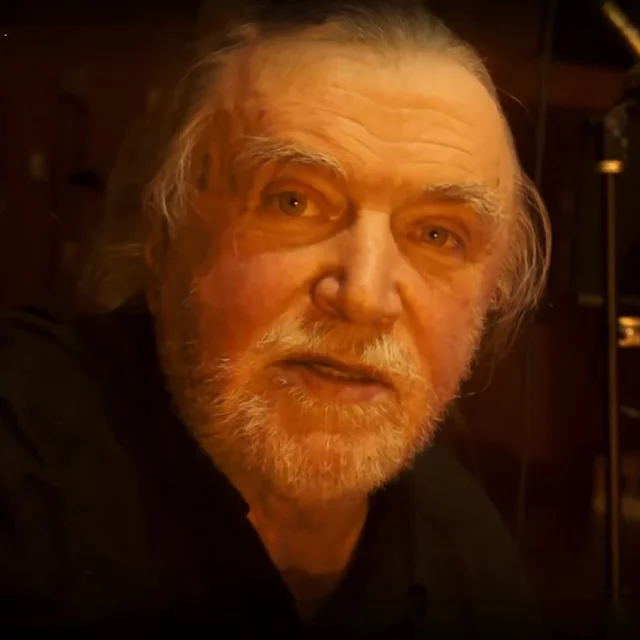
Sergey Bogaev recorded this story on video addressing Alexey Vishnya; the recording lasts 2 hours 22 minutes. In the story he speaks of the "current" album of 2008, so it was apparently made then. Below is a retelling of only what Bogaev says himself, attributed to him; the same story in the written memoirs is in chapter 14.
Where the loops came from
"Aria of the Varangian Guests" first came out around 2004 on a compilation of the magazine "Fuzz" — in the first version, where Bogaev played the drums himself. After listening to the disc he decided never again to release recordings with his own drums: "I am not a drummer". The band had a great drummer, Valery Zhuravlyov, but he lived in Arkhangelsk and there was no money for his fare and stay.
Learning this, Alexey Vishnya invited him over and showed him a library of loops — recorded live drums stored in the memory of a synthesizer. Together they lined the loops up one after another, "like a pyramid", and got a part of about four minutes; Vishnya put it on a disc for Bogaev. "It was a fateful, turning moment," Bogaev says; for both of them this way of working was new.
The first piece
In the studio Bogaev loaded the drums into a session, plugged his guitar straight into two combo amps — a bass and a guitar one — and recorded it with three to five microphones. The first half hour of what he played he later called "slightly heavier pop" and is glad nobody heard it. Tropillo had given him the night shifts, and he experimented until morning; the piece got the working title "number one". After a day or two of work with the loops a four-minute composition took shape; in the middle he inserted a few bars of an acoustic guitar that stood in the studio. The song begins with the sounds of a jaw harp — played at his request by a musician of a folk band that was recording in those days — and ends with a child’s voice.
In all, by his estimate, the first composition took about three days. Andrey Tropillo, coming into the studio and hearing the drums, asked who was playing ("it is not a live person") and learned that there would be lyrics. Bogaev notes that Tropillo never praised him to his face, but by his tone it was clear he was pleased. Bogaev and Vishnya listened to the result and decided to go on: in those days Vishnya had acquired new programs with hundreds of loops and samples, and so the second, third and fourth compositions were assembled. Then Bogaev thought the album would be finished in a month or two; now he is glad it was not completed in 2004 — it would have been "quite a different album".
English and "moving to the West"
Those who listened to the new pieces in the studio told him more than once that with such music one should sing in English and "move to the West". Bogaev answered himself that Russia, from the Baltic to Chukotka, is half the planet — what did he need the West for. Money, he adds, was always an acute question — but the lyrics stayed Russian.
A sound engineer at AnTrop
In those years Bogaev worked on the staff of the studio’s sound engineers together with Tropillo himself and his nephew Viktor Ilyin, recording the bands that came and being paid for it; Vishnya, he says, supported him at the time. The drawback of such work is that after a many-hour shift with someone else’s band there is hardly any strength left for his own music, and the time for it is the night.
Kurylyov and the lost song
Tropillo asked Bogaev to record the solo project of Vadim Kurylyov (formerly of DDT); Mikhail Nefyodov of Alisa played the drums. Kurylyov, Bogaev says, formally recorded for free, at Tropillo’s request, but as a friend paid for the work unofficially — "a very substantial support". The best song of the album, in Bogaev’s view, is Yegor Letov’s "Moya oborona": it got a hard, aggressive sound, unusual for Kurylyov’s soft voice.
The most successful one he calls "Dyadya Misha" — a song about Mikhail “Uncle Misha” Chernov, on which he himself played the saxophone. It had almost been mixed when, late at night during joint work on the mix, it was accidentally erased on the computer and could not be recovered. Kurylyov, to whom Bogaev said "Uncle Misha has been killed", at first thought he meant the man — only then did it turn out that the song had been "killed". It was recorded again in a quite different version, with programmed drums (Nefyodov had left on tour); the original, Bogaev says, was heard practically only by him and Kurylyov.
Katran
A similar case happened while recording the band Katran: Bogaev, who had begun the piece from loops at Vishnya’s home, also pressed the wrong key and the composition "disappeared". The loops of this song, assembled in the right order, were kept on Vishnya’s computer, but he did not want to replay dozens of guitar tracks. He was rescued by Slava, the leader of Katran (who, Bogaev says, also played in DDT): he had the same ProTools at home and had long mastered it, told Bogaev not to try anything else — and brought the composition back in a few steps. Bogaev learned from him what must never be done.
Two tributes
Tropillo twice invited Bogaev to tribute compilations. The first was the double compilation for Boris Grebenshchikov (designated a foreign agent in Russia), "Nebo i zemlya": Bogaev recorded "Ya zmeya", taking only the lyrics — two lines — and composing his own music; Tropillo listened to it twice and approved, and the song, in his words, turned out to be one of the brightest on the compilation. The second was a tribute to Mayakovsky: one had to choose a poem of about five minutes and write a song to it. Tropillo allowed him to work on the condition that he would not be alone but in the presence of Tropillo himself or his brother Yasin (Yasin Tropillo is Andrey Tropillo’s brother).
What does not add up
In the transcript the video is dated 2011, but Bogaev speaks of the album "of 2008" and of three and a half years of work: so the recording was most likely made in 2008, and the album came out later (the "Ygyatta" page). The surname of Slava of Katran and the names of other people at the studio are unclear in the transcript, so they are not given here.
Source: the video "Sergey Bogaev tells about the recording of Ygyatta" (YouTube, 9Yj26ej0mYg); a retelling based on the automatic transcript. Statements about other people are Bogaev’s words.