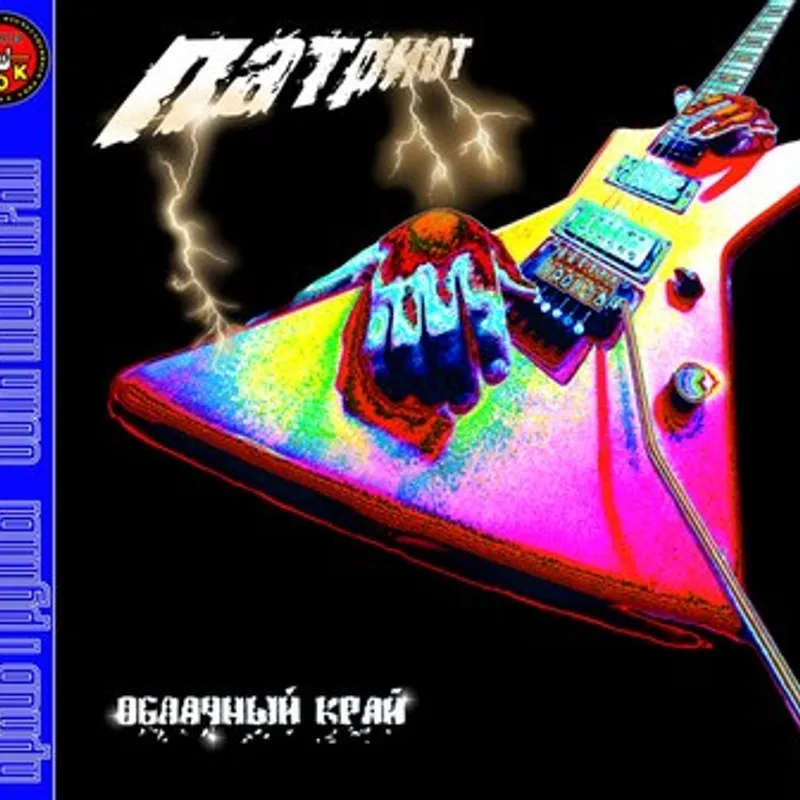
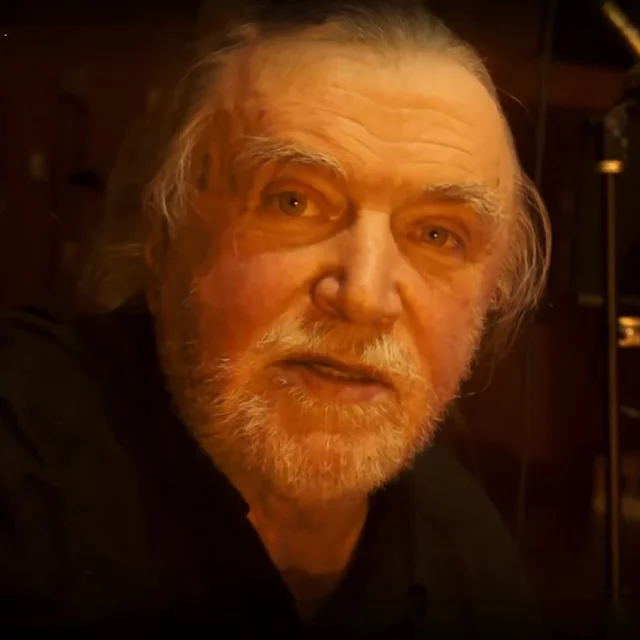
Sergey Bogaev recorded this story on video for the sound engineer Alexey Vishnya and the AnTrop studio archive; Alexey Vishnya put the video in which Sergey Bogaev talks about Tropillo and the album "Patriot" online on 2 June 2024, the anniversary of Bogaev’s death. The story lasts about an hour (the file is almost two and a half hours, but after that there is silence and a still frame). Bogaev speaks unhurriedly and with humour, digressing into anecdotes; below, what concerns the album is retold and the rest abridged: personal episodes, the details of other people’s flats and the swearing are not given. Short quotations are from the transcript, the retelling is ours.
The video in question (the sound lasts about an hour, then the file is silent). You can listen to the story in full.
How the studio moved to Tsvetochnaya
By the end of 1999 the studio of Andrey Tropillo on Bolshoy Prospekt on the Petrogradskaya side, in Bogaev’s words, "had come to its logical end": the premises were occupied by an Institute of Psychoanalysis, and the studio was given ultimatums — to remove everything within a month. Tropillo had long been looking for another place; the best turned out to be the former Melodiya record plant on Tsvetochnaya Street: a fenced territory of almost a whole block, with a checkpoint and guards. Some of the premises had already been given to small firms, while Tropillo took a workshop — on the first floor compact discs were produced ("one of the largest, if not the largest, in the north-west of Russia" — Bogaev’s estimate), on the second a private printing house worked. The studio got a former workers’ changing room on the third floor, with showers and utility rooms: in Bogaev’s estimate more than 200, perhaps even 300 square metres.
What had been recorded before the move
By then the live drums for almost all songs of the future "Patriot", the rhythm guitars and the bass had been recorded. Bogaev stresses the "geographical spread" of the album: the first half was made on tape, on a 16-channel Ampex, and part in Arkhangelsk, in three studios: at the bus station, in Viktor Panov’s theatre and in the studio "Palitra", which he and Igor Patokin supported (mostly Patokin). "Tupaya", the song "about a partisan setting off on a raid" — "one of the best, in my opinion" (in the booklet it is called "Patriot II (Partisan)") and the humorous sketch "Kalmyk — Metalyuga" were recorded there. The drums on all three were played by Valery Zhuravlyov. The rest was recorded in Petersburg with Dima Leontiev: in the same months they were finishing "Na beregu reki Agdam" (about it) and began new songs — among them "Nastenka". On a couple of songs Bogaev himself sat at the drums but prefers not to state it: "as soon as it is stated, some drummers start howling that you can hear it is not a drummer".
Six tapes
Just before the move the Institute of Psychoanalysis finally "outlived" the studio from Petrogradka. Bogaev did not take part in the move, but what he feared most was that in the commotion one of the six multitrack two-inch tapes with ten already recorded songs would be lost. The tapes were old: Tropillo took those written off by Melodiya as worn out, they had at least fifteen years of use, they hissed and crumbled, and to pick a suitable stretch for the next song one had to rummage a long time in a stack of about fifty. On arriving at the plant Bogaev found all six intact. The new studio was being built "at full speed", and everyone who could be drawn in helped: it is non-commercial, musicians who cannot pay for expensive studios get favourable terms from Tropillo and he asks them for help; Bogaev, too, made a "modest contribution".

Moscow: MizAnTrop
But the studio would not start working for at least half a year, while the material was "still fresh and alive". In Petersburg there was nowhere to record for free: Melodiya on Vasilyevsky Island and Dobrolyot were too expensive. Tropillo suggested the only option — Moscow, the studio "MizAnTrop" of his good acquaintance Evelina Shmelyova, "Elya": also a 16-channel Ampex, a good analogue console. He arranged it with her himself in Moscow, staying, as always, at her place, and called Bogaev: "everything is fine, leave today".
Bogaev took six tapes (almost ten kilograms each) and a seventh in reserve, tied them with ropes; Yasin Tropillo (Andrey’s brother) gave him a lift to the Moscow station, and he left that same night. On the platform Andrey Tropillo and Evelina Shmelyova met him with a hand luggage trolley, and they got to the studio by metro: driving through central Moscow in the daytime is pointless. The studio took up almost half a flat on the third floor of a residential building near the Kropotkinskaya station, opposite the Cathedral of Christ the Saviour: "I come out of the entrance, turn left — and there it is". Moscow bands recorded there by day, while Bogaev took the evenings and nights, because the guitars had to be recorded loudly: in the control room stood a real tube Marshall and a powerful tube Ampeg bass amp. The neighbours, in his words, never complained, and Evelina Shmelyova herself kept the equipment in order with "the tidiness peculiar to clever women".
The first night was "educational": Shmelyova explained the console and the patching, Bogaev wrote it down in a notebook. In the morning he checked the tapes he had brought on her machine: the heads on 16 channels may not match, but both machines — Tropillo’s and Shmelyova’s — were well aligned. For the first weeks the work went "quite intensively"; in his free hours Bogaev walked in the centre — for a long time in the Cathedral of Christ the Saviour ("as on an excursion"), on Red Square and around the Kremlin. Other musicians appeared in the studio in those days too, among them Oleg Kovriga — "a devotee and enthusiast of Russian non-commercial rock’n’roll".
The hacker Dobrolyubov and two Pentiums
Bogaev recorded the guitars for more than a month. By the vocals, as he admits, he had grown tired of the centre of Moscow and of the studio; Shmelyova said that "the client had ripened" but needed freshening up, and he went away for two weeks’ rest. On the bus back to Moscow (more than six hours) "quite by chance" two lines were born: "Yesterday I drank away a Pentium 4, today I drank away a Pentium 5". Bogaev explains: it is a metaphor — the hero drank away not only what he had but also what is still to come. One slow song on the album still had no lyrics, and these lines suited it. Then, by association with school, came Nekrasov’s verses on the death of Dobrolyubov ("You were stern, in your young years you taught to subject passions to reason… but more you taught to die"): they had not stuck to any song, and here they fell into place. Then the image of a hacker who "could break into the Pentagon’s computer", and why should he not be a Dobrolyubov: "I think on Rus’ it is a fairly common surname". That is how "Smert khakera Dobrolyubova" appeared.

Bogaev recorded the vocal in it as a scene: he is an eminent writer, and Shmelyova is a young beginning poetess or admirer who asks him to read something. He "declaims" the verses the way, as he imagines, Maxim Gorky spoke. Evelina Shmelyova behind the glass was supposed to stop the recording but did not, and then made a remark; they wanted to cut it, but Bogaev decided to keep it: "such moments bring unpredictable liveliness into any recording". (Her dialogue with the writer is given under no. 8 in the album’s list of participants, in our list the song is no. 9.)
9 June 2002
The rest of the vocals went slower than he wished: the studio was busy. In his free hours Bogaev walked around Moscow; one day, in his words, he "found a gigantic building" from which only generals and colonels came out, and learned from Shmelyova that it was the General Staff. When the Russia — Japan World Cup match had been advertised on television for a long time and a screen was put up on Manezhnaya Square, he set off there but changed his mind halfway ("not a lover of mass gatherings"), bought beer and watched the game on television in the studio. After the team’s defeat, as he tells it, the crowd on Manezhnaya rioted; Bogaev is glad he did not go. That date — 9 June 2002 — is the only one in the whole story that fixes it in time: at that moment the vocals were not yet finished. After finishing the vocals he went back to work at night ("Evelina Shmelyova said the studio was free"), and in those same days Andrey Tropillo called one evening from Petersburg: "Well, how are things?" The story ends there.
What does not add up
Bogaev says the studio moved at the turn of 1999 and 2000 and that the new studio "would not start working for at least half a year" — but he fixes Moscow to the summer of 2002. How much time passed between these events is unclear from the story, and we do not try to "straighten" it. The automatic transcript is also not always accurate: some names and titles (the name of one of the Arkhangelsk studios, for example) sound distorted in it, and we do not give them. We also do not retell the story of Andrey Tropillo’s project that has nothing to do with music.
The album itself is on the page of "Patriot" (lyrics of "Tupaya", "Nastenka" and "Patriot II (Partisan)", line-up, editions).
Source: the video "Sergey Bogaev talks about Tropillo and the album Patriot" (published by Alexey Vishnya); a retelling based on an automatic transcript of the sound part (about 1 h 06 min) with short quotations.