Eight Arkhangelsk bands in one encyclopedia — is that many or few? On 28 June 2003 the newspaper Izvestia answered with a note by Alexander Mezentsev, "Popali v istoriyu" ("Made it into history"; subtitle: "Arkhangelsk rockers are inert even in the pursuit of fame"). The community "Podtankovskaya Gvardiya" later republished it (17 February 2020). Here is a retelling.
Two encyclopedias
The note was about the new encyclopedia "Russky rok", published in Moscow by "A.T.R." in 5,000 copies: 500 pages with information on 1,000 rock bands from more than 60 cities of Russia and neighbouring countries. In the author's words, the main difference of the book is this geographical scope: earlier similar books concentrated almost exclusively on Moscow and Petersburg bands. The publisher is named as Alexander Trofimov, president of the All-Russian Association of Rockers, and the editor and project coordinator as Svetlana Busheva.
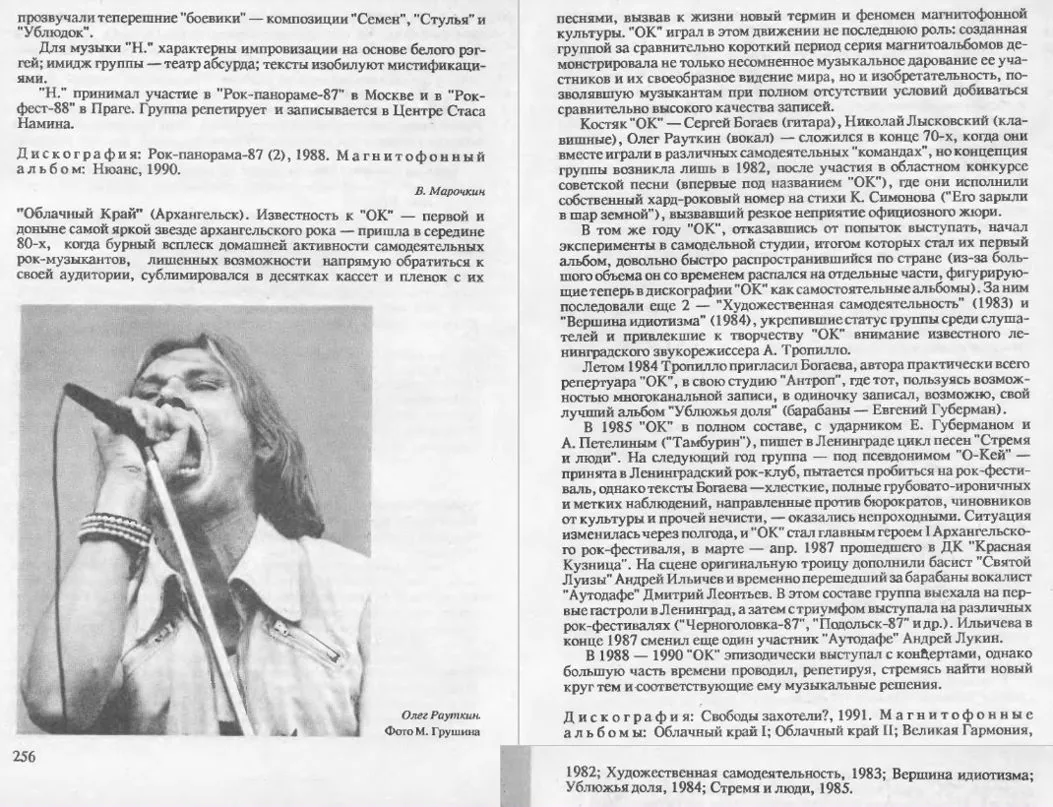
It was preceded by the "Malaya entsiklopediya russkogo roka", which, by the note, came out two years earlier: information on more than 500 bands, including four from the Arkhangelsk region — Oblachny Kray, La Shu, Lyudi pod lestnitsey and Belye Cherepakhi. The second edition is twice as large; these four moved into it "automatically" and were joined by two more Arkhangelsk bands, Blind Vandal and Estremadura, and two from Severodvinsk, Veter and Dva idiota i avtobus. Eight bands of the region in all.
Why not more
The author himself calls eight bands "a drop in the ocean": of more than a hundred rock bands of the Arkhangelsk region of all times, in his opinion at least half deserve a place in such a book, as the albums and concert and festival trips show. But there is no one to blame, he writes, and goes on to explain why: the compilers ignored nobody by geography, seniority or contribution to the genre. Svetlana Busheva told Izvestia that, besides the authors' own plans, "the initiative was also given to the musicians themselves", who only had to send information about the band, a photograph and an album or demo material. Many Arkhangelsk musicians knew this but, the author notes, "only a few bands had the ambition" to tell about themselves and leave a mark in history this way.
A listener's opinion: "Bolshoy obman russkogo roka"
On 28 February 2020 the community "Podtankovskaya Gvardiya" also republished the author's text "Bolshoy obman russkogo roka" ("The great deception of Russian rock"; it ends with the mark "Soundrussia"; the author's name is not given on the saved page). The author recalls a 2015 conversation with a Petersburg rock journalist and then speaks of the bands he considers the best, although they did not win nationwide recognition: Urfin Dzhus (Yekaterinburg) and Oblachny Kray (Arkhangelsk). The assessments are his, not the site's.
- Both bands, he writes, "fully experienced what it means to play rock" in the Soviet Union; their songs had "absolute freedom of creation" and a sense of challenge to the existing system rather than "Aesopian language".
- Many unsophisticated listeners learned of Oblachny Kray from the article "Severnaya legenda" in Moskovsky Komsomolets in May 1987, but connoisseurs had long known the band from its tape albums, whose quality "often left much to be desired".
- He describes the band's music as "talented imitation" (he writes without irony) and a reinterpretation of the best images of 1970s Western hard rock "with its own distinctive intonations": "it turned out surprisingly fresh and worthy".
- He explains the band's love of freedom, among other things, by the fact that serfdom never existed in the Russian North.
- As the "golden" line-up that first played in Petersburg and then performed at the festivals in Chernogolovka and Podolsk (1987) the author names Sergey Bogaev (guitar), Nikolai Lyskovsky (keyboards), Oleg Rautkin (vocals), Andrey Ilyichev (bass) and Dmitry Leontiev (drums; the surname is misprinted in the text). The best-known albums he considers "Ubluzhya dolya" (1984) and "Stremya i lyudi" (1985).
On what happened in 1987 see Moscow, 25 April 1987.
Source: A. Mezentsev, "Popali v istoriyu", Izvestia, 28.06.2003; the text "Bolshoy obman russkogo roka" (marked "Soundrussia"); both publications in the community "Podtankovskaya Gvardiya" (VKontakte); a retelling and short quotations.