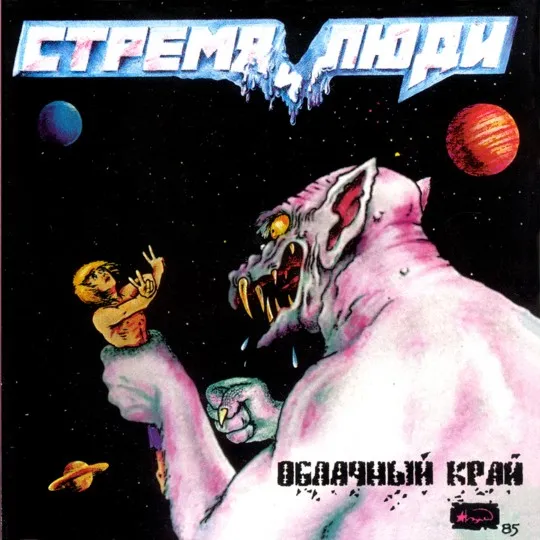
One of the distinctive features of Arkhangelsk's Oblachny Krai was their ability to organically combine the melodious chanting of Russian folk songs with powerfully played hard rock in their work...
One of the distinctive features of Arkhangelsk's Oblachny Krai was their ability to organically combine the melodious chanting of Russian folk songs with powerfully played hard rock in their work. The compositions recorded in this style, "Zazdramaya", "Russkaya narodnaya", "Velikaya garmoniya", "Soyuz kompozitorov", and "Grustnaya istoriya", eventually became classics of underground heavy rock — despite the fact that many listeners didn't really know which band was performing these epochal creations.
The guitarist Sergey Bogaev was the ideologist, author of music and lyrics, sound engineer, and producer of Oblachny Krai. A descendant of the Don Cossacks, he decided to achieve in the studio the exact same sound he heard on the imported records of Deep Purple and Rainbow, applying the zeal and persistence characteristic of freedom-loving Cossacks. Possessing enviable tenacity, Bogaev moved step by step towards his goal — no matter how much effort it cost him. Without overcomplicating things, he began single-handedly inventing unique devices designed for sound processing. While working as an electrician, Bogaev spent two years assembling and perfecting all the sound effects he needed for his future studio work.
"I was feeling my way in the dark: experimenting with where and how to place the microphones, how to set the recording level," Bogaev recalls. "I would sit in the studio for days on end, wasting kilometers of tape. Nobody was rushing me, I had plenty of time — just sit there and record."
The first albums of "Oblachny Krai" were recorded by Bogaev together with Oleg Rautkin (vocals, drums) and keyboardist Kolya Lyskovsky. All three were neighbors in the same apartment building, and two of them even lived on the same landing. At twenty years old, Bogaev was the oldest in this group. Rautkin had just entered his first year at the pedagogical institute, while the two-meter-tall Arkhangelsk hero Lyskovsky was still finishing high school. Starting in January 1982, in the radio center of the Krasnaya Kuznitsa shipyard's House of Culture, Bogaev and his companions, using a Ural guitar, a Yunost electronic organ, store-bought microphones, and consumer tape recorders, began churning out album after album. "Oblachny Krai" preached a tough yet melodic hard rock in the spirit of Deep Purple, marked by drive, energy, and original arrangements. Most compositions exuded a certain dashing bravado, and the lyrics had a radically satirical orientation: "It's no trouble that the shelves are empty / We've all been used to this for a long time / We are nourished by pure art / Books, theaters, and cinema."
All of Oblachny Krai's Arkhangelsk albums were recorded by sequentially layering instruments by bouncing tracks from one tape recorder to another. First, the guitar, drums, and keyboards were recorded, then the bass, then the lead guitar parts and possibly second keyboards. The last thing to be recorded was Oleg Rautkin's vocals. The entire process was carried out without a mixing console, and the instruments were recorded directly into the tape recorder.
One can only guess how the fate of Oblachny Krai would have turned out if Aquarium hadn't come to Arkhangelsk with concerts in 1982. Hearing the compositions of Oblachny Krai, neither Tropillo nor the musicians of the Leningrad band could believe for a long time that these songs were recorded on domestic Soviet equipment. Alexander Lyapin, taking Bogaev's Ural guitar and his homemade tin-plated effects pedal in his hands, shook his head for a long time, looking thoughtfully at his branded Fender. Tropillo summed up everything that was happening. "Ah, kid, everything is clear," he said to Bogaev. "You have a star shining over you."
After Aquarium's tour, the legend of the fabulous Oblachny Krai began its rapid march across the country. Not without the help of those same Leningraders, the early albums "Oblachny Krai I", "Selkhozrok", "Velikaya garmoniya", "Kh...ya samodeyatelnost", "Vershina idiotizma" soon broke out beyond the borders of Arkhangelsk. Reviewing the latest works of Oblachny Krai and DDT, the Moscow rock magazine Ukho wrote at the end of 1983: "Don't cry, but it's a fact. Two bands from rather remote regions have produced such output that many capital city bands will soon have nothing left to catch... Wit, taste, meaningfulness, and depth of lyrics have been the monopoly of Moscow and Leningrad until now. Sooner or later, this monopoly had to fall. And now that it has fallen, we see how much more spacious our world has become."
However, despite such flattering assessments and absentee All-Union fame, Oblachny Krai itself unexpectedly found itself in a crisis at this time. Firstly, Oleg Rautkin moved from Arkhangelsk to Ukraine, and the group was essentially left without a vocalist. Secondly, having no chance whatsoever to perform live, Oblachny Krai also lost the ability to record. In the winter of 1984, as part of an anti-rock campaign, the musicians were kicked out of the Krasnaya Kuznitsa House of Culture, and then they made sure that the group could not record anywhere else.
Bogaev had no choice but to seek "political asylum" from Andrey Tropillo, in whose studio Oblachny Krai recorded two of their best albums over the course of a year. Bogaev prepared the album "Ubluzhya dolya" (84) with an improvised lineup of musicians: instead of Rautkin, who was lost somewhere in the Ukrainian steppes, vocalist Vova Budnik from Svyatoy Luizy (who had previously sung on the album Velikaya garmoniya) was urgently summoned from Arkhangelsk; Bogaev played guitar and bass, and Evgeny Guberman, one of the country's strongest jazz-rock drummers, played drums.
Despite the lack of rehearsal time as a band and the fact that Budnik slightly struggled with the high notes, shifting into a nasal whine and shriek, several compositions from "Ubluzhya dolya" subsequently formed the core of Oblachny Krai's live repertoire. It is no coincidence that three years later, the band began their famous performance at the Podolsk Rock Festival with songs from this very album — "Soyuz kompozitorov", "Moy Afghanistan", "Vremya priobshcheniya k lyubvi".
While working on "Ubluzhya dolya", Bogaev encountered multi-track recording equipment for the first time in his life — the very same equipment on which Zoo recorded "Belaya polosa", Kino recorded "Nachalnik Kamchatki", and Aquarium recorded "Den Serebra". Having figured out the technical intricacies of the House of Young Technicians studio with Tropillo's help, Bogaev decided to record the next album in Leningrad again. Tropillo was not opposed, since he sincerely believed that the "red metal" played by the band was unparalleled in the USSR. He was thrilled with Bogaev's playing technique — a fundamentally new guitar style for hard rock, based on the plucking techniques used when playing Indian folk instruments. "Bogaev pulled the guitar strings like a sitar," Tropillo recalls. "He tried never to mindlessly switch to the lower strings and played on one string. The sound turned out completely different, and a kind of magic arose — everything was put together so solidly and brilliantly."
...The album "Stremya i lyudi" began recording in the summer of 1985 — again with an incomplete lineup (Bogaev, Lyskovsky), but for the first time with professional instruments. Boris Grebenshchikov lent Bogaev his guitar, and the musicians from Strannye Igry provided branded keyboards and a bass. The only thing that remained unchanged was the famous tin-plated effects pedal that gave Bogaev his distinctive guitar sound.
Recalling the recording of the album "Stremya i lyudi", its participants agree that the entire session was full of numerous surprises. For instance, when the instrumental tracks were ready and it was time to record the vocals, Rautkin materialized in the studio in a semi-mystical way. At the time, Oleg was studying at a physical education institute in Kharkov and went to Siberia for the whole summer with a student construction brigade. He had grown somewhat aloof towards the band and had even bailed on recording "Ubluzhya dolya". The likelihood of him showing up in Leningrad was slim.
"We're sitting in the studio, the music is recorded, everything is played, but there's no one to sing," Bogaev recalls. "And suddenly the House of Young Technicians gets a call from Arkhangelsk from neighbors: 'Your Oleg called from Ukraine. He's asking where you are.' Through some means, through third parties, we tracked him down and passed on the information — without much hope that he would come. And suddenly, one fine day, at the very end of summer, Rautkin shows up in the studio." Everything else was, as they say, a technicality. Rautkin was used to working with lyrics he had never seen before — much like Evgeny Morozov from DK.
"Rautkin came to the recording session, I gave him the sheets with the lyrics," Bogaev recalls. "We played the music, attached the sheets to the mic stand, and that's how the vocals were recorded."
During this session, there were plenty of adventures related to recording the drum parts. As is well known, throughout the band's history, anyone who felt like it played drums in Oblachny Krai. On the Arkhangelsk albums, it was Rautkin; on "Ubluzhya dolya", it was Guberman; on the album following "Stremya i lyudi" — "Svobody zakhoteli?" — it was Yuri Korablev; and at the few concerts in the late 80s, it was Dima Leontyev, the vocalist of the Arkhangelsk band Autodafe.
While the recording of the album "Stremya i lyudi" was underway, the band once again had no drummer. Bogaev, already accustomed to the twists of fate, gritted his teeth and worked to the rhythmic accompaniment of a metronome recorded on one of the tracks of the 8-track tape machine. When there was no turning back and it was time to record the drum parts, he cast aside false modesty and started playing the drums himself. The fact that the drums were recorded last didn't bother Bogaev at all. As a result, he played so confidently on several tracks that Evgeny Guberman, who found himself in the studio the next day, was literally dumbfounded.
"I simply couldn't find the words," he says enthusiastically, unable to hide his admiration for Bogaev's technique. "In the composition 'Ot mozgov k mozgam', Sergey played the most complex parts so well that it wasn't immediately obvious how brilliantly it was executed. He would reluctantly put on the headphones, sit behind the kit, and play absolutely flawlessly."
Interestingly, in none of his rare interviews did Bogaev admit that he played the drums himself on several tracks on the album "Stremya i lyudi". On the remaining songs, the drum parts were performed by Guberman — who stated that it was the best music he had ever played in his life.
...Most of this session took place at night — sharing the space with Alisa, who were recording their debut album, "Energiya". "Tropillo would turn off the lights and put the whole floor under alarm because there was an arms room with small-caliber rifles nearby," Bogaev recalls. "We're recording an album, but God forbid anyone touch a wall, a door, or a windowsill. Because everything would instantly trigger an alarm — they'd arrive, arrest everyone, and you wouldn't be able to prove anything. But generally, we got away with it. That's also when we met Kinchev: we're sleeping on mattresses on the floor, Alisa is recording, then they crash, and we get up and record. That's how it went, in shifts."
When the album was finally recorded and began to circulate, the two heaviest tracks became the biggest hits — "Kostya Perestukin" (a satirical composite image of a Soviet fanatical snitch) and "Grustnaya istoriya", a tale of the unrequited love of a Komsomol activist for a lady of the night. No less worthy of attention were the two final symphonic pieces, very organically realized using the expressive means of heavy rock. Primarily, "Stremya i lyudi", which tells the story of a caravan moving through the desert towards an abstract, bright goal, as well as "Mat poryadka" — a large-scale historical sketch dedicated to St. Petersburg during the First Russian Revolution. Both compositions were musically arranged in the spirit of Mussorgsky's "Khovanshchina" and Shostakovich's "Heroic Symphony" — with dark, gripping riffs and Bogaev's virtuoso guitar solos, stylized to sound like Blackmore, Wagner, and Beethoven all at once. The only problem in the final stage of work was the rhythmic incompatibility of the lyrics intended for these two compositions. Without overthinking it, one of the musicians suggested swapping them, and everything fit together perfectly: the lyrics of "Stremya i lyudi" fit the melody of "Mat poryadka" like a glove, and vice versa.
Recalling the studio work on this album, Tropillo highlights the exceptionally successful mixing done at the finale of the composition "Mat poryadka".
"There's an avalanche of sound that sweeps away everything in its path," he says. "This is true art that you wouldn't be ashamed of even a hundred years from now. Nothing is faked here. Everything is in its right place."
"Stremya i lyudi" truly became the pinnacle of the multi-part studio epic of Oblachny Krai. It seemed as though the Bogaev-Rautkin-Guberman-Lyskovsky quartet was playing the most devastating hard rock of their lives, burning everything around them to the ground. Here, the immense energy potential of the musicians perfectly merged with the hard-intellectual madness of the arrangements, the virtuosity of the performance, and the complex imagery in the lyrics, at times masked using symbols and metaphors: comets, galaxies, observatories, stars, cosmic monsters.
After the release of the albums "Ubluzhya dolya" and "Stremya i lyudi", Oblachny Krai rightfully became one of the country's main cassette legends — on par with DK, Yury Morozov, and Bratya po razumu. The indomitable desire of numerous fans to see the band live was only realized in 1987, when Bogaev and his crew gave a series of spectacular concerts at festivals in Arkhangelsk (Audience Choice Award), Leningrad, and Moscow. Perhaps this very year was the peak in the history of Oblachny Krai — largely due to the visually striking performance of the band in Podolsk. The aggressively screaming Rautkin swung a heavy microphone stand over his head, and in the finale, a gloomy Bogaev, having broken two strings on his guitar, smashed it to pieces right before the eyes of several thousand spectators.
...A few months later, cultural officials sabotaged Oblachny Krai's performance at the All-Union festival "Rock-Panorama-87", and a year later the band stopped giving concerts altogether — despite numerous commercial offers. In the early 90s, Oblachny Krai released a rather unsuccessful vinyl record on Melodiya, "Svobody zakhoteli?", and currently exists mostly in theory within the triangle of Arkhangelsk — Ukraine — St. Petersburg, having remained in the public memory as one of the heroes of the Podolsk festival and one of the most mysterious and underrated representatives of the cassette culture of the 1980s.
Alexander KUSHNIR (100 Cassette Albums of Soviet Rock)