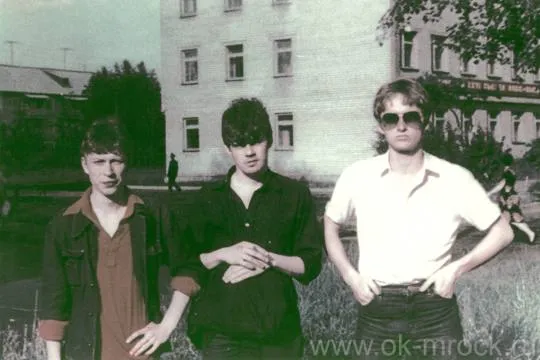
This is how the musicians of "Kray" classify their own work: for some reason, 7 "albums" circulated in Moscow instead of 5. Most likely, this is due to the fact that the first two recordings were significantly longer than an "average record", and in the minds of capital city music lovers, they spontaneously multiplied by division into four...
This is how the musicians of "Krai" classify their own work: in Moscow, for some reason, 7 "albums" circulated instead of 5. Most likely, this is because the first two phonograms were significantly larger than an "average record," and in the minds of capital music lovers, they spontaneously multiplied by division into four.
It was precisely in their studio work—in free, creative communication with the listener, unmediated by countless artistic councils and "tariffication committees"—that a unique model of rock music was formed, which is exactly what draws the sympathy of young listeners to "Oblachny Krai". Unfortunately, many of our journalists still haven't broken the habit of using the word "underground" to describe the products of the "tape recorder industry" (as well as concerts in student clubs, etc.). This looks rather foolish at the very least, since logically, "underground" activity is inherently of a somewhat different nature. After all, these groups were typically just pushing back against departmental regulations that hindered the development of a normal creative process.
SPRING IN MOSCOW. And the "Melodiya" company, swept up in the movement to renew musical life, is holding its auditions today not in a stifling, cloistered atmosphere, but (finally!) in the presence of the main artistic council—which, as a Bulgakov character might say, is the first and the last, meaning in the presence of an audience. To be precise, on April 25th in the assembly hall of the Moscow Gramophone Record Pilot Plant, musicians, critics, young factory workers, and devoted fans of the most rapidly developing musical genre gathered together. Many could not find a seat, but no one minded the discomfort in anticipation of meeting a band whose very existence is shrouded in a sort of mystical aura. Everyone had heard them, but no one had seen them
Meanwhile, the first pages of our history are far from anything mystical: in the ancient northern city of Arkhangelsk, three friends—perfectly ordinary guys—lived in the same building and even the same entranceway. Like many others, they listened to heavy rock. Like others, they tried to make their own contribution to its further creative development, and to do so they organized their own ensemble at the Palace of Culture of the ship-repair plant. The "founders" of "Krai" (as the group is also sometimes called) were: Oleg Rautkin—vocalist (now a student at the Kharkov Institute of Physical Culture), Nikolai Lyskovsky—keyboardist, Sergei Bogaev—band leader, lead guitarist, and author of the music and lyrics. In 1982, the novice musicians were invited to the plant's Komsomol committee—they had to go to the Salambalsky District for a festival. The only thing missing for these gigs was a band name: "It needs to be something native to our North, and it needs to be easy to announce from the stage." Someone suggested: "Oblachny Krai" [Cloudy Edge]. Well, the name satisfied both official criteria of acceptability (it was both "native to the North" and "easy to announce")—and so the band was christened. After that, things stopped going so smoothly.
— To be precise, it was a complete disaster, — Sergey corrects. — Our first performance turned out to be our last, because, to put it mildly, the festival didn't like us.
...No, they hadn't sung "The Sadko Restaurant" yet back then; it was just that all the festival participants enthusiastically performed "Malinovka" together (seven times in a row), while our "laureate candidates," for some reason, considered themselves unworthy of this honor and, instead of "Malinovka," presented the jury with their own song set to lyrics by... Konstantin Simonov. This was deemed an outrageous stunt. Consequently, the doors of concert halls shut firmly and for a long time. The studio path remained—the thorny road to all-Union fame...
Once, Northern Rus preserved the treasures of the national epic for us. Proud people lived here, living by their own wits: simple peasants wrote manuscripts and kept them as sacred relics. It is no coincidence that here, far from the temptations of the capital's "prestigious halls," Sergey Bogayev and his friends preserved the folk purity and sincerity of rock music during the most dismal times for the domestic rock scene.
— We only sing the truth, — say the musicians from Arkhangelsk. — Generally speaking, rock music in our country is not just a musical phenomenon, but to a significant extent a social one as well, so the lyrics are of paramount importance to us. Poetry and music must suit EACH other...
The secret to Oblachny Krai's impact on the listener lies in the fact that the musical power and undeniable professionalism (Sergey is one of the best guitarists in the country) combine in their compositions with a jeweler's precision of words. It is no coincidence that their "satires" provoked such fury among those who recognized themselves in the grotesque characters—bureaucrats, bribe-takers, and hacks who had entrenched themselves around the arts in order to use their monopoly to extract literally "unearned income" from it:
"And then through the airwaves rushes
Heavily drenched in mothballs,
Sweet, much like a marshmallow,
The so-called high art..."
"The main developmental trends of this group, currently one of the strongest in the country," comments art critic Sergey Guryov, host of the 'Rock Music Lessons' column in 'Yunost' magazine, "is a movement away from the English hard rock model: with an abundance of instrumentals and virtuoso solos—toward a more musically austere, harsher sound. 'The Stirrup and the People' is precisely an intermediate phenomenon on the border between classic 'hard' and 'heavy'. Perhaps this is the most promising position, providing the musicians with maximum creative freedom, unconstrained by formal stylistic boundaries?"
As for the ideas, the first 1982 recording represents a search for their own identity, both in music and in poetry, featuring a relatively gentle, early Gogol-esque humor focused on provincial themes—recall their famous Dudyrin, the first rocker in the village. "Amateur Art" is much harsher—it is precisely this "album" that brings true fame to "Krai".
ALONGSIDE "DDT" and "Veselye Kartinki", Sergei Bogayev's group emerged at the forefront of that distinctive movement in rock music pioneered two decades ago by Alexander Gradsky. They respect their "teachers" in music, but imitate no one: art generally does not tolerate imitation; it is not mass production, but a "unity in diversity."
Accordingly, their social thinking becomes deeper and more accurate: they speak not only of the "isolated shortcomings" of the surrounding provincial reality, but also of the hidden historical, psychological, and ethical reasons behind what must be overcome today. After all, the roots of our troubles lie not in abstract formulas, but within ourselves (recall "Stirrup and People"—the track after which the latest album is named).
It is hardly worth ruining the reader's mood by describing all the difficulties "Oblachny Krai" had to face—this is the fate of any band that took its work seriously, rather than simply viewing it as "dance music for the youth." Now their art is receiving, albeit belated, recognition, and the authors of scathing articles feel a certain awkwardness when they open reputable central magazines like "Yunost", "Znanie — Sila", and others, only to find the names of these Arkhangelsk musicians among those whom Soviet rock can be proud of. "Krai" is invited to perform by the Leningrad Rock Club and the Melodiya record label, their songs have already been played on the radio (the song "Gray Eminence")—although, a rock club has now been organized at their native ship-repair plant (from where, incidentally, the band was finally kicked out in 1984 under the pretext of safety violations: "Too many wires!").
HOWEVER, let us return to the hall where Muscovites met their "unknown idols" for the first time—in addition to the three founders of "Krai", drummer Dmitry Leontyev (a locksmith by trade) and bassist Andrei Ilyichev (an electrician) took the stage. The rhythm section did not let the prestige of Arkhangelsk rock down, and the audience's enthusiasm exceeded all expectations.
"Of course, the band will still have to work on their stage image: the caliber of the music and lyrics is such that the theatrical component in the 'triangle' (music + lyrics + show) must be truly extraordinary," note the seasoned music critics, "but 'Oblachny Krai' still has far too little experience in live performance."
Well, the experience will come—there is no doubt about that today, because we are talking about one of the most popular bands in the country. The spring that has arrived in our land, where, as is well known, "there are highly skilled craftsmen of all sorts...", promises a worthy continuation for the northern legend.