My wife, Lena, met me, holding our infant daughter, Polina, in her arms. We gave ourselves over to marital bliss and didn't even notice how a couple of days had flown by. We turn on the TV in the morning, and there it is... Swan Lake on every single channel... we turn on the radio – it's the exact same picture. Someone must have died, we thought... but who?... the President was in good health, vacationing in Foros, a fact we had been made aware of the day before by the TVs hanging in the airport. We dropped by the Lyskovskys' – they didn't understand what was going on either. Finally, the ballet broadcast was interrupted. A group of elderly people with stone faces and trembling hands appeared on the screen to announce that the country was in deep shit and in need of an immediate washing. Naturally, during the first hours of the GKChP, no one knew how this would end. We worried sick about our friends who had stayed behind in the capital with pockets full of money.
I was greeted by my wife, Lena, holding our infant daughter, Polina, in her arms. We surrendered to marital bliss and didn't notice how a couple of days flew by. We turn on the TV in the morning, and there it is... *Swan Lake* on every channel... we turn on the radio – it's the exact same picture. Someone has died, we thought... but who... the President is relaxing in good health in Foros, which we had been informed of the day before by the TVs hanging in the airport. We dropped by the Lyskovskys' – they didn't understand what was going on either. Finally, the ballet broadcast was interrupted. A group of elderly people with stone faces and trembling hands appeared on the screen to announce that the country was in deep shit and in need of an immediate wash. Naturally, during the first hours of the GKChP, no one knew how this would end. We worried for our friends who remained in the capital with pockets full of money.
Andrey Lukin called that very evening. He could no longer fly home. All roads were blocked, the streets were filled with tanks, soldiers, and armored personnel carriers, and a curfew was in effect. I had never heard his voice sound so frightened. I advised him to somehow make his way to the airport, and take it from there. But, as it turned out, they got lucky with the flight. Upon arrival, Andrey stopped by our place; his face was completely white.
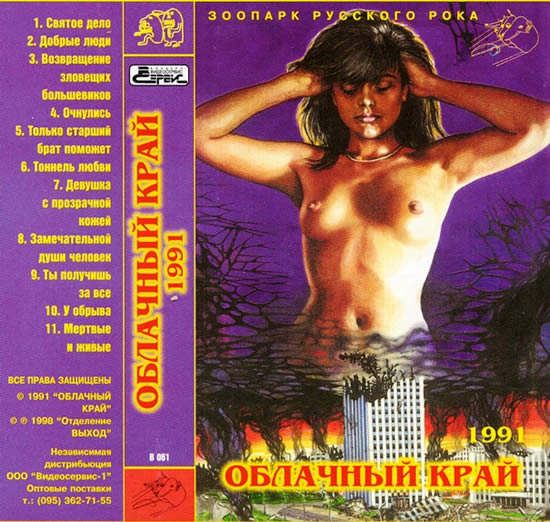
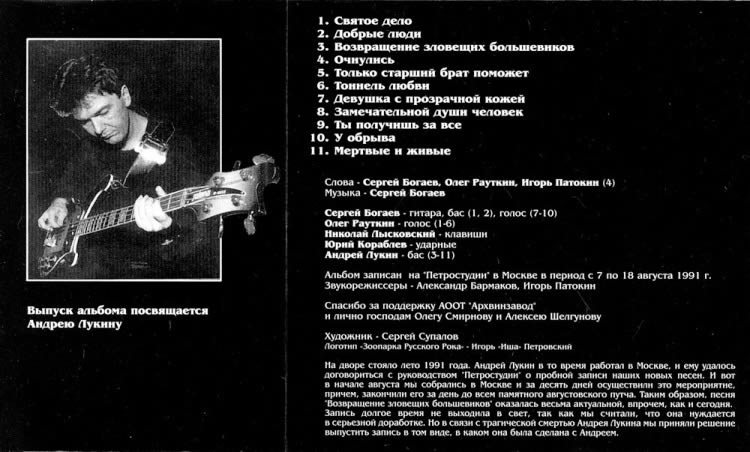
And that is how our recording came to an end, coinciding with such a momentous event for our entire country. We figured that calling the album *The Dead and the Alive* wouldn't do; it would be far more impactful at the time to simply title it: *1991*.
The first thing I did was take a copy of the album to our wonderful artist, Andrey Supalov, so he could start working on the cover art. For many years, he had been our visual chronicler, equally skilled with a pen, a pencil, and photographic exposure. I saw a black-and-white sketch of his, about the size of a postcard, depicting the half-ruined city of Arkhangelsk, with a towering, naked young maiden standing above it in a pose reminiscent of a nuclear mushroom cloud. I was deeply struck by this image and asked him to render it in full LP size and in color. He painted our main square, featuring a massive 24-story high-rise, surrounded by the city and regional Party committee buildings – all destroyed, looking just like footage from September 11... it's amazing how he predicted that. I asked him to illustrate the instrumental, closing track, "The Dead and the Alive."
When he brought the paintings over, I was simply dumbfounded. Tropillo called, overjoyed, saying that everything was ready. Andrey urgently summoned me and our sponsor to Leningrad to sign a contract with him for the release of products that no longer belonged to him. Vadim immediately booked tickets, and that very day, in early October, we were at Tropillo's. I handed him the original recording and artwork. That same day, Igor Talkov was killed at the Yubileyny Sports Palace.
"Our movements are constantly affecting something," I thought to myself at that moment, and I voiced this observation to Tropillo. Andrey launched into a lengthy explanation about the nature of willpower and whose will governed things—ultimately, on whom everything here depended. At the time, in addition to managing the Melodiya record label, he held the high office of Superintendent of the Evangelical Lutheran Church of Russia. He probably had a better grasp of the workings of the world than we did. Being a convinced atheist, I tried to avoid spiritual discussions. Besides, any conversation with Tropillo inevitably turned into a relentless monologue from him. That day, he was expecting high-ranking Lutherans from Europe and threw a dazzling banquet in their honor at the Olgino camping hotel. We ate, drank, listened to the standard formal toasts, and stayed there for the night.
The next morning, we arrived at the office and sat down to sign the contract, at which point Tropillo said, "You know, guys, here's the situation: our Leningrad plant and the Melodiya label are going through hard times. As the director of the label, I theoretically can, and very much want to, pay you for this album. However, the Leningrad branch has no money in its account—the budget doesn't even cover the operating costs of our buildings. I *can* pay you, but not as much as Moscow can. Therefore, I suggest you immediately head to the capital, to Melodiya's headquarters. I'll make the arrangements and give you all the phone numbers..."
Vadim threw his hands up—well, Sergei will go, if that's how things are. If there's a chance to get more money rather than less, why hesitate... these flights were nothing new to me. We were talking about receiving an author's royalty of 50,000 rubles. A lovely lady by the name of Irina Kats, an editor at Melodiya, signed the contract with me. However, for some reason, they couldn't pay me the specified amount at the cashier's office; they asked me to open an account at a nearby Sberbank branch and bring them my savings book so they could enter its details into the contract. They promised to notify me by phone once the money came through. And that's exactly what I did.
I returned – I waited a week, then another, a month – no call. I phoned Andrey, figuring maybe they’d lost my number... but the truth was that Melodiya was at a massive crossroads at the time: the Compact Disc was entering everyday life, and vinyl was piling up in warehouses. The once-mighty, multinational manufacturing and distribution network was bursting at the seams. The equipment was outdated, and the quality of the vinyl records was terrible – no maintenance, no cleaning... later on, Sukhorado unloaded the entire Aprelevka production line to some German craftsmen. They cleaned it up, retooled it for 45s, ran some ads, and have been happily pressing local DJs' records ever since. Our record died; along with us, many, many other projects passed away under the shadow of mounting geopolitical and financial problems.
We at least needed to get the original tape out of there. Anything could have happened under the radar. I voiced this concern to Andrey, and soon enough I had to fly down there while the building still at least belonged to Melodiya. I bought a ticket that very day and set off. I knock on the door... the editor who had drawn up our contract had already quit, and no one knew anything. They gave me a quick glance at the archive – thousands upon thousands of miles of tapes with packaging that looked exactly like ours, like two peas in a pod. I even told them, "Look, it's just like this one – a white BASF box with red calico trim." They showed me a shelf with a myriad of similar tapes... they said that in a matter of days, the building would be transferred to a new owning organization with no connection to music... a lost cause.
We hadn't anticipated such a turn of events. There was only one consolation: the first copy was still in Arkhangelsk. Supalov agreed to redo the artwork, and we settled into our usual spot under the train station to rehearse our live sound. The 10th anniversary of our group was just around the corner – we had to prepare for a concert. I met a charming girl, Lena Shatrovskaya – absolutely stunning and perfect in every way. I asked her to model for the cover of our record. She was a brave girl – I took her photo and passed the picture to Sergey.
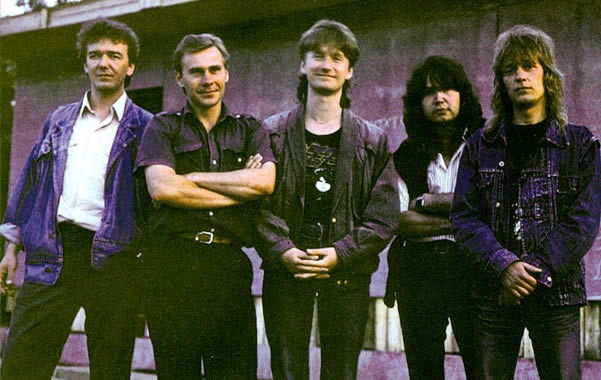
January 1993 crept up on us unnoticed. Back then, a progressive director named Vitaly Golelyuk worked at Arkhangelsk Regional Television. He had initially led an underground theater before being invited to work in television. To mark our 10th anniversary as the most famous Arkhangelsk band in certain circles across the country, he decided to make a half-hour documentary about us. The winds of change were blowing, and the management gave the green light. The TV station dispatched a crew on an expedition to Leningrad, where they interviewed Tropillo, Andrey Burlaka, and Yura Morozov. The "Edvin" company financed Rautkin's trip to join them.
They decided to film right at our place. The attitude of our TV crew was the exact opposite of the one that came from Moscow. This time, our wishes were actually taken into account on all matters, and literally ten days later, the film was broadcast in our northern region, which had been promoted in advance with segments on our local front pages. That very day, we celebrated our 10th anniversary with a great feast, in cozy company, watching this film on air right in the middle of prime time.
We felt like superstars in our specific region. We were recognized everywhere, and everyone would point at us the moment they spotted our hairy silhouettes on the horizon. We kept up our rehearsals: we felt like we were riding the wave, because they kept paying our salaries on time, despite the fact that we were no longer recording anything or playing shows. I realize now that our well-off sympathizers, who wanted for nothing themselves, simply decided to ensure that we—the people they liked—would also go at least a little while without needing anything. They couldn't care less about our new material; they expected nothing from us. They were just happy for us, recognizing their own contribution to our current golden era. I cannot thank our very own Andrey Lukin enough, two hundred thousand times over, for all the blessings brought about by his personality, his temperament, and his business acumen. Thanks to him, we had so much money that we couldn't spend it fast enough, and for the first time in my life, I even started saving up for a rainy day. No one knows when their rainy day will come, but we were lucky—we found out, and very, very quickly.
One evening, fifteen minutes before midnight, the media announced that "tomorrow, all bills larger than ten rubles will be taken out of circulation..." And let me tell you, we had money... Andrey Lukin had even more of it—he hoarded stashes of fifties and hundreds. So, he comes running over to me with a wad of fifty-ruble bills. For some reason, he figured that since there were still fifteen minutes left, he could buy dollars from the cabbies. We sprinted to the bus station, where a whole crowd of taxi drivers were standing around, heatedly discussing something. "Brothe-ers!" Andrey hollered. "We'll buy everything you've got!" and with that, he pulled out the green wad. "Heh," they grunted. "You know where you can shove those fake bills, smartass, right?"
He took all the ten-ruble bills I had on me so I could save face. It was enough for five bottles of cognac. He got into the car, paid, and stepped out, clutching all five to his chest... an awkward movement, and his haul crashed to the ground. Not a single bottle broke, much to the delight of the amused cabbies. At least we got lucky there... and truly, you never know where you'll find something and where you'll lose it.
Yura Gordeev, who by then had founded his own "Oryol Trading House," which was sponsoring Valery Leontyev's newly launched program "Full Moon," made Lukin an offer he couldn't refuse. "Drop your Arkhangelsk," they told him, "and come to us in Moscow. The company will rent you a one-room apartment and give you a car. Bring your ladylove, and as for Arkhangelsk, you can fly there for rehearsals every week at the company's expense." Andrey asked me what I thought. — But what could I possibly say against a lever like that? He didn't have those kinds of prospects in Arkhangelsk, and there was housing, a salary... well, so be it...
Andrey left, but he flew back to us for rehearsals every weekend. He didn't miss a single one. Yura Korablev, on the other hand, started showing up less and less frequently, even though the problems with his hand had been completely resolved. He already fully felt like the drummer of the best band in the northern region, so damn awesome that he personally felt he no longer needed rehearsals. At first, we would go to his place after canceled rehearsals, thinking maybe something had happened again. But no: he’d just be sitting there watching videos, sipping his homemade moonshine. It was understandable; he worked like a dog all week, and on weekends he couldn't be bothered to drag himself anywhere... in short, it was obvious he was sick of it. He had his own drum kit at home, lying disassembled on top of his wardrobe. The guy had "made it," clear as day. The very first echo of mass public recognition completely knocked any aspiration for self-improvement right out of him.
Lukin wasn't going to put up with this for long and immediately suggested I find a replacement for him. It was insulting for him to fly in from Moscow for two days only to have rehearsals and plans fall through. It didn't take long to find a replacement for Yura: an incredible specialist, Valera Zhuravlev, came into the rock scene from the VIA clan. I first heard him in the metal band "Tor," which was organized by the current Father Alexander, the chief priest of the city of Onega. Andrey and I approached him and asked if he wanted to play. — "What about Yura, isn't he playing with you?" — No. As a comrade and good friend to us, he remained exactly that, but as a drummer, he was holding the band back. He was skipping rehearsals. And most importantly—he had stopped playing entirely.
Andrey Lukin was doing exceptionally well for himself in Moscow. He lived with his beloved Ira, now in a two-room apartment. I had finally quit my day job and spent most of my time in Leningrad, at Tropillo's new studio on Petrogradskaya, which had just been built and put into operation. I was mastering the new sixteen-track AMPEX tape recorder, experimenting with sound in every possible direction. In July, Igor Patokin came to the studio to record his album—he was the author of all the songs, the guitarist, the vocalist, and also the band's driver. Just like me in O.K.
Meanwhile, a hard rock club called "Sexton FoZD" opened in Moscow—the trendiest spot around, which received regular coverage on Channel One in the program "MuZObOz". Getting in to perform there was a great honor. Andrey met the club's owner, who was very fond of us. Upon learning that Andrey literally played in his favorite Arkhangelsk band, he immediately invited us both for a chat regarding an idea he had instantly cooked up concerning us. Perhaps he wanted to promote the band on an all-Union scale, using his connections with Lena Karpova and Vanya Demidov?.. I don't know. At the very least, he offered us to spend a whole day with him at the club, on the house. Andrey called me and summoned me to Moscow. I immediately got my things together, went to the train station, and bought a ticket for the next day, August 6th. I returned to the studio that evening, for some reason couldn't reach Andrey, and went to bed.
I always wake up very early, around six. By eight, I decided to call Andrey to give him my train number so he could meet me. I got through. Ira picked up the phone—she couldn't even speak—she was sobbing uncontrollably. They were a passionate couple, anything could have happened—it was a common occurrence. I tried to calm her down as best I could and asked for Andrey. – "Andrey is... he's not here, Seryozha..." – "Well, when is he coming back?" I had often been a witness to their stormy relationship, so I firmly demanded she find him, because our business was a hundred times more important than their quarrel... – "Seryozha, he's gone. Andrey is gone, Seryozha..."
He had a lot of friends in Moscow; he could get stuck anywhere, could rush out to the highway in the middle of the night to catch a ride and go to god-knows-where, because there were no barriers for him, he never had any problems. He was so charming that he could effortlessly talk his way out of trouble with the fiercest cops or thugs, getting them to let him go, give him money, or drive him home... This was our Andryukha – the "instigator" of all the true blessings that happened to us over the course of two years, my beloved bassist and best, most reliable friend.
They had only been living in this apartment for four days. His brother, Dima Lukin, had come to stay with them and settled in the next room. They were settling in, experimenting with the furniture arrangement. For the first three nights, they slept with their heads toward the window, but since it was a cold August, on the fourth, fateful night, they moved the bed against the wall and slept with their feet toward the window.
Ira woke up and saw Andrey stepping onto the windowsill. They lived on the seventh floor. The transom windows in their building were high, while the windowsills were low. Looking in horror as Andrey squeezed himself through the window, she screamed:
– Andrey, where are you going?! Dima burst out at the scream, rushing to the window hoping to grab Andrey, if only by his clothes, but he was a fraction of a second too late.
– Just a sec... I'll be right there, – Andrey uttered, and plummeted through the opening.
Having grown accustomed over three days to getting up in the mornings and immediately heading to the right, that day, prompted by his biological alarm clock, he got up and headed in his usual direction – the opposite way, toward the window.
The guys ran out into the courtyard – Andrey was lying face down on the asphalt. He was still alive for about twenty minutes until the ambulance arrived. By the time the doctors got there, he had died in his brother's arms.
It is difficult, almost impossible, for me to describe my current state of mind. My colleagues from the Trading House "Orlovsky" covered all the expenses related to the delivery to Arkhangelsk and the funeral services. It took several days to arrange everything. I, however, could not manage to buy a plane ticket out of Leningrad. There were crowds of people, everyone rushing off on vacation. I spent a whole day hanging around the airport. Someone surrendered their ticket, and they gave it to me. I flew in, dropped my bag, and my wife Lena said to me: "Why are you so late, we waited for you so much... everyone knew how much Andrey loved you, but you—his best friend—weren't at the funeral." – What do you mean I wasn't?! – I was ready to tear my hair out, – is it all over already? – "Yes." – Were you there? – "I was." – Can you show me? – "I can."
We took a taxi and went to the cemetery. I was drinking vodka straight from the bottle, but it didn't even touch me. Lena led me to the spot: a mound of damp earth, wreaths, a sea of flowers... and absolutely no one else around. I was too late...
Only vague, blurred fragments of those days remain in my memory. Fate dealt us a terrible blow, one from which we were never able to recover. We had so many plans... the country was gaining momentum, we had finally learned to play together as a band, everything was running like clockwork: studios, sponsors, money—we had it all, and in an instant it all collapsed, went out, and fell apart. I lost interest not just in music, but in life itself. Without Andrey, I had no one to lean on. For some reason, I returned to Leningrad, but Tropillo, after taking one look at me, advised me to temporarily put any new projects on hold, because trying to create and invent in such a state... there was nothing to even talk about.
The loss of Andrey was a cruel blow. All other troubles paled in comparison to this one... But there is a saying—trouble never comes alone. Dark days arrived for the Edwin company: the country was growing stronger, large industrial and trading groups were taking over the market, eliminating small firms, including our sponsors. At one point, they first started getting pressured, and then the issue moved into the legal realm. They were all imprisoned the following year, receiving lengthy sentences. I wonder what has become of all of them now.
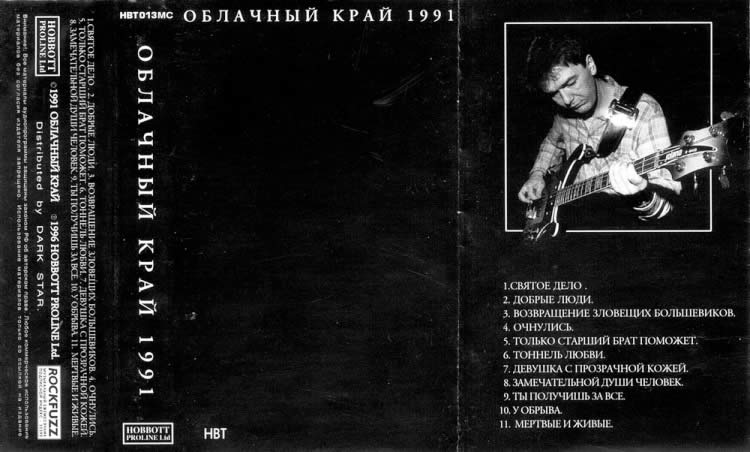
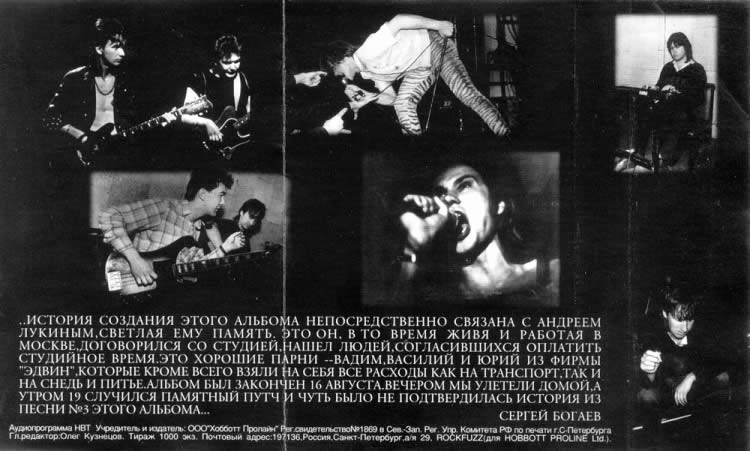
It was only in 1997 that the album OK "1991" was released on CD in Germany. This release was dedicated to Andrey Lukin.
Recorded by Alexey Vishnya
For Spetsialnoye Radio
January 2007
Related materials:
Original article: https://specialradio.ru/art/id256/