Every day, the city of Leningrad continued to surprise me with its unusual people and new unforgettable impressions. Huberman took me under his cultural wing and, after the recording sessions, made a point of taking me to various apartment gigs and semi-underground concerts, thereby curing my Pomor backwoods ignorance...
Day after day, the city of Leningrad continued to surprise me with unusual people and new, indelible impressions. Guberman had taken me under his cultural wing, and after recording sessions he tried to take me to various apartment gigs and semi-underground concerts, thereby curing my Pomor backwoodsmanship. Spending time like this in Leningrad was a commonplace occurrence, but living in Arkhangelsk, I had never even suspected that such things existed—an apartment concert. In general, Guberman and Vishnya simply introduced me to the phenomenon of "Russian rock," which until then I had not acknowledged, did not know, and had no desire to know. Tropillo schooled me more on the technical side, because listening to other people's music while sitting next to a multi-track AMPEX tape recorder was simply absurd—all those precious hours were spent solely on the greater good.
Only once did I allow myself a recreational outing: Zhenya Guberman took me to see a legendary, absolutely iconic figure—Kolya Vasin. When I saw all of that... but after a while, this house began to oppress me. Everything was strictly about the Beatles, revolving around the Beatles, and nothing but the Beatles... the hardest moment came when I realized that for the owner of the apartment, neither I, nor my music, nor any music at all—except for the Beatles and their singing wives—existed. And moreover, nothing else ever should or had the right to exist.
And despite the fact that I loved the Beatles, and the first music I ever heard was the Beatles, to Zhenya's question of "whether I'd like to see rare photo albums of the Beatles," I firmly answered: "no." Kolya Vasin's beard somehow jutted forward, and he hissed through his teeth at Zhenya: — "Looks like the kid isn't from our camp." "What are you doing, everyone dreams of getting into this house"—Zhenya felt awkward, but I suggested we immediately leave this place, where such an unfriendly atmosphere reigned.
Material of astonishing quality was taking shape: becoming clearer and more precise with each passing day. The question arose—who was going to lay down vocals over this beauty? Who would sing? Did Tropillo really have to find a vocalist for our album? What would come of that? Would it even be "Oblachny Krai" if a Leningrad vocalist were singing?
Pushing all these troubling thoughts aside, I kept thinking about Rautkin, who was currently in Kharkov; after all, no one but him could sing our parts, and I was so used to his vivid performance style that I couldn't imagine who could replace him. I was forced to scratch my head, and quite hard at that. Andrei did eventually make me a few staffing suggestions: they were generally decent vocalists, but they were clearly unsuited for our music. Ultimately, I came to the conclusion that only one person could help me—my old friend Vova Budnik from the Arkhangelsk band "Svyataya Luiza," who had already sung on our album "Selkhoz-rock." And although his voice was very different from Rautkin's, I really liked it; I liked his delivery—in terms of sheer energy, he wasn't inferior to Oleg in the slightest.
The situation needed to be saved. I could still somehow belt out a couple of songs, which is exactly what I did, but high notes were beyond my control. Tropillo supported my idea to go to Arkhangelsk for Budnik, and although I had doubts about whether we'd be able to bring him back—Vova was heavily using literally anything soluble at the time. I bought a ticket and headed to my hometown, with the firm intention of delivering a vocalist to the recording session in any condition.
I arrived in the morning, around 8:50, and went straight from the bus to Budnik's place, even though I knew the outcome of visiting him at such an hour was completely unpredictable. Usually, at this early hour, Vova was just starting to nod off... His mother opened the door and rather unfriendly suggested I try to bring him around myself. Stepping into his room, I immediately realized this wasn't going to be easy.
I pushed my way through mountains of empty bottles and the axe-proof stench of stale booze hanging in the air, and started shaking him by the shoulder, frantically yelling right into his ear. My friend's sleep wasn't just deep, it was *very* deep! I applied all my knowledge of civil defense on him—I just stopped short of giving him mouth-to-mouth, and he finally stirred, mumbled something, and stared at me unrecognizing. Finally, his heroic slumber began to slowly retreat:
- "What? You? What are you? Didn't you, like, move to Leningrad, what the hell..."
- "Yes, I did, I'm telling you, and I came here for you, Vova."
- "What's going on?" he stared at me uncomprehendingly, "where for me?"
- "Over there—remember, you promised me that if I ever needed a vocalist's help, you would help me out?"
- "Ah, yeah, I remember, sure, for real, so what do we gotta do?"
- "Nothing special, we just need to grab our stuff right now, get on a plane, and head to Leningrad, to the studio."
- "Ah, okay, I got it. When do we need to leave?"
- "Not *when*, but right now. There's still a flight today, we'll get on it and fly to the studio in Leningrad."
Budnik was famous for being always ready to go; he obediently handed me his passport so I could buy the tickets, only asking me to get him a "wee bottle" to nurse his health a bit. He warned me he had absolutely no money, and I reassured him, saying that since I was the one inviting him, the financial side was on me. I ran to the Aeroflot ticket office, bought the ticket, and the "wee bottle" for Budnik. Vova immediately downed it in one gulp and sniffed the sleeve of his battered sweater. Literally before my eyes, within a minute and a half, the man was transformed; his wild eyes lit up.
We went outside, got on the bus, and headed to the airport. Almost missing check-in, we successfully boarded the plane and—off we went! Vova slept the entire way, and upon arrival, I had to practically drag him on my shoulder to the parking lot and load him into a taxi. On the way, we had to make a stop—Vova asked me to buy him a bottle of beer... we had arrived. As previously arranged with Tropillo, I first went into the studio alone; Budnik waited around the corner. None of the staff were supposed to see him.
- "Did you bring him?" Andrey asked.
- "I did!" I replied.
- "Well, bring him in, let's see him." Troprillo and I stepped outside. Around the corner, Vova Budnik was shifting from foot to foot. Andrey gave him a careful look, pulled a hood over his long hair, and said he'd pass for a Young Pioneer. Chatting away, we walked past the female concierge and said hello; she gave us a very intent look. Vova was quite short, and only his bloated face betrayed the fact that he had long outgrown the Young Pioneer age.
To cut down on session time and avoid crossing the management's path more than necessary, Troprillo rescheduled all the other ongoing parallel recordings at the studio. He decided to work relentlessly, only occasionally stepping out of the studio to catch some fresh air and stretch his legs. We put Budnik in front of the microphone, played some blank tracks to warm up his vocal cords, and I headed to the grocery store for our daily sausage—and the "flesh and blood" that were just as essential to us. Without all that, any talk of productive work was simply out of the question.
Since my own trips past the concierge also had to be kept to a bare minimum, I bought exactly as much as I could carry in one go. Everything was ready for the recording, and within an hour or an hour and a half, Volodya announced he was fully warmed up and ready. There was no need to memorize the lyrics—it wasn't a live concert, after all—so I wrote out the first song, "Soyuz Kompozitorov" (The Union of Composers), for him in large block letters. This was how we decided to record the tracks: in the exact order they would appear on the album. Troprillo was pleasantly surprised that, despite his frail appearance, Budnik's voice kept growing stronger and stronger. Finally, a raw power emanated from him the likes of which Leningrad had never heard before.
For the sake of variety and simply to expand our sonic palette, we decided that we would perform some songs together as a duet: Vovka would sing a few lines, then I would sing a few, and we'd tackle the choruses together. We had never tried doing it this way before—it had always been either me or Rautkin singing. Vova's and my timbres complemented each other perfectly. He had this high voice, while mine was the opposite—low and raspy. Together, it sounded fantastic!
Anyway, after a few hours of work, any doubts I had about the wisdom of that morning's mad dash vanished. Even back on the plane, while Vovan slept soundly on my shoulder, I still wasn't entirely sure if I'd made the right decision. Now, however, I could see how much Vova was genuinely digging the chance to work in a proper studio—to record vocals onto a dedicated track and actually hear his own voice clearly. Besides, Budnik had never before had the opportunity to lay down vocals over music of this caliber.
Overall, the atmosphere in the studio was conducive to meticulous work, despite the dread circling like a black crow over our heads in the form of some random snitch who had wandered into the studio... The anxiety was compounded by the fact that in the studio's "waiting room" there was an armory under 24-hour armed guard. The alarm was so sensitive that the slightest leaning or propping of our bodies against that door risked the immediate arrival of a SWAT team, who would be very interested to know what unshaven, booze-reeking men were doing in an educational institution. Such an event wouldn't have threatened us at all, of course, but Tropillo would definitely have been fired, and our recording, as well as all the other bands' recordings, would have been scrapped or postponed indefinitely.
And so, without noticing, evening fell. Thoroughly exhausted from the tension, we had a good drink, and navigating through space became rather difficult. Tropillo brought out some rolled-up rags and instrument cases—we decided to just camp out here until morning. We woke up early, looked at ourselves, and decided to hit the bathhouse on Srednekhtinsky Avenue. An old St. Petersburg bathhouse made of dark brick.
Generally speaking, Okhta has a lot of relic sites: a bathhouse, a fire tower, a hemp factory, the Polyustrovo spring... We walked along Okhta, unshaven and reeking, each lost in his own thoughts. I was thinking about Tropillo and how he didn't just need a bathhouse, but a laundry, too. He had a habit (and still does): no matter what he ate—smoked capelin, juicy ham, or jellied meat served on butcher paper—he would invariably wipe his hands on his trousers, his jacket, or his own hair. Unshorn, greasy locks, a lopsided mustache of indeterminate shape, dressed in God knows what, and God knows what gleaming in the sun with greasy spots... Marginal and cynical on the inside, he had subordinated his entire life to completely different laws—outside of time, outside of social norms. The most important thing to him was always his work. Not with the Young Pioneers, of course—Andrey was engaged in capturing, or to say more, creating something that, perhaps, the world had never seen before him.
Overall, Leningrad completely blew me away. The difference from Arkhangelsk was obvious, and not just in the grocery stores... I couldn't imagine people in our town walking around in what they casually strolled around in here. That kind of stunt wouldn't fly with us.
I remember Vova Budnik and Andrey Bulychev—my late bassist—getting drunk, turning two army sheepskin coats inside out with the fur on the outside, and walking on foot toward the city center like that. They didn't get very far doing that. A police paddy wagon caught up to them, and they started shoving them inside without asking too many questions... but they resisted and yelled: "Farewell, we are from the New Freedom organization, farewell!" The whole city talked about it afterwards, and I even wrote a song about it, which Vova Budnik sang.
But here in Piter... I was staying at Vishnya's place, and such characters would come visit him—they wouldn't have made it a single block in Arkhangelsk. Take Pig, for instance, Andrey Panov, also deceased now; well, if he had decided to fly over to us, he would've been nabbed right off the airplane gangway. Ripped leather jeans, a toxic-colored raincoat jacket painted with acrylic, and a red leather tie. No, I simply couldn't fathom how something like this could happen in our country, let alone in the cradle of three revolutions.
…We were approaching the mixing stage. Although at the time I didn't yet fully understand what that meant. Theoretically, of course, I knew, but I lacked the practical experience. Tropillo's tension had reached its peak; I couldn't tell when he slept—he was on his feet constantly, day and night. But the moment Andrey sat down, even for a minute, he’d instantly fall asleep. There were four of us gathered for the mixing—the owner, Budnik, Huberman, and myself. Zhenya found the process extremely fascinating—it turned out he was playing this kind of music for the first time too; back then, he was playing in Aquarium.
The mixing took place at night, starting in the evening once all the administration and teachers had gone home. We sat on chairs lined up one behind the other so that everyone was in the stereo zone; from a distance, it looked like the seating arrangement of rowers in a kayak. The first track we mixed was the album's intro. It isn't listed separately, but is spliced onto the song "Composers' Union" with tape. By the second piece, Andrey's head was sinking closer and closer to the console—he was falling asleep on his feet. Budnik had settled into the most distant, secluded corner.
A little while later, Tropillo quickly showed me what absolutely shouldn't be done to avoid accidentally erasing anything, and asked if he could lie down for a bit. "I won't sleep, I'll hear everything, and if you do something wrong, I'll hear it immediately and tell you," Andrey reasoned, settling in right next to Budnik and seemingly falling asleep before his head even touched the support. Occasionally he would start mumbling in his sleep; we'd ask him if we were doing everything right, he'd mumble that we were, and fall back asleep.
Ultimately, today I would have scrapped the vast majority of what we mixed back then. But we seemed to like it fine. Budnik woke up around eight o'clock—said everything was great, fantastic. Tropillo hadn't really grasped it either. "Do you like it?" he asked me. But I didn't know... I was so exhausted that my senses had dulled, and I couldn't make heads or tails of anything anymore...
I have this trait—if I haven't fallen asleep by four or five in the morning, I get a "second wind" by dawn, and there's no forcing myself into bed after that—the sleepiness passes, and I'll briskly make it through the next day. We felt the urge to somehow celebrate finishing the work. But it was 1984—the stores didn't open until 11. We had three hours to kill, and during that time we made a cassette copy for everyone on 19, and I made one extra for Vishnya.
I must say that Alexei and I grew very close spiritually; back in Arkhangelsk, I never had a friend like him, and I still don't. He understood everything half-word. We tried recording some things together too, and the amazing thing is... Vishnya remains to this day the only person in my life for whom I am willing to forgive musical dissent. Under his spell, even I, a strict devotee of heavy rock, could play absolutely poppy riffs without feeling sick to my stomach—in fact, it was actually kind of fun, in places. It was probably our sense of humor that united us, and for this quality, which Vishnya had perfected, I was ready to forgive him even for having a complete collection of Boney M records on his shelf. I never experienced that kind of mutual understanding with anyone else like I did with him. Although we were completely different people... though today I already realize what united us—we both, essentially, spent our whole lives doing the exact same thing: turning shit into candy. We always worked on God-knows-what, yet unfailingly put out a product. Just like back then, and still today...
I sent Budnik to the airport in a taxi, then headed over to Vishnya's, bringing him the first copy and lamenting that such an adventure had passed my friends and comrades by. Undoubtedly, the album would have turned out better if Rautkin and Lyskovsky had been there; just having them present during the recording and mixing would have made things much easier for me. By the way, later on, when they all heard it, they strictly ordered me to take them along for the next recording...
I didn't have a ticket. I handed the tape to Alexei; there was no time to listen to it together either, so I grabbed the instruments and rushed to the airport, hoping to pick up a reserved booking. But it was the end of August, and there were about thirty people standing in line at the ticket counters, all with children. So I ended up lingering at the counters for about a day with those guitars, which I thoroughly cursed by then. It was impossible to step away from the counters during all that time—I had to "catch" the moment they announced stand-by seating and tossed out two or three tickets for a flight. Those twenty-four hours became a real trial for me... The tapes for my friends burned in my mind—I couldn't wait to show them off, tell them everything, and give them a good ribbing: "You're idiots, absolute idiots! You missed out on such an adventure..."
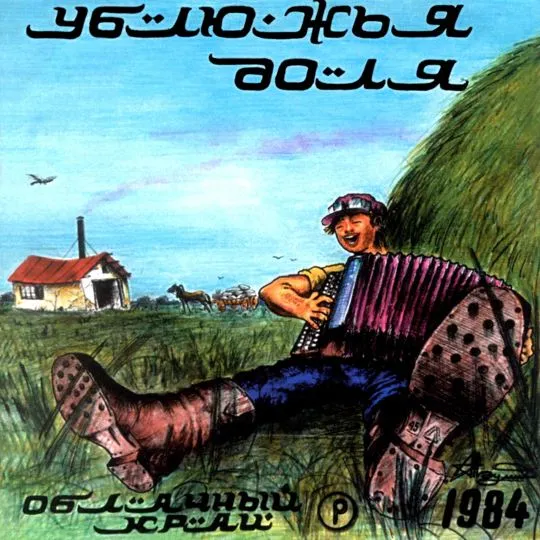
My friend Alexei Bulygin from the band "Autodafé" listened to the album and drew the magnificent artwork in which the OK vinyl record "Ubluzhya Dolya" ("A Dog's Life") was released by the "Melodiya" label a few years later. But at that moment, I already realized that the recording method we had mastered in Arkhangelsk was hopelessly outdated. I had mixed feelings—on one hand, a wild delight at reaching a new qualitative level, and on the other hand, I realized that I had become a hostage to it—because working the old-fashioned way back at home was simply no longer interesting.Recorded from the author's words by Alexei Vishnya.
Source: Memoirs of Sergei Bogayev, specially for Spetsialnoye Radio