The year 1989 arrived. By that time, our ranks had been joined by a new drummer, Yura Korablev, from the band "Autodafe," following bassist Andrei Lukin, who had switched over to us shortly before the events described. All this time we were knocking around various towns and cities, playing our set, which had already become rather tiresome, and I felt: we were burnt out, exhausted… I wanted some new adventures.
The year 1989 arrived. By that time, our ranks had been joined by a new drummer, Yura Korablev, from the band "Autodafe," following bassist Andrei Lukin, who had switched over to us shortly before the events described. All this time we were knocking around various towns and cities, playing our set, which had already become rather tiresome, and I felt: we were burnt out, exhausted… I wanted some new adventures.
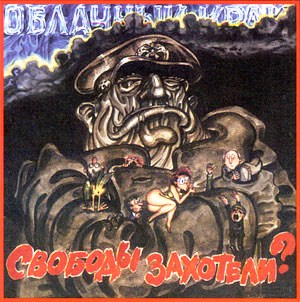
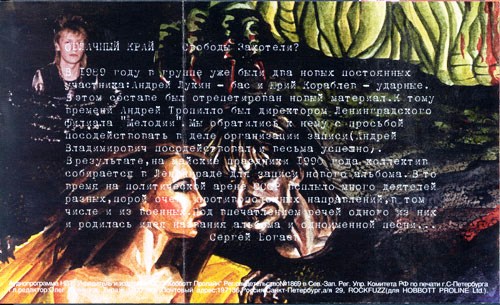
Four years had passed since the recording of the last album. Naturally, a fair amount of new material had accumulated, enough to embark on a new recording. Besides, what I now realize was the best lineup of "Oblachny Krai" had practically solidified—the strongest and most complete, a five-piece. In this lineup, we slowly began rehearsing the new material in Arkhangelsk. We didn't have our own spot or a studio in Arkhangelsk, so we worked wherever we could.
It would be wrong to say that "we came up with an album and went to record it"—the bulk of the arrangement work was always done in the studio, directly during the recording process. However, the new material was already taking shape; it had rounded out and with each passing day became more concrete, practically begging to be put on magnetic tape. I called Leningrad and reported to Andrei Tropillo that we had new songs.
"Well, it's about time," was all he said. "Come quickly!"
Tropillo was mastering a new space on Bolshoy Prospekt on the Petrogradskaya Side, belonging to the Institute of Psychoanalysis—yes, there is such a place in Piter. I don't know by what hook or by what crook Andrei managed it, but he got 150 square meters right under the attic on the fourth floor—which was more than enough for a studio. It wasn't fully equipped at the time, but Andrei suggested we test it out, and we hit the road without hesitation.
The four of us arrived, without Rautkin—the plan was to call him over from Ukraine specifically to record the vocals, closer to the actual session. The studio turned out to be completely unready for work: a single stereo tape recorder was connected to the console, while the multitrack AMPEX—the heart of the studio for the next ten years—stood alone in the corner, wrapped in transport plastic. We tried to record something, played the material—completely raw sketches—and went home to think further...
By that time, Andrei had become the director of the Leningrad branch of the "Melodiya" record label. He was unanimously elected to this position by the creative team of the legendary corporation, with the goal of leading the "empire" out of pitch-black economic asthma into a bright, democratic future. After all, no one was buying Kobzon or Magomaev anymore, and Andrei decided to release all the legendary records of legendary bands with absolutely new cover art: The Beatles, Led Zeppelin, Deep Purple... we got a piece of the action too! But let's take it in order. The studio on Petrogradskaya was absolutely not ready, but that was for the best.
Melodiya's main studio, equipped with the newest technology available at the time, occupied the building of a Lutheran church. An analog complex with two 2-track and one 24-track "Studer" tape recorders, a 48-channel console, combined with the huge church hall—all of this awaited us, its LEDs blinking.
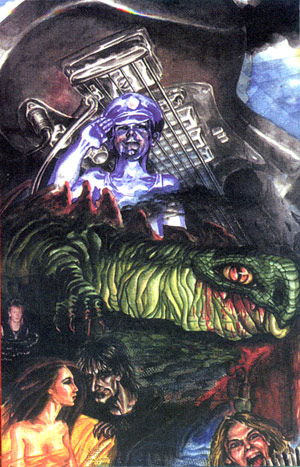
Not to mention having to watch the owner agonizing over it, pleading: "Please be careful, you know how much it costs... and when you're stomping on the effects pedals, watch out, don't break anything..." But how can you play guitar carefully? Well, you can if you're playing flamenco on nylon strings, or maybe reggae, but not rock, and certainly not heavy rock. It's a mockery of work, not the real thing. So I brought my "Ural" and my personally soldered guitar effects pedal... this was gear I could bend and mash as much as I wanted—it could take a beating...
Andrei Lukin owned a Czech "IRIS-Bass" guitar at the time—a decent Fender knock-off—so we were ready to start. The studio had a drum kit, and everything seemed fine, except the bass drum was far too pop-sounding. Igor Dotsenko came to the rescue—he and "DDT" had just returned from Germany and were resting. We called him, and Korablev and I went to see him, drunk. We had already gotten hammered on the flight: we were flying, stashing our bottles under the seats. As long as the plane flew smoothly, no one noticed. There were four of us, the flight was an hour and twenty minutes, and we downed about six bottles. When the plane banked, maneuvering between the clouds and approaching from the leeward side, all our bottles rolled straight forward. Everyone had to step over them as they exited the plane. We were in that much of a state the whole time, and we arrived at Dotsenko's with a wicked hangover, looking completely wrecked.
"Ye-e-ah," was all Igor said as he opened the door for us. "Well, alright, I'll help you out right now."
"No, no," we panicked, "we can't, we have a recording session right now." "It's not what you think, you tramps! Now I will show you a miracle! Damn capitalists—can you believe they invented such a thing," Igor said as he pulled out two packets of the foreign wonder-drug "Alka-Seltzer," which we had never seen before. He takes two glasses, pours some water... plink—and two tablets started dancing on the surface, saluting us with large carbonated bubbles. We stare at this like Chukchi—we had never seen effervescent tablets before, knocked them back blindly out of fear, and waited for them to work... though how could aspirin with citric acid help people like us, in the condition we were in? We grabbed the bass drum, and trudged off to the Church of St. Catherine. Yura set up the kit, Lukich tuned the bass...
Yuri Morozov, now deceased, recorded us. He was loyal to us because he had been friends with Andrei Tropillo for many years. He gazed peacefully at the battery of alcoholic beverages we had brought with us—well, what could you do with us... and we had money: Tropillo, in addition to the hotel, had wrangled us a daily per diem—which we were given every day. We spent it on wine and brought it with us to the session. We'd record a track—wash it down. Another layer—wash it down again. And a recording shift isn't that long—only four hours. We recorded the entire rhythm section pretty quickly, and Korablev successfully punched in all the most difficult parts.
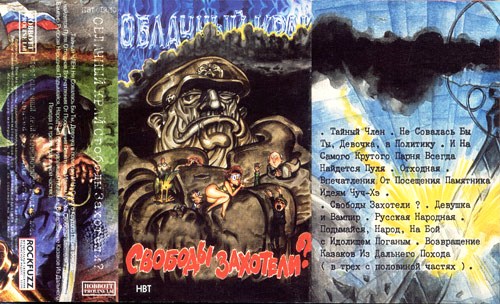
The title track, "Wanted Freedom," was sort of from the perspective of General Makashov—he was a highly controversial figure in those years. Compared to the other songs, it looked as simple as cheap underwear. I thought we'd leave this song for last and knock it out in one take, but no such luck. Korablev, who played the most complex drum patterns flawlessly, stumbled on what seemed to be the simplest, most elementary part. There are people who give great performances at concerts or in casual settings, but put them in front of a camera or have them hear "Action!"—and they freeze. That's what happened with Yura: he'd get halfway through and stop. We record again—another stop at the exact same spot. We start scolding him over the talkback—like, come on, Yura, what's wrong with you?.. You can't raise your voice at a musician during a recording—it knocks them out of their creative groove for a long time; the slightest shout during work can completely ruin any takes. You always have to explain their mistake as calmly as possible, very, very quietly... but we'd get to that cursed spot, and after the downbeat, he just couldn't pick it up and would stop. Eventually, I started swearing at him over the talkback, and then he started stumbling earlier and earlier, with no end in sight... it was surreal.
"That's it, come up here," I barked, and just then Tropillo walked into the control room with a large briefcase in hand. He sees something is wrong. He asks what the matter is. And then we all start yelling simultaneously, interrupting each other. We play the part for him, and he makes a hand gesture—like—"quiet in the studio." He opened the briefcase and pulled out a large bottle of expensive vodka. He took a glass and filled it, looked at us sternly, and slowly declared:
"Only for the drummer!" and our entire band, swallowing hard, watched as his state changed. We sat in silence for a couple of minutes, and Andrei suggested Korablev give it another try. Needless to say—he drummed the track flawlessly, with a nice little swing—just magnificent. That's what a life-giving glass at the right time can do.
After recording the drums, we went to return the bass drum to Dotsenko. He asked about the Alka-Seltzer; we said, "Yes, of course, thank you," and he goes, "Well, see, I told you so..." Although, we probably wouldn't have made it to the studio with that bass drum without buying a couple of beers on the way. We needed keyboards, and Igor introduced us to Murzik—Andrei Muratov—he played keys in DDT and now lives as an emigrant in Germany. He lent us his keyboards—a Yamaha DX21. We recorded some parts, but they didn't have the sounds we were hearing in our heads, so I went to see Alexei Vishnya on Gagarin Avenue—maybe he could advise us. Right from the doorway, I was struck by the gentle sounds of choirs, exactly what we needed for one song; Lyokha switched the sound, and his room filled with other, previously unheard sonic beauties that would sit perfectly in another one of our compositions. It was a KORG M1. Returning to the hotel, I told Lysik that all the keyboards we'd recorded could be safely erased—they didn't hold a candle to what I had just heard at Vishnya's place. But if only it were his instrument—he had only been given it for a very short time at Boyarsky's Theater, and it was completely out of our reach.
We recorded all the parts on Muratov's keyboards, and together with everything else, they sounded quite decent, even very good—after all, we had no keyboards at all, and everyone was basically satisfied. But I couldn't shake the thought that it could all sound even better, and I knew it for a fact. And then fortune smiled upon us! Vishnya asked his creditors to push back the return date of the instrument by a week; he was leaving on tour to Lugansk for two days and could leave the coveted Korg with us. At the agreed time, we went to meet him, feeling anxious, and then... a miracle! A taxi pulls up, and out steps... no, he floats out, as if in slow motion, the huge Vishnya in a luxurious burgundy coat and a wide black baker boy cap. He looked so tall—like he was a head taller than me—carrying the enormous Korg box in front of him, holding it like a baby. And there we were, like tapeworms—hungry, unwashed, and drunk. He hoisted the instrument onto his massive shoulder, pointed a finger at us, and laughed loudly—and we didn't keep him waiting: we stood there in the church courtyard for about two minutes, writhing in hysterics.
We went up to the control room; Lyokha set everything up, plugged it in, and explained it all to Lyskovsky. Kolya caught on very quickly, and soon he was confidently poking his fingers at the sacred device. "You don't need me anymore, and I can safely start heading back?" At this, Yura Morozov turned in his chair and looked closely at Alexei. "Lyokha," Lukich asked him, "where do you get such weed, how much does it cost, do you have any on you, and if so, could you find a way to..." Lyokha understood everything, and they both retreated to the restroom one floor down. They sat there for a long time; we even managed to completely lay down an entire track in two takes. A call came to the control room from the director's office—it was Kobrina calling: "Yura, is anything burning in there? Do you smell smoke? Like, curtains or a mop burning." Yura instantly understood, asked me to go downstairs after them. I knocked on the restroom door; they came out, followed by a thick cloud of intoxicating gray smoke. The director's office was located right next to the restroom. Yura was an extremely tactful man. He respected the rights and freedoms of the musicians recording in the studio: he allowed us to drink alcohol and had nothing against such mischief, as long as it didn't pose any real danger—out of ignorance, the church staff could have easily called the fire department.
As an alternative, Yura let them into a tiny room adjacent to the control room with a sign that said "Control Room-2," which essentially served as a soldering workshop. That's where they sat the entire session, despite being strangers until then—they had already found many common interests while we recorded the Korg. Suddenly, the door to the control room creaked—it opened inward—releasing a thick stream of gray fog first, followed by two humanoids slowly floating toward us. We tried to say something to them, ask them something, offer something, but you could see our words passing right through them without affecting them at all. Yura hastily opened all the ventilation grates, aired the room out thoroughly behind them, and looking at the door of the closet, he said: "That sign should be changed. What kind of control room is this? This is now the 'marijuana room.'"
Kolya was overcome with such an emotional uplift on those sounds; he recorded everything very quickly, literally in two days. I remember when we were working on one of the songs, a veteran of domestic sound recording, Viktor Dinov, appeared in the control room. We were recording a ballad about the Russian people's struggle against the accursed idol. Dinov suggested we change literally one note, and it was so spot-on that the piece became completely convincing and took on a finished form—just one single note, and a true professional immediately noticed the missing detail.
Then it was my turn to bear the heightened responsibility. I always record rhythm parts with a clear head: you have to cleanly nail the riff, so any mind-altering substances are strictly unacceptable. But solos are a different story! That requires a complete release of emotion—I allowed myself... well, there's no need to beat around the bush—next to the amp stood a glass, and next to it, a bottle of port wine.
Recording in a church is a special case. The acoustics are such that you say a word, and fifty come back to you. I would crank the amp to full volume—it put me in the right state of mind. Once, I felt someone tap me on the shoulder. I turn around, and there stands this little, gray-bearded old man, looking like a wood sprite, saying reproachfully: "Young man, excuse me, but what exactly are you doing right now?" "What do you mean, what? I am currently recording a guitar solo, and you are..." "You know, the way you are doing this is very unprofessional. Playing at such volume—have you lost your mind? This is a church, a Temple, people pray here, young man. It has the acoustics of an 18th-century white-stone cathedral; choirs sing here, frescoes... it all gets picked up. You are working unprofessionally—no one records guitar like that; this isn't a concert..." "Listen," I started to get nervous, though still maintaining my composure, "the music we play requires a specific sonic aesthetic, which necessitates a certain sound pressure to provide acoustic feedback with the electric guitar's pickup, so it feeds back, you know, so it sings and wails. If I turn it down, I'll hit the notes, but they'll sound completely different." "Young man, why are you spinning such tall tales? Back when you were learning to write your letters, I was already recording Kobzon. What are you teaching me? I say it can't be done this way, nobody does it—what is there to argue about? You have wine sitting on the edge of the cabinet—you're going to bump it with your shoulder now, and it'll shatter right onto the parquet floor..."
I won't lie, he made me seriously angry. Morozov is already shouting over the talkback: "Seryoga, well, are you going to record or what?" He plays the backing track, but this guy won't leave—just keeps staring at me, staring at the amp, saying something, gesturing, and I've got headphones on... So I say to him with a very clear expression that he should go his own way before I put down my guitar and help him leave. "What? How dare you, I recorded the finest examples of the Soviet pop stage..." "All the more reason you shouldn't be bringing your pop music into this neck of the woods!" "Neck of the woods? Well, what a pigsty Tropillo is running here; I'm going to tell him right now, the nerve..."
As it turned out, he was some hardcore old-timer from the Capella—there was another Melodiya studio located there. He threw a veteran-level tantrum for Tropillo; naturally, Andrei calmed him down, apologized on my behalf, and smoothed things over.
Recorded by Alexei Vishnya
For Special Radio
July 2006
Related materials:
Original article: https://specialradio.ru/art/id236/