By the beginning of 1987, the Arkhangelsk Rock Club had firmly established its existence. Songs approved by the literary director could now be performed at concerts that periodically took place at various poorly equipped venues across the city. The club's management, in collaboration with the city authorities, decided to organize a rock festival. The venue was chosen: our stronghold, the Krasnaya Kuznitsa Palace of Culture, whose management had recently taken a clear liking to us. The plan was to hold a full-fledged rock festival featuring as many local bands as possible, and to invite a well-known out-of-town band as guests of honor—a common practice in other, larger cities. The festival was scheduled for March 1987, and we were essentially chosen to headline the event.
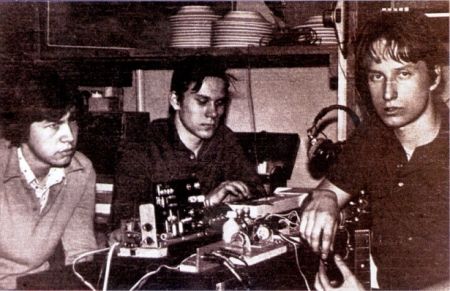
By the beginning of 1987, the Arkhangelsk Rock Club had firmly established its presence. Songs approved by the literary director could now be performed at concerts, which were held periodically in various locations across the city on poorly equipped stages. The club's management, together with the city authorities, decided to organize a rock festival. The venue was chosen: our stronghold, the DK Krasnaya Kuznitsa (Red Smithy) Cultural Center, whose management had recently taken a clear liking to us. The plan was to hold a full-fledged rock festival featuring as many local bands as possible, as well as to invite a well-known out-of-town band as guests of honor—a common practice in other, larger cities. The festival was scheduled for March 1987, and we were essentially chosen to headline the event.
At the time, we were the most famous rock band outside of Arkhangelsk, because within the city itself, posters only ever advertised officially sanctioned bands, while our cassette tapes circulated among the people, spreading outward like ripples on water. There were already quite a few bands by then. Collectives like Svyataya Luiza, Autodafe, Stsena, Zapasnoy Vyhod, and Vremya Iks had gained serious clout. Among the younger acts was the band Termometr—in short, there was plenty to show the audience. And the audience itself had changed, too.
A few days before the festival, while looking through my record collection of favorite Western bands at home, I noticed that the drum kit was always positioned at the musicians' ear level, just a little bit higher. After all, drummers can't be seen if they are stuck down below, and the musicians can't hear as well. But if the drums are slightly elevated, the overall look of the stage is much more convincing.
I went to Dubinin and told him the idea. We reached out to some sympathetic guys from our home factory, Krasnaya Kuznitsa—a name alone that suggested there was plenty of metal and blacksmiths around. After working hours, they welded a structure that could be assembled in half an hour into a small platform measuring 4 by 6 by 0.7 meters. They covered it with a particleboard sheet and placed the drum kit on top. Everyone immediately realized that this was exactly what we had been missing. The stage design was already finished, and this detail significantly improved the visuals. Later on, this collapsible platform served the Arkhangelsk rock scene faithfully for years, and it is clearly visible in all the rock photographs from that era.
Our vocalist Oleg Rautkin had already graduated from the Kharkov Institute by that time and, to the absolute astonishment of the university administration, requested a job assignment to the North, in Arkhangelsk. We prepared for this event especially thoroughly; essentially, it was the band's first real live performance, since we were a "studio band." The guitar parts were originally written with multiple guitars in mind, but here I had to play everything myself. As for that previous performance at the Soviet song competition I wrote about earlier—it doesn't even count. The audience and the vibe were completely different there, and we didn't play our own songs, but rather ones set to the poems of Soviet poets. Essentially, it was the debut of a band that had already released seven cassette albums. We absolutely couldn't screw up in front of a packed house of rockers—we were considered the most famous band in Arkhangelsk.
We built the setlist around our two latest albums—*Ublyudya Dolya* and *Stremya i Lyudi*. Out of the older songs, we only played "Russkaya Narodnaya" from the '83 album; we never performed any other songs from OK's old "pre-Tropillin" period at our concerts. "Soyuz Kompozitorov", "Moy Afganistan", "Napadenie Monstra na Dvupaly Individuum", "Russkaya Narodnaya", and "Grustnaya Istoriya", which Rautkin performed brilliantly at rehearsals and didn't disappoint during the live show. We decided to close with the monumental track "Mat Poryadka", but we played it twice as fast and a bit shorter. It was a knockout set for those times. On drums was Dima Leontyev, vocalist of the band "Autodafe"; on bass was our good friend Andrei Ilichev from the band "Svataya Luiza". He was a kindred spirit—I always loved his playing. There were no doubts whatsoever, and so we rehearsed all day long.
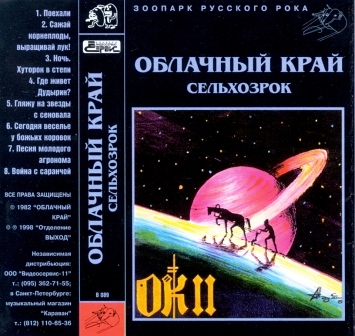
All the announced bands were preparing intensely for the festival. I'd like to note that to this day, the rock bands that played there remain the best in the city. "Autodafe" was generally our sister band: their vocalist Dima played drums for us, while their songwriter and guitarist Alexei Bulygin drew the artwork for three of our albums—remember that drawing for OK-II *Selkhozrok*, where a plowman works a wooden plow against the backdrop of a giant Saturn. Later he drew the covers for *Ublyudya Dolya* and *Stremya i Lyudi*. Undoubtedly, Autodafe's music was closest to our own. Andrei Karelsky played second guitar for them. Later on, with his help, we arranged the classical instrumentation on the albums *Lyubov k Zhizni* and *Patriot*.
Back then, all the Arkhangelsk rock warriors were very tight. Of course, everyone rooted for their own band first and foremost, but no one ever refused to help others—and for free, naturally, without any money or payment—the thought never even crossed anyone's mind. Everything was done from the heart back then, fueled by a great, and seemingly eternal and indestructible, love for Rock 'n' Roll.
Many musicians from that first wave of rock in Pomorye became like family to our band through their participation in recording our albums. The group "Stsena", even though they played a completely different style of music, were wonderful. Their music was very interesting, even by today's standards. It's a pity that this band is no longer active. Their saxophone player was Kostya Lapshin, who beautifully played the sax and flute on our album "The Peak of Idiocy". Based on the tracks he played on, one could tell what a true specialist he was. I say "was" because he hasn't been Kostya Lapshin for a long time now—he is Father Methodius, having become an ordained priest.
"X-Time" was one such interesting group, as were "Knockout" and "Ravelin", and "Saint Louisa"—a band where Budnik sang, who also sang with us a couple of times. There was also a band called "Hot Air Balloon", if I'm not mistaken. The vocalist there was Dmitry Kulikovsky, who later recorded the saxophone for the song "Stupid" from the album "Patriot". Among the younger bands back then, I really liked the group "Thermometer", led by Oleg Sigov, nicknamed Guslya. Kinchev also took special note of this kid: "He has so much potential; if he keeps going in the same vein, he will definitely make a name for himself." It's a shame that Oleg didn't continue down that path.
The president of the Arkhangelsk Rock Club at the time was Rostislav Dubinin. He wasn't a musician, but among the local creatives he was well-known for his calm demeanor and excellent communication skills. He possessed rare diplomatic qualities that could bring the most heated disputes with the most thick-skinned officials to a consensus, all while maintaining his composure and invariably steering negotiations to an optimal outcome. Having secured the support of the district Komsomol authorities, we managed to acquire the best equipment available at the time.
Today, no one would even bother rehearsing on that kind of equipment, let alone playing a gig. But back then, an abundance of "Rodina" amplifiers and two or three Czechoslovak "BIG" amps solved all our pressing needs. Considering the city's genuine enthusiasm for the event, it's understandable that for any band back then, it was enough to simply step onto the stage and make a single sound for the hall to erupt in cheers and screams that far exceeded the volume of our own amplifiers.
The question arose: who could we invite as honorary out-of-town guests? We needed a band that wouldn't demand an astronomical fee but was still well-known. Most importantly, they had to stand out from all our local acts and serve as a contrast to them—the Komsomol-youth event was supposed to carry an educational vector. The festival's organizing committee turned to me with this, and I suggested inviting "Alisa" with Kinchev. I justified this by pointing out that their album was the most popular among us at the time, everyone was raving about it, and, in general, it met all the criteria optimally. Besides, I had seen their show myself and could guarantee that there was nothing like it in Arkhangelsk, Severodvinsk, Murmansk, or anywhere else. Our locals would definitely have something to learn from them... and it would serve as a massive, epic culmination to the entire event, one that everyone would remember forever. I convinced them. The Komsomol supervisors allocated a whopping three hundred rubles to Dubinin to cover the flights, transfers, and meals for the invited band.
The adventures with the band "Alisa" began right in the air. Mid-flight, Kostya Kinchev got the urge to smoke. I think there's no need to explain what preceded this natural desire. They had downed a shot or two, presumably more than one: to a successful takeoff, to a smooth flight, and to not crashing... Kostya could have quietly sneaked off to the lavatory—there were two, or maybe even four of them... but no... the cigarette was lit right there in his seat. The surrounding passengers were outraged; they called the flight attendants, and then someone from the crew to restore order. However, Konstantin sent them all to every conceivable part of the human anatomy. Without hesitation, the crew radioed ground control for a police squad to meet the plane with paddy wagons. The airport in Arkhangelsk, much like Boryspil in Kyiv, is located outside the city in a place called Talagi. Our psychiatric hospital was also located there: if someone asked, "Where did they take him? To Talagi!"—everyone knew exactly where they meant.
The ship's crew reported that there were hooligans on board who were completely unresponsive to anything. When the plane taxied to the stand and the stairs were brought up, Kinchev stepped out of the aircraft, and right then and there, he was grabbed by the arms and shoved into the back of a truck...
That was how the band Alisa remembered their first step onto Pomor soil. It seemed like the end of our festival. But Rostislav Dubinin wasn't meeting our guests alone; he was accompanied by employees of the factory's Komsomol committee. As delicately and tactfully as possible, they began to soothe the law enforcement agencies: "You see, these are our guests after all; they live such stressful lives—tours, concerts, travel... the guys just relaxed, they were tired, lost control of themselves a bit. Let's forgive them, surely? So many people are waiting for their performance... they won't do it again..." Dubinin's words, underscored by the presence of official higher-ups, had their effect: the police met them halfway and released Konstantin into our custody.
I didn't get to meet Alisa – I was busy dealing with a technical issue at the venue. I wasn't part of any organizing committees, but all the technical equipment was entirely my responsibility, as I was considered the top technical specialist. For the last three days before the festival, I practically lived at the club. That evening, I was preparing sleeping spots for the guests from Leningrad. They arrived at midnight, and Kinchev immediately jumped into the workflow. He was particularly concerned about the sound and asked me who would be running the soundboard. I replied that if he wanted, I would do it, since he wouldn't find anyone better anyway. He expressed his wish:
– "Sergey, you know what, even if the gear is so-so, and even if you don't know all the intricacies and nuances of our arrangements, the main thing is that the kick drum, the snare, and the vocals are heard. That's the most important thing."
We immediately held a rehearsal to set up the sound. I still added the keys, guitar, and bass to the mix, because drums without bass are one thing, but with bass, it's a completely different story. Kostya simply couldn't believe that our flimsy setup could handle the bass. The keys and the trumpet were audible too. I remember the trumpeter, Andrey Vasiliev, as the most eccentric character in Alisa – absolutely reckless, unhinged, and totally detached, a quiet guy... but his parts fit the Alisa songs perfectly. When the Alisa musicians realized they would be staying exactly here, some grumbled in displeasure. In particular, the bassist and arranger of the songs, Pyotr Samoylov, was so exhausted from the flight that he looked incredibly tired. He simply stood up and said firmly:
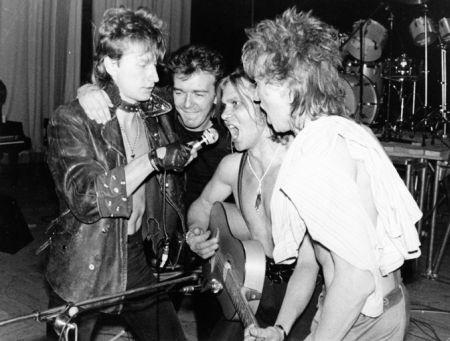
– "I need some rest. Proper rest, where I can wash up and stretch out in a real bed"... and then Andrey Lukin chimed in:
– "No problem, I'll call my mom right now to give her a heads-up, and whoever wants to can come over to my place." His mom was wonderful; she understood everything and was always supportive. He called, his mom gave the green light, and Pyotr, along with Vasiliev, headed over to Lukin's place. The next day we meet Petya: looking fresh and clean-shaven, he sits down and tells us:
– "Imagine this: I wake up... and there's a saucer on the little chair in front of me, a glass on the saucer, and kefir in the glass! I reach out my hand – it's cold!! Can you imagine?" Andrey's mom, seeing the condition of her guest, had thoughtfully left him this morning surprise. The happy, fresh-smelling Pyotr was deeply touched by this small but meaningful gesture. Meanwhile, we spent the entire night in the hall. The last of the equipment was delivered well past midnight, and everyone wanted a chance to try themselves out on stage.
As the festival opening approached, the atmosphere inside the Palace of Culture of the Red Kuzya Ship Repair Plant, awarded the Order of the Red Banner of Labour, turned not just into a bustling camp... the setting resembled a halt of Mamai's Horde. All the participants, naturally, arrived early and settled into the hall along with their friends invited to the concert. There were many bands, and they had plenty of friends too... and they were all hanging out backstage, in the dressing rooms. Space was already running out there – people started occupying the areas adjacent to the backstage. The administration tried its best to hold back this pilgrimage, not yet of spectators, but of their own people.
Everyone behaved quite properly and didn't get on anyone's nerves. The tension was building, and the Palace of Culture became like a buzzing beehive. Even the walls seemed to be stirring – it was like a volcano ready to erupt. And outside... there wasn't even room to swing a cat. Everyone was pestering me – because I was involved everywhere: here, there, and everywhere, I had to answer someone's question, turn something on, check whether something worked or not, take pictures somewhere – a photo exhibition, similar to the ones at Leningrad festivals, had been set up in the foyer. The stands displayed photographs of the bands involved in the Arkhangelsk rock movement. I noticed that our stand drew an especially large crowd – everyone had heard the recordings, but no one had ever seen us live.
Transcribed by Alexey Vishnya
For Spetsialnoe Radio
March 2006
Related materials:
Original article: https://specialradio.ru/art/id222/