In 1993, Olga Pershina began appearing at the studio more and more frequently. She was a legendary lady from the very heart of Leningrad's rock-n-roll scene, which by that time had once again become St. Petersburg, as in the times of Peter the Great. Pershina, a British subject, had managed to retain her Russian citizenship. In the late 1980s, exhausted by Soviet reality, she emigrated by marrying an Englishman named Perry. Accordingly, she transformed into Olga Perry. Being a friend from Andrei Tropillo's turbulent youth, she decided to commit her creative work to tape, with the subsequent goal of releasing it in Russia.
In 1993, Olga Pershina began appearing at the studio more and more frequently. She was a legendary lady from the very heart of Leningrad's rock-n-roll scene, which by that time had once again become St. Petersburg, as in the times of Peter the Great. Pershina, a British subject, had managed to retain her Russian citizenship. In the late 1980s, exhausted by Soviet reality, she emigrated by marrying an Englishman named Perry. Accordingly, she transformed into Olga Perry. Being a friend from Andrei Tropillo's turbulent youth, she decided to commit her creative work to tape, with the subsequent goal of releasing it in Russia.
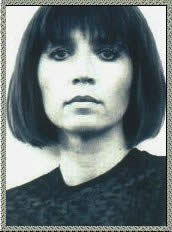
I knew her from the Aquarium album “Triangle” (Crookedness is my motto), and from the series of BG's songs in the “Bagel-album”, which included all the songs about Innokenty, Poltoraki, and the young maiden. In London, Pershina had luxurious accommodation: her neighbor played bass guitar in the band Pink Floyd – the very one who came to replace Roger Waters. Olga wanted to record an album in London, but who would let her do it for free in London... no one would. But back in her homeland, she had Tropillo. And I have no idea how Olga motivated Andrei, but she ended up in my hands...
Let me tell you a little about the staffing situation at the ANTROP studio in those days. The main sound engineer, already quite experienced, was Stas Vedenin. Andrei's nephew – his student and successor, Yasin Tropillo – also worked at the studio, but in those days he was mostly devoted to live performances. He constantly worked with bands like “Nol”, “Kolibri”, and “Dva Samolyota”. He no longer had enough time for studio work. Andrei hired two more sound engineers who were just starting out in the field: Viktor Ilyin and Sergei Smorodinsky. Thus, three people worked there, not counting me, because I was mostly busy with my own work. The main burden of recording Pershina fell on them.
Life in London had greatly influenced Mrs. Perry's character: she brought with her a vast wealth of knowledge about what a real studio should be like and what qualities the sound engineers working there had to possess. Olga was terribly capricious; she didn't like absolutely anything: whatever the sound engineer did constantly caused her irritation, and with every passing hour she made more and more complaints, with no end in sight. What can you do: high European culture demands high European standards, damn it...
Vedenin was heavily loaded – he was running several projects at once, so the main workload fell on Smorodinsky. This happened right before our eyes, because Pershina's recording sessions started while we were still recording with Novaya Zemlya. To be honest: we sincerely felt sorry for this noble man. We'd be sitting there sometimes, drinking tea with the guys. Out of the control room walked pale Seryoga, sitting down with us, holding his head in his hands. He never used swear words, but here – he was breaking. Looking at him, everything was clear. He would barely light a cigarette with his thin, trembling fingers when, from far down the corridor, through the doorway of the control room, a call would be heard: “Seryozha! Seryozha! I'm ready.”
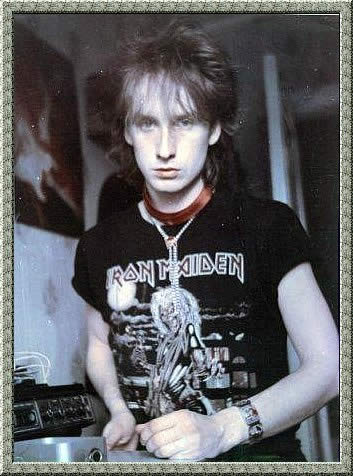
You didn't need to be particularly observant to understand: they were treading water. For days on end, a single song played endlessly in the studio. Something had to change – people were working, after all... but nothing changed in this flow. Time passed, resources were depleted without visible progress. Studio time was free for Olga, so she used it highly inefficiently. Kostya Strelkov from “Novaya Zemlya” nicknamed her “Pershing”. I remind you that in those days, the evil American imperialists intended to place “Pershing” intermediate-range missiles in Europe, which posed a specific threat to Russia. That was the kind of atmosphere Pershina created in the studio.
Olga arrived at exactly 10 o'clock in the morning, and the sound engineers were late – even if by a minute, or five to ten minutes. This circumstance poisoned her entire existence, completely scattering all her muses. As soon as a tardy engineer appeared in the studio, Pershing would descend upon him. Therefore, everyone tried by any means necessary to shift the work with her onto someone else. Fortunately, this didn't concern me. I even mentally gloated over how lucky I was that it didn't concern me at all.
By the time work on Novaya Zemlya was finished and I went home to Arkhangelsk for a couple of weeks, Olya had completely exhausted her patience with the people she was working with. Whatever they did, no matter how hard they tried – she didn't like any of it, which she constantly complained about to her childhood friend, Andrei Tropillo.
And so one day they met there in the studio – Olga complaining: “I don't understand, Andrei... such a studio, such a space, but what absolute morons you've hired to run things... it's incomprehensible. Tactless, incompetent, cretins, in a word. You need to kick them out with a dirty broom.” – To which Andrei calmly objected: “Well, you know, the ones we have are the ones we have; I don't have any others.” – But then Olga's sharp gaze landed on my guitar, which, in my haste to leave, I had foolishly not put in its case and hidden as I usually did: “And what is this? And whose is this?” she asked, pointing at my guitar. “Do you know Bogaev? 'Oblachny Krai',” Andrei asked Olga with a questioning look. – “Play it.”
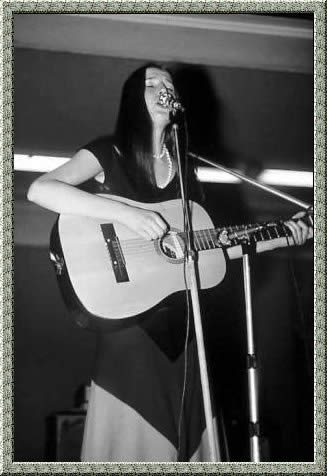
It was logical: I used the ANTROP studio without restrictions, and I was obliged to pull my weight for the common good. I thought I'd sit down, we'd knock it all out, and in a couple of weeks I'd continue my own explorations, but... how cruelly I was mistaken! I couldn't even have imagined that this endeavor would drag on for a year.
First, I sat down and listened to it all. Upon closer inspection, it turned out to be a complete mess, recorded by three different sound engineers, two of whom were beginners, each with their own sharply individual tastes. I told Olga that none of it worked and that we needed to call all the musicians back in and record it properly. I must say, Olga was a well-known figure in the St. Petersburg scene. The best musicians she could reach out to were ready to play with her. So, having roughly formulated her overarching goal at home, Olya would get on the phone, open her address book to the letter “A”, and start calling everyone in a row. No one refused her.
Every musician who came in familiarized themselves with the material directly in the studio; none of them had heard Pershina's new songs before, and it even amused me. Olga gets the idea to insert a cello – right behind the thought comes Seva Gakkel, who had exactly half an hour to spare from his chain of social commitments. He listens to the song, pays attention to Olga: “Here you play, here you don't, here you play again, and here you don't...”
While the microphone is being set up, he figures out the notes to the harmony, then records a take, a second one, and immediately leaves. We listen – well, it's raw, practically oozing: “It's all fine, normal, besides, Dyusha Romanov will be here soon, we're going to record the flute.”
And it's true: about twenty minutes later Dyusha arrives, blows through his flute, listens to the song for the first time, and he also has forty minutes at most. He plays the whole song straight through, and Olya says to me: “Great, let him play even more, and then we'll choose – maybe we'll cut something...”
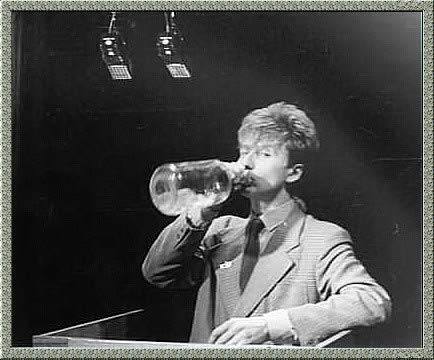
We'll choose... I remind you that the recording was made on an analog multi-track tape recorder: this isn't something you edit on a computer. Dyusha played his part, bailed. We listen – well, it's just a set of sounds roughly in the key. Every evening I dumped the results onto a cassette for her, and in the morning she would come in, and it would start: “You know, here Seva played great, but I don't like this part; maybe we can move this over here, and let this stay here, and take this out...”
Editing to that level of depth was beyond our capabilities, but Pershina, upon recording another track, held on to the hope that later on something drastic could be fixed: the musicians were all very reputable, so everything would be fine.
The next day Nail Kadyrov comes in, for example, to record the bass. The magnificent Nail, a single note from whom can work wonders. He has a maximum of an hour, and he absolutely cannot be late for his next meeting. While he unpacks his guitar, he grasps the structure of the song very quickly. He played, recorded it, ran off, we listen. The bass is a fairy tale, very beautiful... but only in a few places it's ragged – under-thought – he didn't have enough time, and it drifts out of sync with the drums. We need to re-record the drums. We agree – Sasha Kondrashkin arrives, listens: “Here you played great, and Nail played well too, but you see – together it doesn't work here – try to fix it.
We re-record the drums... and I must say, Kondrashkin and I quickly found a common language, because like Suvorov, out of all musical instruments I like the drums the most, and he was a... sociable guy. As a result, to Pershina's deep displeasure, the drum recording stretched out for a long time: we planned to get everything done in a day, but we found a common language and went on a drinking binge for a whole week. For about four days Kondrashkin didn't even leave the studio, until someone came to pick him up; because he played – I don't remember in which fairly famous band at the time. For Olya he was invited as a session drummer, but with them he regularly went on all their tours, including to Germany, where a tragic incident happened to Sasha, resulting in his death.
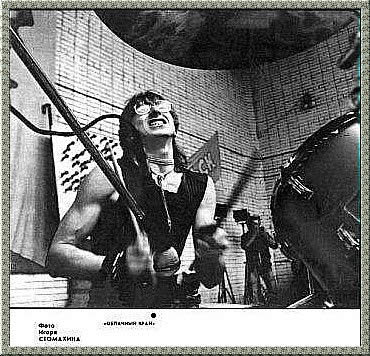
There's no getting around it, things like that need to be rehearsed. And when everyone only has half an hour, and they've never heard the song before – well, what can you record? For lead guitar, she wanted to recruit me, but I said no way, we agreed that I'd be recording you, so that's what we agreed on. I wasn't going to learn any lead guitar parts, I wasn't going to play anything, you could kill me. In a couple of places she did convince me to throw in a couple of notes, and I hit an E note. But I can only play solos in my own band, “Oblachny Krai”.
For the solos, Olga invited guitarist Alexander Gnatyuk. He had recently acquired a rare instrument – a MIDI guitar. When plugged into a processor, it could sound in completely different tones – whether an organ, a piano, or a violin. Sasha more or less knew the material, but he had just bought this guitar and hadn't really learned how to control this processor yet – the mastering happened during the recording, and this too turned into one murky, drawn-out, tedious mess. Among other things, all of this was interspersed with frequent live performances. Olya toured quite actively with her band, commuting between the Western world and the northern capital. While she took off for a couple of weeks, I would breathe a sigh of relief – doing my own thing.

It should be noted that I am describing the first period of communicating with Olga in this way, because our whole dispute is divided into two parts – “before” and “after” certain events...
She was a lady of absolutely free convictions, without any complexes, she liked to drink, she liked to eat, she loved a cheerful, noisy company, jokes and gags, and, of course, our relationship began to go beyond the scope of studio work. She constantly invited me to her concerts, of which she had many at the time. The St. Petersburg folk-rock band “Brain Drain” actively helped her then. There was Kolya Fomin, a very good musician – he plays the accordion magnificently and I really like his voice. He had his own excellent songs, and he was a great help to Olga Pershina on stage.
He had a great bassist in his band, or rather a bass-balalaika player named Sam. An absolutely unique person, no more than one and a half meters tall; next to this balalaika, which was larger than him, he looked... and when he packed it into its case, it became several times larger. Sam would heave the case onto his shoulder and walk. He couldn't be seen behind it at all – just a giant bass balalaika walking by itself. Sam played it virtuosically, and in general – he was a very good and kind person. The very next year he was killed at his home in Luga. Every summer in the warm season, they performed on the streets of Europe and earned more money than could be earned here. The day after returning from a successful tour, he was found at home: everything had been ransacked – a banal robbery.
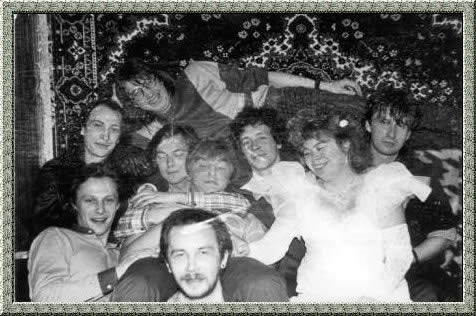
To replace Kondrashkin, who died in Germany, Olga invited Nikolai Korzinin, a rock-n-roll veteran from the bands “St. Petersburg”, and a comrade-in-arms of Vladimir Rekshan. Of course, I had heard of him, but I got to meet him personally in the studio. Another kindred spirit... nevertheless, the kindred spirit didn't affect the quality of the performance, although it must be said – the beat was different, the rhythm was different, and everything was completely different from Kondrashkin.
Nail Kadyrov had already played all the bass parts to a metronome earlier; Kondrashkin managed to find common ground with this recording, but Korzinin needed a different kind of freedom in his playing – the recorded bass constrained him, preventing him from realizing his own patterns, so we had to call Nail Kadyrov in again, and again it dragged on and on and on and on, and there was no end in sight to it, and I no longer knew what to do myself... Olya was still our kind of person, a real hoot, and it didn't cause any particular tension in our relationship: the recording process itself hadn't started annoying me yet.
For Special Radio
September 2008
Related materials:
Original article: https://specialradio.ru/art/id381/