The year 1991 arrived. I was sitting quietly at home with my family, bothering no one, watching TV, and playing the guitar. Even though it was already late spring, the weather was unstable, with a springtime but still very cold dampness hanging in the air. The mood was perfectly domestic. Suddenly, our bassist, Andrei Lukin, called:
The year 1991 arrived. I was sitting quietly at home with my family, bothering no one, watching TV, and playing the guitar. Even though it was already late spring, the weather was unstable, with a springtime but still very cold dampness hanging in the air. The mood was perfectly domestic. Suddenly, our bassist, Andrei Lukin, called:
– Seryoga, it looks like I've found some sponsors…
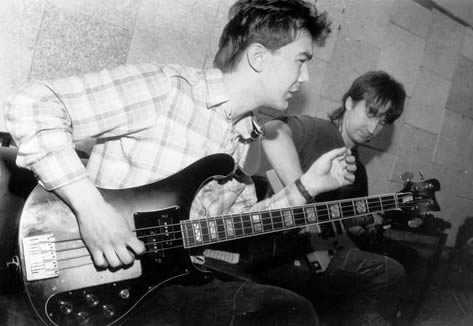
It was understandable – I didn't even believe it right away. We arranged to meet in the lobby of the fanciest hotel in our city, the “Yubileynaya”. Fifteen minutes later, I was already there. As we rode the elevator up to the thirteenth floor, Andrei told me that about three hours prior, he had been sitting in the hotel's eponymous restaurant, sipping some wine. There he met a businessman named Vadim. In the course of their conversation, it turned out that he was from central Russia, worked for a company called “EDVIN”, which stood for Ecology of Dvina.
They talked about business, various methods and schemes that were popular in those years, and gradually it emerged that Vadim was a passionate fan of heavy music, and out of all the Arkhangelsk bands, he knew and loved only one – Oblachny Krai. Vadim asked Andrei if he knew of such an Arkhangelsk band, and if there was any way he could meet them?.. To this, discarding false modesty, Lukin replied that yes, he knew the band; moreover, he knew it very well, and to top it all off – he himself played bass guitar in it.
Vadim's reaction was much like mine when I heard about the sponsors; he was utterly amazed by the coincidence and might have even slightly doubted whether he was being set up... He asked if Andrei knew Sergei Bogaev. The latter replied – how could I not know him, we are the best of friends, needless to say, we play in the same band. They arranged a meeting.
Vadim held a high and responsible position in the company – he was the chief accountant and deputy director of finance. For us, this situation was more than lucky – a person with access to finances was a passionate fan of our music. He knew that underground musicians always needed support and asked if he could somehow help our band financially. That's when they called me.
His room – 333 – was located on the 13th floor. We walked in... and there... right in the middle of the large living room stood a huge table, literally groaning under the weight of delicacies – laden with all sorts of pickles, marinades, fruits, and delicacies, expensive foreign drinks hitherto seen only in movies about the decaying capitalist life. Around the table sat the complete staff of the “Edvin” company – all three of them: the company's president Vasily, his financial deputy Vadim, and security deputy Yura, an internationalist soldier with a combat past.
We were seated at the table, and a leisurely, substantial conversation began. Along the way, we were made an offer that was hard to refuse: since their business was succeeding remarkably well – all commercial operations were bringing in multiple profits – they had been mulling over such plans among themselves for quite a while. Being sympathizers of Russian-language rock and roll, they harbored the idea of somehow participating in the process of its development and directing part of their budget to this noble cause. Fortunately, Andrei Lukin crossed their path.
Vadim informed his colleagues, saying “we don't need to look for anyone else, he has found a band, and this is the band. We are taking them under our financial wing.” They asked about our immediate plans – I said that the newest material was in the works, which it was already time to record. I listed a number of necessary measures: firstly, I was tired of playing the Soviet “Ural” guitar; I really liked the instruments crafted by Lyosha Bredis – the guitarist of the band “Ravelin” – he had made a guitar for himself, and I really liked how it sounded, it was comfortable to play, and it looked the part. Shortly before, I had already raised this issue with him: given the funds, he was ready to build me a guitar. The colleagues agreed to this expense item. In addition, they set a salary of one and a half to two thousand rubles a month for each of us – for all five of us, plus the operator. It must be said that at those prices, it was very decent money.
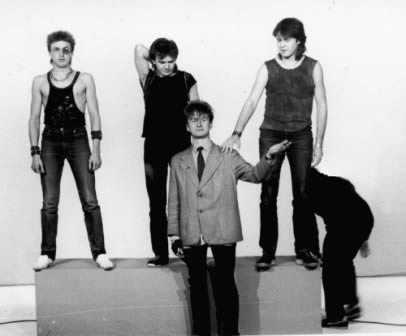
We were deciding where to record the new album. I said that the last three were recorded in Leningrad, on professional equipment that simply didn't exist in Arkhangelsk. We didn't want to make a new album with quality inferior to the previous ones, and our colleagues offered a completely unexpected option: “If there's nothing to catch in Arkhangelsk, and in Leningrad the choice is only one, why don't you record in Moscow, where there are many studios with different types of equipment. Choose the best studio, and we will pay for it, no matter how much it costs.”
We calculated that if we arrived there fully armed, ten ten-hour shifts would be quite enough for us. And so it was decided. They would pay for 100 hours, travel, per diems, and accommodation. They asked us to make a list of everything we needed at that moment, and to put a price next to each item. They asked us to do this literally the next day...
To be honest, I didn't expect such a turn of events at all. We went up the elevator as one type of people, and came down as completely different ones. Andrei is a great guy: he possessed a magnificent ability to get along with people, which neither I nor the other members of the band had in the slightest. We shook hands and agreed to meet the next day. We prepared a list of urgent expenses, a list of the band members with passport details to enter them into the payroll and immediately receive our salaries. It was the end of May. We decided that we would rehearse at our spot for two months, and in August – move out.
They gave us a bag with several bottles of French wine, various snacks, and said goodbye until tomorrow. Andrei and I walked out completely stunned, intoxicated by the prospects, and headed straight to my place to draw up the necessary document. We appointed our friend Igor Patokin from the band “Shish” as our operator, and took Dima Leontyev, the drummer from “Autodafe”, as our administrator.
We counted up some number of thousands, sitting up until the very morning. In the morning, we went to the guitar maker. At that time, he worked in an office that did large-format photocopying. It was located in the building where Andrei Lukin lived – right opposite my house. Lyosha Bredis worked there as an operator of a large machine, simultaneously acting as a repairman. The equipment was complex and precise, requiring perfect cleanliness of its internal organs, for which Alexei received alcohol on a monthly basis. In connection with this, we often visited our friend at his workplace, especially since we lived right across the street. He set up his guitar-making workshop right there on the premises, which his bosses did not mind at all. The task was clear: he needed to make the body and the neck, install real pickups and a genuine Floyd Rose tremolo block, which had never been produced in our Fatherland at all. Alexei suggested we drop by in a couple of days so he could prepare everything, and I could see if it suited me.
As agreed, we came to look two days later. He found an excellent bright red body, shaped exactly like his own; a neck from a Musima electric guitar – only Alexei promised to make it thinner. He ordered the bridge at a submarine plant in Severodvinsk. The total came to 800 rubles: the body cost 300, the neck – 150, the bridge – 300; I was gifted a “good American” pickup with no identifying labels, and Alexei agreed to make the second pickup himself as a bonus. The guitar was supposed to be ready in a week.
That same day, we brought the list of our anticipated expenses to room 333, to which Vadim was even surprised: “You guys were a bit too modest when drawing up the estimate.” To which I replied that modesty is a virtue... in short, the requested amount of investment satisfied both parties. We decided that while Bredis was making my guitar, Andryukha would go to Moscow to choose a studio and sign a contract with them.
The next day, I went to the Central Bank to receive the first salary for the whole crew. It was hot – I didn't have a jacket, or pockets, or even a plastic bag. Vadim asked me – how could this be – coming for money without any... I didn't know what to answer him... In truth, I didn't fully believe it would happen. I wrapped the impressively sized stack in a newspaper and hid it under my T-shirt, tucked into my jeans belt.
Two days later, Andrei returned and reported that he had found a studio – for those times, the most well-equipped and expensive in the entire Soviet Union. It was called “Petrostudio”, serving as the creative appendage to the first store in the USSR for branded musical instruments, “Petromag”. The owner of the store was named Vladimir Pruglo. For some reason, everyone called him Pyotr. And everyone addressed him exclusively as Pyotr. And here is how they reached him: Andrei, along with our drummer Korablev and Kostya Leontyev, were involved in a small business, namely buying household appliances in Arkhangelsk at a reasonable price and hauling them to Moscow... to a structure also owned by Vladimir Pruglo.
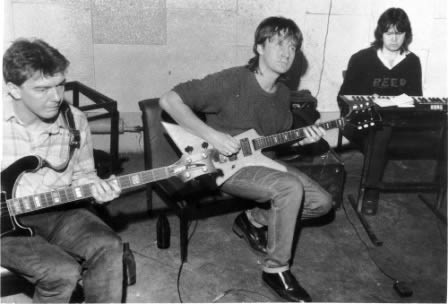
Pyotr's studio was already extremely popular among the paying part of the Moscow muses; the cost per hour was 25 rubles (a sum equivalent to a plane ticket from Arkhangelsk to Sheremetyevo). Accordingly, very famous characters hung out there: Philipp Kirkorov, the chansonnier Zvezdinsky, Alexander Kutikov. They were recording their albums in parallel with us. We were put on the schedule from August 9th to 18th – 10 days, 10 hours each, without days off or any pauses.
Andrei arranged with Pruglo that we would be provided with any instruments for the recording – keyboards, guitars... Knowing our situation, Pyotr said that a custom guitar is good, of course, but wouldn't Sergei like to lay his hands on a real instrument, an American guitar, the most expensive one in the entire store – in short, there were absolutely no barriers – just like in a fairy tale. Andryukha brought me Boomers strings – he bought them right there, at Petromag, and we went to Bredis to celebrate the occasion. The guitar was already practically ready, and subsequently served me faithfully for fifteen years, for which I am deeply grateful to Alexei.
We got in touch with Routkin – called Ukraine. Things were shaping up for the best: in July, he and his wife were heading to their hometown of Arkhangelsk and were just about to buy tickets. And by that time, I was getting ready to become a young father with my first wife, Lena. She could give birth at any moment.
We spent those days at the rehearsal space, rehearsing, preparing for the recording. The spot was located in a bomb shelter under the Arkhangelsk bus station and bore the name “Palitra”. For some reason, our local wits had rebranded it as “Pol-litra”... There was plenty of space there, and we brought in everything we could gather – practically everything was homemade, or from countries of the crumbling socialist camp: all sorts of Vermonas, Formantas, and other Teslas. We spent days and nights there. We grew close to our sponsor, Vadim – like peas in a pod: he often dropped by our spot empty-handed... which is to say, never empty-handed...
I called Andrei Tropillo in Leningrad and asked how he would feel about us recording the next OK not with him, but in Moscow. He was pleased – why not give it a try? Besides, he still held a high position at the “Melodiya” company, and upon the completion of the phonogram, he expressed a desire to receive it and release it on vinyl.
The pre-launch preparation for recording the album was coming to an end; we rehearsed a lot so as not to embarrass ourselves in front of the Muscovites. “Palitra” was so well soundproofed that during our playing, no one in the bus station building suspected the devilry going on beneath their feet. No one could bother us either – the bomb shelter was built to withstand a direct hit from an aerial bomb.
And right around then, Routkin flew in with his family. We met them at the airport, brought Oleg to the studio, and Vadim showed up as well, naturally bearing gifts. They got acquainted, we brought Oleg up to speed, and planned a trip to Severodvinsk to fetch Lyskovsky, to persuade him to take a couple of days off at his own expense. But for the time being – we sat and raised toasts to the health of the founders of the “Ecology of Dvina” company.
It was assumed that Routkin would spend the whole week with us, but alas, no such luck... We would gather in the morning, turn on the amplifiers, untangle the wires, and naturally – have a little drink to mark the start of the workday, followed by the slogan “between the first and the second...”. As a result, the creative process withered under the weight of the copper basin; the rehearsal smoothly transitioned into a state of “an evening of reminiscences in a warm, friendly atmosphere”. No one was particularly worried about this – Routkin was famous for the fact that in the studio, hearing the finished backing track, he would catch on instantly and nail the perfect take right off the bat.
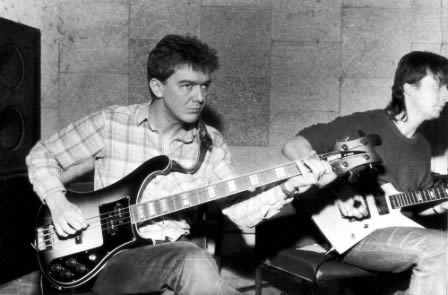
And then Lena went into labor... One day, namely June 15th, she uttered her fateful “I think it's time”, and I drove her to the hospital. The next day, on Medical Worker's Day, I had a daughter, Polina Sergeevna. The whole crew went to the maternity hospital, shouting and bantering; in short, I became a young father, but how exactly Routkin left to go back home – I honestly don't remember...
Left without Routkin, we quickly finished everything we had planned, and by early August, we had it all practically ready in our heads, so it could safely be recorded onto tape. We bought tickets for August 8th in order to arrive the day before and choose our instruments. The schedule was strictly defined: we had five days to play all the music so that Oleg, flying in from Kharkov for two days, could sing everything, and then I could calmly start mixing... However, real life made its own adjustments to our plans...
Yura Korablev – our drummer – didn't show up for the final run-through on the eve of our flight. There were no mobile phones back then, and Yura didn't have a landline phone either – all we could do was wait. The next day he showed up at the airport – pale, barely standing on his feet, his left arm bandaged and hanging in a sling, with a bloody spot seeping through the dressing...
That day, he had asked to leave work early, went to the bus stop on the way to our place, and while waiting for the bus, he ran into his buddy, a stellar drummer from the bands “Knockout” and “Ravelin” – Alexander Kharev. The latter was heading to the birthday party of an equally stellar bass guitarist, Andrei Zubrikov. He managed to convince our Yura that there was absolutely no point in a final rehearsal before the flight, but missing Zubr's birthday was a far greater crime than skipping our last run-through. It didn't take much to persuade him.
From there, things went completely sideways: an apartment packed to the brim – everyone drunk, cross-eyed, smashed – they started pouring penalty drinks for the newcomers, then more and more; half an hour passed, and even after an hour, Yura couldn't come out to us. All sorts of arguments flared up about what was shit and what wasn't, this is real metal and that's pop, whether this is rock or not rock, Soviet or not Soviet; a dispute flared up on the verge of a foul. Yura was wearing an Iron Maiden T-shirt, and one of the local right-bank opponents presented a counterargument, like “and what the fuck is this Iron Maiden of yours, it's shit, it's not music, just cheap stuff...” To this, Yura Korablev, without declaring war, took a wide swing and punched the opponent in the nose. The guy fell, went quiet, and the party continued, but the vanquished one came to his senses. Realizing that he couldn't defeat Korablev in a fair fight, he rushed to the kitchen, grabbed the largest meat cleaver, flew up to Yura, and struck him, aiming for his throat. Yura blocked the blow, and the knife went into his left hand right up to the handle.
Recorded by Alexei Vishnya
For Spetsialnoe Radio
January 2007
Related materials:
Original article: https://specialradio.ru/art/id254/