From "Radio" Magazine to the Dead Ears
From *Radio* Magazine to Dead Ears
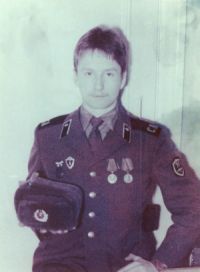
If we are to recall everything from the very beginning, to return to our roots and the moment the group was conceived, we had better get comfortable and swiftly spiral downward through time, back into the past: the last millennium, the last quarter of the twentieth century, the mid-1970s. Right around 1974–1975, the three of us—friends and neighbors from the same apartment building: me (Sergei Bogaev), Oleg Rautkin, and Kolya Lyskovsky—found ourselves at a crossroads, wondering what to do next. Playing Indians was losing its appeal for us with each passing day. We had started looking at girls not simply as classmates; childhood was ending, bringing a reevaluation of values. Adolescence was setting in, and there was nothing to do: the tomahawks, bows, and arrows had been abandoned, and ahead lay a void. We knew absolutely nothing about rock yet. At 13 or 14, I seriously believed that *rock*-music derived from the word "fatal" (*rokovoy*), and that pop music was so named because it was performed by priests (*pop*). And then one day, someone from our class brought in a couple of audio postcards, like sound letters with some songs on them. One featured a song by some Beatles—a band everyone had heard of but no one had ever actually heard or seen. We only knew about them from newspapers, where their work was mercilessly trashed. On the second postcard, we heard the enchanting sounds of another band unknown to us, which made an even greater impression. However, there were no titles on the postcard, so we had no idea who was playing. It was something from the West. Now there was a word—"Western"—which was practically synonymous with "enemy". Small records from the *Melodiya* label began to appear in the *Soiyuzpechat* kiosks; one was called "Vocal-Instrumental Ensembles of the World." It featured two ensembles; we didn’t care much for one of them, but on the other side were two songs that pierced our hearts straight through. They amazed us, but we didn’t know who it was. We didn’t know anything at all. The heaviest thing we had heard up to that point was *Pesnyary*—they came to Arkhangelsk, and they had electric guitars, drums, Ionika synths, and all sorts of other shiny, glittering, loud equipment, and it seemed like nothing could be cooler than that. And suddenly—boom! —something completely different, "a whole different ballgame," from the spirit of the music and the sounds to the overall mood... In short, that was the moment we decided where to direct our efforts: toward creating something similar, just the three of us neighborhood buddies, the former "Indians."
The question arose of what to play: we had no guitars, no electric organs, no drum kits. Naturally, none of us knew how to play because we had nothing to learn on. Then my uncle brought me a guitar as a gift from Leningrad. It was made at the Lunacharsky factory and cost 14 rubles and 50 kopecks. I was completely blown away by this turn of events. As you can imagine, the question of finding a guitarist was unequivocally resolved. Kolya Lyskovsky decided to take up keyboards, and his older brother Igor chose to play the spiritually related drums and sing, as he had a loud and clear voice. I attended a radio enthusiasts' club at the local school and already knew how to solder a bit and tell a diode from a transistor. I had grasped the basics and even soldered a crystal radio receiver. The magazine "Radio" had published a schematic for a simple monophonic keyboard instrument, and I immediately set about building the device. We bought some cheap parts, knocked together a box, and glued a little keyboard out of wooden sticks. Finally, this contraption produced its first buzzing sounds, vaguely resembling musical notes. As for drums, we utilized various household items: old basins, pots, cushions, pieces of furniture, and cardboard boxes that our moms rarely used. Of course, none of us had the slightest idea how to create the music of our dreams. After I was gifted the guitar, I played it for a year without even knowing how or why the tuning pegs worked, or how the instrument was tuned. I just lined up all the tuning pegs parallel to each other, nice and neat in a single even row; it seemed more correct to me that way. I tightened the strings so they wouldn't flop around and so I could bend the notes while playing. I even used to wonder when watching other guitarists why their pegs were turned differently—one way for one guy, another way for someone else. Couldn't they see the mess? I thought everything should be neat and even.
And that's how I played all through 1975. I couldn't manage chords; I started playing right away—first with one finger, then two. The parts I played were lead lines, and we had no doubts whatsoever. None of us even considered that the guitar might sound off. Our keyboard couldn't produce specific notes either; it just made a generic sound, which didn't discourage us at all. There were no major dissonances, and coupled with our pots and basins, it all created a sort of musical, everyday wall of noise. Around that same time, I was gifted a cassette recorder, one of the early Soviet models, called the TON-403. It came with a microphone and a few cassettes. The meaning of life had been found; the path was chosen definitively and irrevocably. We tried playing unknown songs by unknown bands from postcards with no identifying marks. A year passed like that. I played and played that guitar with its neatly aligned tuning pegs, until a classmate, Vitya Romodanov, came over. He was considered the best guitarist in our school; he already knew how to play and sing Russian songs about a sunny island. He visited me after finding out I had a guitar, wanting to show me the coolest stuff coming out of Moscow. He strummed one chord, then another—it sounded like absolute crap. Baffled, he asked:
– "So what's going on with your guitar?" – "What do you mean, what's going on with my guitar? Everything's fine," I tried to defend myself. – "Dude, it's completely out of tune!" – "What are you talking about, Vityok?" I was starting to get offended. "I've been playing for a year now, and everything's fine. No one's complaining. Ask the guys in the band, they'll back me up." – "What do you even play on it? Go on, play something." So I took the guitar and played a solo part I had already memorized. He was amazed, but he said, – "Seryoga, you're an idiot. You can't play a single chord properly. It's out of tune. How can you play like that? Where is this band of yours even heading? It's a dead end. You need to tune the guitar properly."
Vityok happened to have a tuning fork in his pocket that played an 'A' note—a little white thing that looked like a cigarette holder. He tuned my guitar for me, and I thought: «Damn, holy shit, this sounds way better. My classmate is right...» Kolya, Igor, and I exchanged glances. There was nothing embarrassing about it—we needed to learn from useful experience. Within a month, I had already learned how to tune a guitar. Of course, I had to abandon the "parallel" alignment of the tuning pegs; the quality of the chord sound outweighed that aesthetic. I had started using actual chords, since they could actually be extracted from the guitar now, but the ability to play chords still didn't give us the desire to perform the songs everyone else was playing at the time. We wanted to create our own compositions. That's why we had formed our group in the first place, and now new possibilities had opened up for exactly that purpose.
We soaked up information from wherever we could. Half-erased, murky photographs of rock bands from Western music magazines were being passed around among the people, and that's how we learned that bands had a division of labor. Our drummer-singer suggested we find a drummer to free him up for vocals. We remembered our neighbor, Rautkin, whom we used to play Indians with as kids. We hadn't considered him a musician, but one day the Lyskovsky brothers came over and told me that our neighbor had found an empty packing crate someone had thrown out by the dumpster, whittled two poplar sticks down, and just started wailing on that crate. "He's really good. You should invite Oleg to join us, Seryoga."
All our rehearsals took place in my room at the time when our parents were at work. I went upstairs to the fifth floor and invited Rautkin to come over and try his hand at being a drummer. Now, in front of him wasn't just some random box, but a whole drum kit!: one little basin, another larger one, a pot like this, a pan like that, a pillow, and some sort of cardboard box. And then he just let loose, unleashing these incredible drum rolls. We were blown away by how loud, and more importantly, how inventively he was bashing away at them. Anyway, the drummer question was settled—we now had our own drummer! We played him our first recordings, he approved, and said he was ready to play in that style for as long as we wanted. Especially since we went to the same school, got out of classes at the same time, and no one was home—all the adults were at work—so we could make as much noise and scream as loud as we wanted until evening. We changed the band's name almost every day; it was still a few years before we became "Oblachny Krai" [Cloud's Edge], but by that point, the core group of like-minded individuals who understood each other without even speaking had already formed.
We listened exclusively to foreign heavy rock acts; we loved the Beatles, Pink Floyd, and Queen. We wanted to play similar music, only in Russian. Igor Lyskovsky could sing in English quite well at a school level, but this didn't generate much enthusiasm among us. After all, you could get any Western music—which was already quite abundant at the time—and listen to it in English, but there was nothing of the sort in Russian back then; either it simply didn't exist yet in our country, or we just didn't know about it.
We used exclusively our own original lyrics. The first rock records with detailed information on the covers were starting to reach us, and it was clear from these that whoever performed the songs also wrote them. We saw this as the fundamental difference between rock music and mainstream pop, where, say, Kobzon or some vocal-instrumental ensemble would sing Dobonravov's lyrics to Pakhmutova's music. In those days in our country, only members of the Composers' Union had the right to write songs, and only using poems by members of the Writers' Union. Naturally, we weren't members of any such unions, nor could we possibly have been. Still, it seemed unfair to us: if a person's soul is singing and they feel the need to express something, who has the right to forbid it? With rare exceptions, we really disliked what was played on the radio, and we strived to make our own contribution.
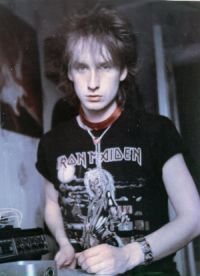
Listening to Western bands, we couldn't help but notice their sound, and we realized we simply had no idea how to achieve it. Aside from basic electronic components, there was nothing in the shops that could help us; there were no books or any other sources of information. We took up engineering and tried assembling guitar effects pedals. We chipped in three rubles each for a pickup for my guitar, but the sound that made our hearts skip a beat remained out of our reach. This sound was called "fuzz," and I sifted through many magazines and circuit diagrams before I finally soldered this pedal. Using the final amplifier stage, I built a filter on a separate circuit board, which was called a "quacker" [wah-wah] back then. As a result, my pedal yielded an astonishing result! We now had fuzz and quacker in our sound! It was unbelievable...
But we didn't know how to read sheet music. I was composing several melodies a day and immediately forgetting them, so the urgent question arose of recording our efforts onto magnetic tape. I had already managed to acquire my first four-track reel-to-reel tape recorder, the "Nota-303," which brought about a massive leap in quality. You couldn't record anything with a single microphone dangling by its wire from the chandelier. Looking at photos of Western bands, we noticed that each drum had its own microphone, and each instrument had its own. Logically, this made perfect sense, so that every instrument was clearly recognizable, without the sound reflecting off the walls, floor, and ceiling. Among our friends and acquaintances, we put out a call: many of them had already acquired tape recorders of varying quality, and each came with a microphone, or even two if it was stereo. We asked everyone who could spare them to give us their microphones.
We gathered about a dozen, but my "Nota" only had a single microphone input. There was no way to mix the signals from ten microphones, so I found the only right solution. Cutting off the quarter-inch jacks and five-pin connectors from the microphone cables, I stripped back quite a bit of wire, twisted them all together—grounds to grounds, and signals to signals—soldered a five-pin DIN plug to this massive bundle, and jammed it into the mic input. It worked brilliantly! Everything could be adjusted by distance and angle of inclination. These were just nuances and very pleasant хлопоты (troubles) that gave us room for creativity and experimentation: position it one way, you get one sound; turn it slightly to the side, you get another; stick the microphone somewhere else entirely, you get a third. In short, we were finally making recordings that were actually worth listening to and playing for our friends. True, our classmates didn't really appreciate our compositional experiments. They told us, "Guys, why are you messing around with this nonsense? There are perfectly good songs out there..."
But for us, this was completely unacceptable—the dubious joy of playing something that someone in Moscow had already composed, while we had to figure out the chords and perform their songs... Confident in the infallibility of our chosen path, we set out on our own road: exclusively our own music and our own lyrics. Only this way, and no other. Another serious challenge we faced was the lack of reverb. We already knew about the concept—you'd listen to music, and there would be this beautiful tail hanging on the vocals or the drums, like an echo, but we had absolutely no idea how it was achieved. There was nothing about it in the "Radio" magazine, but we already understood that without this device, the satisfaction we got from our playing was incomplete; it lacked sufficient depth. And then suddenly, a new issue of the magazine arrived, from which I learned that you could extract the tungsten filament from an electric stove burner, stretch it out, anchor one end to something stationary, and glue the other end to the speaker of an amplifier connected to a guitar. At the far end of the stretched spiral, I attached a piezoelectric pickup taken from the tonearm of a record player, and routed its signal into another amplifier.
The effect exceeded all expectations! It was almost a real hall effect. I played the guitar for hours on end, skipped school, and could barely wait for my friends to arrive. I showed it to them, the guys got fired up, and right then and there we wrote several songs with lyrics and music. On the very first day, we recorded about forty-five minutes' worth of material, and if our parents hadn't come home from work, we could have recorded even more. Around that time, in '79, Igor Lyskovsky started gradually drifting away from us. He was a straight-A student aiming for a gold medal, and hanging out with us was already holding him back. The three of us remained, but that only made us tighter. Suddenly, it turned out our drummer, Oleg Rautkin, had an absolutely amazing voice.
He screamed so loud his vocals carried far beyond our courtyard, and it didn't hinder his drumming at all. We slowly saved up money and bought guitar strings. I cut out and hammered together my first electric guitar out of ordinary construction boards, painted it, varnished it, strung it with seven-ruble strings, and it sounded more than decent. Way better than just an acoustic guitar with an overdrive pedal. The sound was already heavy, and paired with my fuzz and wah pedals... it produced an unmistakable farting noise that would just sweep you up and carry you forward on wings; the guitar literally sliced through space. It felt like the entire building was being pierced by lightning. A photo of this guitar survived – it was painted red.
We bought a small pioneer drum to use as a snare, because up until then, that role had been filled by an old, decrepit pressed-cardboard shipping box. I don't really remember how I finished school. We decided to try our hand at the popular genre of rock opera. Inspired by the overly pop-sounding "Jesus Christ Superstar," we committed our own take on the genre to tape. Our opera was called "The Appearance of the Wild Peach to the Masses."
It's useless to recount the plot of the opera, but the lyrics were pretty funny. After that, I started taking a more serious approach to arrangements. I put together five or seven tracks that actually had some structural development: an intro, a beginning, a verse, a chorus, a breakdown, an ending... you could call them our first "fully realized compositions." Sure, they were played amusingly, with a sound that... well, but at the time, good lord, we thought it was super! Just super! Not Deep Purple, of course, not Pink Floyd, but you know, by our Soviet standards, and especially for a home recording – not bad at all. Plus, I soldered together a few simple electronic devices that produced all sorts of hissing, squealing, gurgling, and grunting sounds. Every song was enriched with this stuff to make the sound fuller. Slowly but surely, our knowledge of electrical engineering grew; we honed our playing techniques, developed our taste, and improved our performance skills. By the beginning of 1980, the issue of finding a venue arose. We were absolutely itching to perform and show everyone what we had achieved, but where and how? Who would let us... art councils stood as insurmountable obstacles in the path of such craftsmen like us, of whom there were already plenty by then, not just in the country, but even in Arkhangelsk.
The home period of the group's development was coming to an end. We had outgrown the space in my small room, and we needed to do something, because the three of us could barely even turn around. I had already finished school, Routkin was still in the eighth grade, and Lyskovsky was in the seventh. I was faced with a choice – where to apply. My school diploma had good grades, but my options were limited. The city had three institutes and a maritime college. My dad was a sailor; in my early childhood, I wanted to become a sailor too, just like my father. But I wasn't accepted into the maritime college "due to poor health," which was particularly insulting, because that didn't stop them from drafting me into the army on Novaya Zemlya that very same year.
I passed the exams for the communications technical college, but when it became clear in September that we had to go to a collective farm, and we were just about to record our first album, I flatly refused to go harvest potatoes. "Well, then you won't be studying here," they told me at the technical college. I thought to myself: so be it, I already know how to solder and have a decent understanding of things... But where was I to go? School was over, I hadn't enrolled anywhere else, and it was too early for the army. Dad was a captain; his ship was docked for repairs at the Arkhangelsk Ship Repair Plant "Krasnaya Kuznitsa". He took me there, and I got a job as an electrician's apprentice in the electrical workshop. This was one of the turning points, because having become a worker at the city's main plant and being a member of the Komsomol, I couldn't avoid the attention of the plant's VLKSM (Komsomol) committee: after just a week of working as an apprentice, I was called into the committee office and asked what I was into and what my interests were. I didn't hide the fact that I was most passionate about creativity, and that I lived only for music.
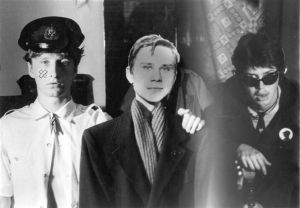
"What kind of music?" asked the Komsomol secretary. I was too embarrassed to answer "Western," so I replied: "Modern music, electric." "I see," he said, "Do you collect records, compile recordings?" "Not really," I answered, "I have a band. We write our own stuff, play it, and record it ourselves." "Oh! So you probably know your way around the equipment, then? Amplifiers, speakers, and all that?" he rejoiced. "Sure I do, the most important thing in this is knowing how to hook everything up, tune it, and not burn it out," I said. "Very well, then we're bringing you in to help with our plant's disco. We host them on Saturdays at our plant's House of Culture."
I was given permission to use the club's premises for music practice in my free time, as long as it didn't interfere with scheduled events. That's how we moved out of my little room and into the House of Culture, where we were given a small closet of a room, and inside it... There was a drum kit!!! from the Friedrich Engels factory, a real "Rodina" amplifier with a speaker cabinet, a "Brig" amplifier, a couple of electric guitars—battered, but real—and a "Yunost" electric organ. We absolutely lost our minds when we realized we could use all of this equipment without holding back on the volume, without fearing that someone would bang on the pipes or start hammering the ceiling with a mop. Our happiness was boundless. Now, right after work—and right after school for my friends—we would head straight there, to the House of Culture. Every penny I earned back then went toward buying reel-to-reel tape. If we managed to catch them in stock at the store, we'd buy about ten at a time, because we recorded absolutely everything, laying down whatever came into our heads.
It's a shame it has all crumbled to dust long ago. Of course, the sound quality on the new equipment was an order of magnitude higher than before—I'm not afraid to say it. I turned eighteen, and my friends and I had to part ways—I was shipped off to Novaya Zemlya, to the frontlines of the anti-aircraft defense. Six months later, the medical board concluded that my continued service to the Motherland was impossible. I was discharged due to health reasons, and I returned home.
My friends' joy was boundless. I went back to the factory, where they welcomed me with open arms. They had even snagged some new equipment in my absence: a "Trembita" amplifier, another, more powerful "Brig" (which I particularly liked), a Baltic-made electric organ, and most importantly—an "Ural" electric guitar! Now that was another momentous milestone in the band's history. I played that guitar from 1980 all the way up to 1990, because in 1990, at the Melodiya label in Leningrad, I recorded the album "We Wanted Freedom" on that same shaggy instrument, which I tortured however I pleased without any fear of breaking it. Besides, it would have taken a tractor to break an "Ural".
Armed with all this wealth, we spent every day rehearsing and recording. Ideas were bursting at the seams, fighting to get out, but we still didn't have a name. And then a remarkable event occurred—one that gave our band its name and cemented our authority in the city's youth music scene. In '81, the factory's new Komsomol committee secretary, Yakov Poporenko, called me into his office and said:
– "Sergey, here's the situation: next week the city is hosting a Soviet pop song competition, and every Komsomol committee representing a workforce has to send a group. We can't just ignore this event, and as I understand it, you have an ensemble. From what I've heard in passing, you guys know how to play, and you sound pretty good. There's just one condition – you have to sing songs by Soviet composers." This put me in a difficult position – because songs by Soviet composers meant songs by whom? It was obvious... by everyone who was a member of the Composers' Union at the time. That fundamentally did not work for us, so I offered him a compromise:
– "Tell you what, Yasha, we'll take lyrics by Soviet poets, and we'll write the music ourselves. Why wouldn't I be a Soviet composer? I have a Soviet passport, I'm a Komsomol member, a shock worker of communist labor – don't I have the right?" – "Well, alright, of course you have the right, who would dare take that away from you... And what's the name of your VIA? We're putting together the application for the City Komsomol Committee right now, and the box for your group's name is still blank. What do you call yourselves?"
– "Dead Ears," I reply, and Secretary Yasha nearly slides under the table from laughter. – "Sergey, what 'Ears'? You're a grown man, a Komsomol member, don't embarrass me. A musical group can't call itself that; this isn't a gang of mobsters, think about it." I thought about it and realized that, indeed, for a Soviet vocal-instrumental song competition, the name "Dead Ears" didn't quite fit, but nothing else came to mind.
– "Maybe we also thought about 'Big Iron'... and why not – we've got the Red Smithy here, the ship repair plant, iron all around us, you could say it's nothing but iron." – "No, that's all wrong," the secretary dismisses it. "We need something suited to our region, reflecting the North, our nature, the local color. How about 'Pomory'..." – "What 'Pomory'? Next you'll say 'Severyane'... There's already a VIA called 'Pomory', and there's a dance ensemble called 'Severyanochka' too. Maybe we could call ourselves 'Cloudy Land' – you see the clouds over us constantly..." – "Oh! That's it!" Yasha rejoiced and immediately said to his secretary, "Write it down, Tanya – Cloudy Land, let it be that." It had just slipped off my tongue; I didn't even like it, but Yakov had already decided everything. Oh well, screw it, I thought, let it be "Cloudy Land," the main thing is that it's not "Pomory," not "Severyane," and not "Korabely". The name was ambiguous: either an edge in the clouds or the edge of the clouds. In general, it was unclear, and that was a good thing. But it sounded beautiful. And so it was settled. The application went in, where I was listed as the composer and leader of the VIA "Cloudy Land". We delicately skipped the "musical education" box so as not to embarrass the judges; otherwise, at the very last moment, our performance could have been banned.
I took three poems: by Tvardovsky, Simonov, and Orlov. We wrote some killer music, real hard rock, a cross between Deep Purple, Uriah Heep, and Black Sabbath, dressed up in velvet jackets and bell-bottoms, walked out, and just wailed... We performed closer to the end, and I must say that before us, the song "Hearing the Voice of a Raspberry Bird" had been performed seven times by previous groups, and Stas Namin's "Summer Evening" was performed by nine different groups. But those songs were recognized, they were played on the air, and then out come some weird-looking Beatles, some Cloud Region, and the presenter announces: music by Bogaev to a poem by Orlov – "He Was Buried in the Earthly Sphere", and clicking her high heels, she walks away. And we... Bam! Well, the audience was stunned, the jury's eyes were bulging, I met the gaze of the secretary Yasha, comments are unnecessary... A complete fucking disaster, dead silence, and after our third number, we left the stage to the sound of our own hooves.
Backstage, the guitarist from the local ensemble that played at the dances ran up and started slapping us on the shoulders: – "Man, you guys are great, you're totally awesome, the way you just let it rip, now that's respect!" That cheered us up a bit. We walked to the bus in silence; the silent Yasha Poporenko said nothing to us, but everything was written all over his face. We arrived at our home factory, unloaded, and then a couple of days later Yasha got a massive kick in the ass from the Party bosses because such musical hooligans were operating in his district, and that they had been sent to represent the great, Order of the Red Banner of Labor "Red Forge" factory. To his credit, Yasha defended us then, saying the guys were young and hot-headed, that they'd practice more and learn, but he was told firmly: no, these guys must never be put on display anywhere ever again.
I wasn't kicked out of the club because, as a technical specialist, I handled the work related to the discos; the sound at the disco was excellent for those times, and we were never dragged out to any more competitions. We didn't bring up that incident again and seriously got down to recording our first studio album. We were bought two stereo tape recorders; I earned enough money for tape to buy twenty reels a month. We dove completely into our work and had no idea that our Komsomol committee secretary kept taking it on the chin for us for a long time. A review article about the VIA competition came out in the main city newspaper; it honored the winning group for the best performance of "Raspberry Bird," while our factory's group was publicly shamed for putting up such reckless ignoramuses as us. But Yakov had nerves of steel, he listened to the same music we did, and he always defended us. That was only the first time, and there was so much more ahead. Later on, he would have to blush for us in front of far more serious organizations than some rag of a newspaper; the most important stuff was still ahead of him. Today, Yakov Poporenko is a media magnate, the owner of several TV channels and radio stations. Even the Arkhangelsk television tower now belongs to him. But back then, while still serving as the secretary of the local Komsomol committee, he helped us immensely, and it is with him that I associate the very earliest stage of our band "Cloud Region." Who knows, if it hadn't been for him, we might be called "Dead Ears" right now.
Recorded by Alexey Vishnya
For Specialnoe Radio
Related materials:
Original article: https://specialradio.ru/art/id61/