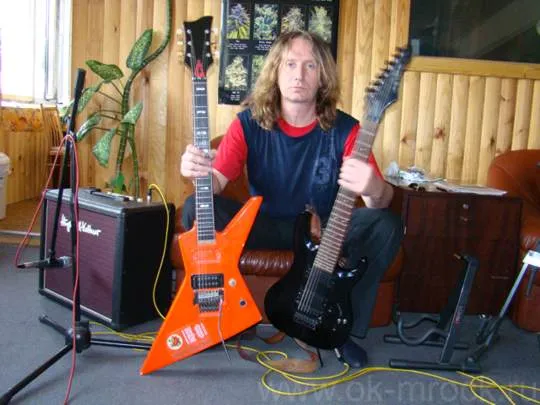
Music lovers from the late eighties have not forgotten this name. Sergey Bogaev, the leader of the band Oblachny Krai, stood at the forefront of the rock movement. Alas, this northern gem could not stay at the peak of his popularity for long. There are many reasons for this. And once, Konstantin Kinchev himself admired this musician...

Now he simply remembers him as a hero of his stormy youth. Backstage at one of the concerts at the Yubileyny Stadium, the superstar sighed: "He is a wonderful person; we started out together at one point... I will always be glad to see him. If you meet him, say hello."
That's all. Yet Bogaev was one of the first rockers in the country—those who disturbed the peace of the stagnant era. He became famous even earlier than Kinchev. While Kostya was recording his debut album, *Energy*, at Andrei Tropillo's studio, Bogaev was already creating his third compilation of songs, *Stremya i Lyudi* (*The Stirrup and the People*). Very soon, the band Oblachny Krai was featured in all Russian rock encyclopedias. They say Fyodor Chistyakov eagerly absorbed the work of the Arkhangelsk "genius," visiting the studio where Bogaev, Kinchev, and Tsoi recorded.
The power of the words in Bogaev's lyrics drove more than one generation of rockers crazy. Some didn't hesitate to steal a few tricks from fresh, unreleased material. It seems Sergey never paid much attention to this. According to musicians, he was only surprised once, when a few years ago he heard a recording of his song performed by a Yaroslavl band. Rumor has it that these rockers still perform their only hit, *Zemlya Bylinnaya*, at concerts, clearly borrowed from Sergey Bogaev's repertoire—or more specifically, from his song *Russkaya Narodnaya* (*Russian Folk*). It's unlikely the leader of Oblachny Krai knows about all his imitators.
Moscow labels are still happy to buy his "raw material," but so far, things haven't progressed beyond that. It seems the former rock idol has only now realized that the days of his past glory are gone. Perhaps this is what spurred his desire to return to his former positions. Changes in his personal life undoubtedly played a role as well. Serezha finally got married and has a little daughter, Mashenka. He is writing new songs again, experimenting with a different sound. Quite recently, he released an album titled *Patriot*.
— Is it true that the 1985 album *Stremya i Lyudi* will be reissued soon?
— Not only that one, but also the previous one—*Ublyuzhya Dolya* (*Camel's Share*) from 1984. That was the first album we recorded in St. Petersburg. The material was reissued a few years ago, but those records are now out of print.
— What is the reason that you "disappeared"?
— The reason is myself. I never took it seriously, and in vain. Such are the realities of our Russian life. Although a musician's job is to do their work, while commercial success is a matter of luck.
— The band Oblachny Krai is considered a studio project. Do you have a desire to create a live, touring band?
— That's what everything is being done for right now. The musicians who will make up the core of the band are already there. The main problem is the vocalist. I sing on the new albums myself, but, as they say, not out of a good life. A different performance approach is needed during concerts.
— You recorded the album in both St. Petersburg and Moscow, and then brought it to St. Petersburg to release. Why didn't you release it in Moscow?
— After mixing in Moscow, I came to St. Petersburg and here I concluded that the album needs to be remixed, and two songs simply need to be re-recorded from scratch. This happened because I listened to the sound we were getting at the studio where I'm working now.
— They say you often had financial problems and owe money to a lot of people?
— Ever since I left my official job in 1990, financial problems have arisen with depressing regularity. Sometimes I had to live on my friends' charity. I've owed Kostya Kinchev 500 rubles since 1995. I was traveling from Rostov, a very wild trip full of adventures, so I only made it as far as Moscow. Out of all my acquaintances, only Kostya was home. Of course, he bailed me out.
— Your new album is called *Patriot*. It's obviously a joke. But to what extent does this definition correspond to your true civic stance?
— Why do you think it's a joke? Everything is completely serious. I believe there are at least three non-joke songs on the new album, and *Patriot* is one of them.
The fact that Sergey is putting out new, fresh material is truly an event. Of course, the recent songs are far from the currently popular disco style, but this is real rock music—solid, high-quality, and energetically rich. Naturally, there are nuances and rough edges, but when you listen to Bogaev's compositions, you feel acutely how irrevocably the culture of lyrics has vanished from our music scene.
Who trusted this moron
With an apartment, a dacha, a car, and a mobile phone?
Who allowed this punk
To stitch up the wound on my body?
How did it happen that this scumbag
Graduated from MGIMO without any problems?
Who allowed this freak
To mess with the Russian people's minds?
Many people today feel nostalgia for that synthesis of humor and grandeur that was a distinctive feature of Russian rock. People wistfully remember the old Fedy Chistyakov, the early albums of Alisa, Aquarium, and, of course, Oblachny Krai. The old-school representatives are sometimes themselves to blame for not wanting to adapt their work to the demands of the modern "promotion" conveyor belt. And surviving within this scheme is very difficult, especially without substantial financial support.