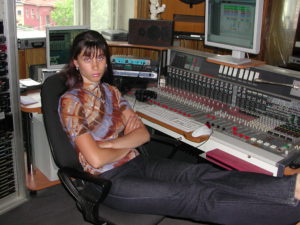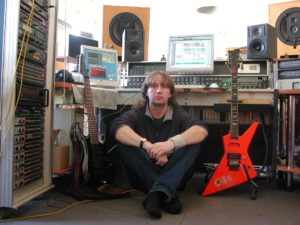
At the time, I was working as a staff sound engineer at ANtROP, and along with the other guys, I handled the bands that came in off the street. Tropillo would audition them sometimes and decide whether to record them or not. If the guys paid money, the question didn't even arise: they paid, so we're at your service. I'd get some money, send it home, and barely have enough left to live on. But then there was another problem: you'd sit with a band like that for eight to ten hours, and after they left, your own shift would begin, and you were incapable of doing anything else except brewing yourself some strong tea and vegging out in front of the evening TV broadcasts. No matter how well they played, your human resources are easily depleted when you have to closely monitor someone else's creative process. Meanwhile, the studio costs eight hundred rubles an hour, and for that money, I had to be as useful as possible; otherwise, next time they'd choose a different sound engineer. And you couldn't exactly tell them, like, 'Pack up your gear faster and fuck off back home, go to hell, you fucking assholes, you're in the way of my work...' You really want to say it to them, the words are practically itching to come out, but instead, you give them helpful advice and watch their playing closely so you don't miss any screw-ups. So you sweat it out, gritting your teeth, recording them, and recording them, and those bastards keep messing up again, and again, and you just keep recording them. And then there are requests like, 'We'd really like it to sound like the latest Yes album.'
Motherfucker, you need to at least learn how to play first, just move your little fingers around—what the fuck do you need Yes for, you filthy goat? You get a 'No', not a 'Yes'! But for some reason, musicians think they are completely at the mercy of the guy behind the console, and they don't understand that if every note is played on time and cleanly, you don't even need a sound operator. Or they'll bring in the latest Judas Priest album and say it absolutely has to sound like them, because they're paying money and have a right to sound like Judas Priest. In those cases, I always look up the release info on the album and tell them, 'Guys, you've got the wrong outlet. You need this specific city, on this specific street there's a studio where Judas Priest records. Deep in the basement of that building, deep underground, there's an acoustic chamber with twenty kilowatts of power. At a short distance from the speaker systems are twelve microphones of various designs—condenser, ribbon, and dynamic. When a musician makes a sound, the sound pressure created in that underground chamber exceeds the fatal pain threshold many times over, should a living human ever find themselves in there. But this isn't the outskirts of London; the Hermitage and the Moyka are right next door here.

At the time, I was working as a staff sound engineer at ANTHROP, and along with the other guys, I handled the bands that walked in off the street. Tropillo would sometimes listen to them and decide whether to record them or not. If the guys paid up, the question didn't even arise: they paid, and we were at their service. I'd make some money, send it home, and barely have enough left to live on. But then there was another problem: you'd sit with a band like that for eight to ten hours, and then they'd leave, your own shift would begin, and you weren't capable of anything else except brewing yourself some strong tea and planting yourself in front of the evening TV shows. No matter how well they played, human stamina is easily depleted when you're closely monitoring someone else's process. Meanwhile, the studio costs eight hundred rubles an hour, and for that money, I had to be as useful as possible, otherwise, next time they'd choose a different sound operator. And you couldn't exactly tell them, like, "Pack up your fancy gear real quick and fuck off back home, get the fuck out of here, you fucking assholes, you're in the way..." The words are just begging to be said, your tongue is itching to let them have it, but instead, you give them helpful advice, keeping a close eye on their playing so you don't miss any screw-ups. So you just suffer through it, gritting your teeth, recording them, and recording them, and the bastards keep fucking up over and over, and you just keep recording them. And then they make requests like, "We'd really love it if it sounded like the latest Yes album."
Motherfucker, you need to learn how to play first, just learn how to move your damn fingers, what the fuck do you need Yes for, you unwashed piece of shit! You need a 'No', not a 'Yes'! But for some reason, musicians think they are completely at the mercy of the guy behind the console, and they don't understand that if every note is played on time and cleanly, the sound operator isn't needed at all. Or they'd bring in the latest Judas Priest album and say that they absolutely have to sound like them, because they're paying money and have the right to sound just like Judas Priest. In those cases, I always looked up the recording info on the release and told them, "Guys, you've got the wrong studio. You need to go to this city, on this street, that's where the studio that records Judas Priest is located. Deep beneath the basement of that building, in the bowels of the earth, there's an acoustic chamber with twenty kilowatts of power. At a short distance from the speakers, there are twelve microphones of various designs—condenser, ribbon, dynamic. When a musician makes a sound, the sound pressure created in that underground chamber exceeds the fatal pain threshold many times over, should a living person ever find themselves in there. But this isn't the outskirts of London; we've got the Hermitage and the Moyka River right next door."
Long story short, they were squeezing me dry. You always need money—whatever I could earn, I made and sent back home. Lyoshka chipped in regularly, Andrey too, needless to say, but it still wasn't enough for a decent life. If it were just me, it would be one thing, but I had a wife and kids to think of. Every year I had to take them out to the Khutor for the whole summer, which was a real hassle—first to Arkhangelsk to get them, then to the Rostov region, getting to the Khutor, surviving for two months, and then back to Arkhangelsk and back to Petersburg again. Still, I managed to produce several solid releases in that grind, like Katran, Nizhe Nolya, and Vadim Kurylyov's solo album after he left DDT. We had crossed paths before: during the recording of "Svobody zakhoteli," Vadik lent our late Andryukha his Rickenbacker bass. Mikhail Nefyodov from Alisa played drums for Vadim, so overall, I felt like I was in my "own" element. And, of course, things didn't go off without a hitch.

At the time, to put it mildly, I wasn't exactly best friends with a computer. I was constantly turning to other engineers, pestering them with questions at every opportunity. That morning, Yasin was working, but after his shift he didn't go home; he stayed behind to solder something. Vadik and I were mixing the album's standout track, "Uncle Misha." The song was about that very Uncle Misha, Chernov from DDT. A lot of musicians had been invited and recorded, including the hero of the song himself. Everything was played brilliantly; these were seasoned pros. The only problem was we were running out of time to mix. It was already midnight, Vadik needed to head home, and I promised him I would finish the mix. Especially since there was practically nothing left to do, except maybe slap a maximizer on the master. And that’s exactly where the snag occurred: I put it on, turn it on, and it doesn't work. It was as if the entire audio portion of Pro Tools had frozen. I call Yasin over.
Yasin comes over:
– "Hold on, we'll just move this here, and this here, then a little clickety-click, and... OOPS! I think I did something wrong," he says.
I look at the session, and it's empty. There's nothing there, no tracks at all. We messed around with it for an hour and a half, and by then he had to get going too, what with the bridges. I figured I'd just call Vadim myself and tell him. But what can you even say? That the song we had struggled with for so long, recorded, and brought so many people in for... was now gone forever? Bitter thoughts overwhelmed me, and my hand didn't quite reach for the phone, but rather reached for the bottle.
Vadik calls in the morning:
– Well, Seryoga, how's it going? Can't wait to hear it, should I come over now?
It became clear that Yasin was asleep and hadn't yet had time to report the night's incident.
– You know, Vadik, – I answer him, half-asleep, – Uncle Misha is gone.
A heavy pause hung on the other end.
– What do you mean, gone? – Kurylov gasped in bewilderment.
– He's dead, Vadik, that's what happened. He's no more.
– How is he dead? I just talked to him late last night, told him how you and I hooked up. What happened, do you know? What went on?
I should mention that I had gotten pretty wasted the day before to calm the wild stress of losing the material. I hadn't managed to sleep it off properly, and I couldn't even really understand what Vadim was saying to me on the phone. I was incredibly sleepy and desperately wanted to end this sticky, dragging conversation as quickly as possible. So, without thinking straight at all, I nervously told him that he might have talked to him yesterday, but he was killed during the night.
– And do you know who did it, Seryoga?
– How could I not know, of course I know, Yasin did it.
– How??
– With one finger. Very simply. I didn't even have time to figure out what was happening myself, even though I was standing right there.
– Right there? Seryoga, what the hell, my brain is about to melt right now, I don't understand a damn thing... fine, I'll call the relatives to find out.
And then I realized the full extent of my hangover-induced faux pas and yelled:
– Ahhhh, wait, you misunderstood, you misunderstood. Hello! Vadim, Yasin and I just erased the song, the song 'Uncle Misha' – bam, with one click and it was gone.
– What do you mean, erased? What about Uncle Misha? What happened to him?
– He's fine, he's still alive, but your track is already dead.
– And Uncle Misha himself?
– Alive.
– Phew, – Vadik caught his breath, – you really scared me... phew. Screw the song, piece of crap, we'll record it again, and we'll record it even better. The main thing is that Uncle Misha himself is alive, you get it, he's alive!!!
I marveled at such a high level of spirituality; I personally would have left no stone unturned and killed everyone if that had happened to me. But Vadik showed his best side, and from that day on, I respected him twice as much. Musicians are people of delicate mental organization, vulnerable, impressionable, and it can be useful to find a common language with them. But the song, in its original form, we never did recover. We made a new version; Misha Nefyodov couldn't make it, so we recorded a drum machine instead of drums. Naturally, it just wasn't the same.
Once, I messed up my own track so badly it was impossible to find later. Thank God Vishnya had kept the raw takes, but re-recording the guitars was no fun. In the sound of music, there is only one ruler: the god Random. If you manage to nail something once, you will never repeat it again. Especially if three guitar parts take up fourteen channels. But Slava from the band Katran showed up to the recording session, sat down at the computer, and click-click, he restored everything. I couldn't even believe my eyes. I wish we had him back then with Yasin, at the right time.
We went through a lot of mysticism with this work, there's no denying it. When the album came off the presses, Vadim came to pick up the batch, and there... all the covers were printed in negative. How does that happen? "Well," Tropillo said, "we thought that was how it was supposed to be..." fine, he said they decided to reprint it, come back in two days. Vadim and his band were supposed to go to Moscow that exact day, and all the posters advertised the presentation and sale of the new album. You can imagine the state of Vadim's sensitive soul when they arrived to pick up the batch right before their train, only to find it unpacked, with the new sleeves not even printed yet. He had to blush in Moscow, explaining himself and making excuses. That's show business for you.
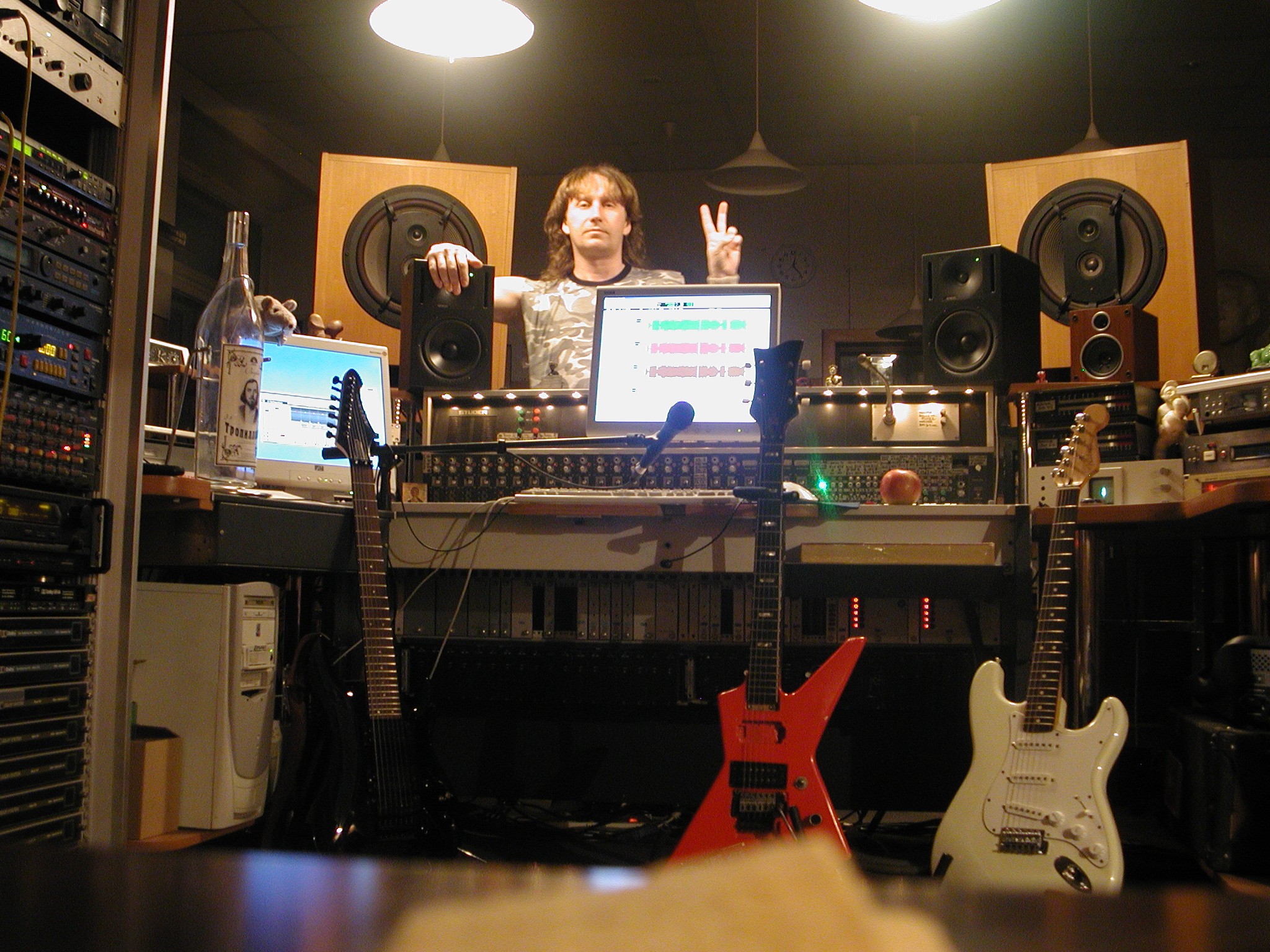
Later on, Yegor Letov's track "My Defense" was recognized by the public as the best song on Kurylyov's album. It featured the hard, aggressive sound characteristic of Grazhdanskaya Oborona. Vadik, no matter how you look at it, is a gentle guy, and he sings softly, without any pomp. Against the backdrop of such sonic pummeling, his voice sounded surprisingly organic. I really enjoyed working with him; he is an understanding person. Even though Tropillo provided the studio for free, Vadim paid me in full for the sessions, for which I owe him a huge, deeply human thanks.
People always tell me that all my troubles stem from my drinking. But Vadik doesn't drink! And yet he had such terrible luck with this album: first Uncle Misha "dies," then the batch doesn't sell. But since he doesn't drink, it means all that other stuff is nonsense. And it has absolutely nothing to do with booze.
FOR SPECIALRADIO.RU
Prepared by Alexei Vishnya
Summer 2008
Saint Petersburg
FROM THE HISTORY OF THE BAND "OBLACHNY KRAI". CHAPTER 14: WHY THE HELL DO WE NEED THE WEST
Related materials:
 FROM THE HISTORY OF THE BAND "OBLACHNY KRAI". CHAPTER 19: BOGAEV FOREVER
 FROM THE HISTORY OF THE BAND "OBLACHNY KRAI". CHAPTER 18: MY COMPUTER
 FROM THE HISTORY OF THE BAND "OBLACHNY KRAI". CHAPTER 17: EXILE FROM PARADISE. A TRIBUTE TO MAYAKOVSKY
 FROM THE HISTORY OF THE BAND "OBLACHNY KRAI". CHAPTER 16: EXILE FROM PARADISE. A TRIBUTE TO GREBENSHCHIKOV
 FROM THE HISTORY OF THE BAND "OBLACHNY KRAI". CHAPTER 14: WHY THE HELL DO WE NEED THE WEST
 ASTRAKHAN LESSONS OF THE SELECTIVE ACCORDION OF THE PETERSBURG GUITAR SENSEI
 Short stories about interesting cases from the life of Andrei Tropillo, told by himself. PART 12. Alcohol .:. Bogaev .:. The Golden City .:. Analog
 Elektricheskie Partizany – "Minefields of Freedom" – 2017
 EXCERPTS FROM AN UNPUBLISHED RECORDING. PART 3. About Moscow music lovers, Iggy Pop, John Lydon, Andrei Tropillo, Leonid Fedorov, Dmitry Prigov, Konstantin Zvezdochetov, Sven Gundlakh, Vovan Terekh, Anatoly Gerasimov
 Interview with Vadim Kurylyov, leader of the band "Elektricheskie Partizany"
 UNCLE MISHA'S MELODIC LINE: The fingering of life, riffs of the soul, and pauses of change
 FROM THE HISTORY OF THE BAND "OBLACHNY KRAI". CHAPTER 13: SHEVCHUK, KINCHEV'S WIVES, AND SERGEI KUREKHIN