…By the spring of 1984, the situation of our collective had become quite pitiful. We had visited every cultural institution in Arkhangelsk in search of a space for recording and rehearsals, but to no avail. Having been rejected everywhere, we grew despondent. Concert performances by Oblachny Krai were out of the question. My friends had already begun to drift away from musical life: Lyskovsky was finishing school and taking exams, while Rautkin was transferring to his second year at the Kharkov Institute of Physical Culture, having moved to Ukraine. We had the material, but nowhere to record it, and on top of that, I was essentially left alone...
…By the spring of 1984, the situation of our collective had become quite pitiful. We had visited every cultural institution in Arkhangelsk in search of a space for recording and rehearsals, but to no avail. Having been rejected everywhere, we grew despondent. Concert performances by Oblachny Krai were out of the question. My friends had already begun to drift away from musical life: Lyskovsky was finishing school and taking exams, while Rautkin was transferring to his second year at the Kharkov Institute of Physical Culture, having moved to Ukraine. We had the material, but nowhere to record it, and on top of that, I was essentially left alone.
The rock scene in Arkhangelsk had completely withered — for the most part, our local Melpomene consisted of students from three universities: medical, pedagogical, and forestry. It was enough to simply summon them to the right office and threaten them with expulsion for them to quickly hide their guitars inside their briefcases alongside their notebooks and get a haircut. I, on the other hand, had already served in the army, worked at a factory, and wasn't afraid of such threats. Not wanting to let my comrades down in any way, I decided to let them go their own ways for a while — to study and establish their own lives. It was then that I remembered Leningrad and Andrey Tropillo's offer to record in a proper studio.
In our northern circles, rumors were already circulating that things were much simpler in Leningrad regarding this matter; that something called a Rock Club had even been formed, under whose roof practically all Leningrad rock musicians were united, and they had the official opportunity to perform. The police didn't even break up their concerts, and no measures were taken against the musicians by the authorities. A free city, in general. I found Andrey's phone number and gave him a call.
- "Alright, gather your guys and come on over," — Tropillo didn't hesitate in the slightest. He worked at the House of Young Technicians and taught in an Acoustics and Sound Recording club, and since all the Young Pioneers were away on summer vacation, the studio was free. Relatively free, I must say, because there were many bands in Leningrad, but Tropillo, at that time, was the only one of his kind. I warned him that no one but me would be able to come; Andrey reassured me that there were plenty of great musicians in Leningrad, and if that was the case, we would find someone to play both the keyboards and the drums.
I took a few days off, some at my own expense, bought a plane ticket for 19 rubles, and flew out. I was nervous: previously, I had always come to Leningrad with my mother, but here I was alone, having arrived who knows where, and to be honest, I had no idea how I would manage to record with unfamiliar musicians in an unfamiliar place... but the moment I stepped onto the ground, half of my phobias dissolved on their own. I caught a cab and headed to Okhta.
The closer we got to the studio, the fewer doubts I had. Tropillo came out to the street to meet me — just as I was pulling up. We went up to the third floor, where Andrey's club was located, and stepping over the threshold, taking in the room and everything in it — I gasped. What I saw surpassed all my fantasies. I used to think that our studio at the Red Forge was some kind of breakthrough in studio construction — but compared to this one, it was certainly a golden childhood. Two large rooms separated by a large double window, and in the machine room stood large studio reel-to-reel tape recorders, with a huge mixing console under the window frame.
My ecstatic contemplation of all these riches was interrupted by Andrey asking in an embarrassed tone: "So, Seryoga, how are things with your finances?". I asked what the problem was; Andrey hinted that it was already 12 o'clock, and as they say, "it's time to take a shit, and we haven't even eaten yet"...
My finances were actually quite good: I went to Leningrad right after payday, and my salary was that of a normal Soviet proletarian — 250 rubles — not like an ordinary Soviet teacher. Besides, shortly before flying to Leningrad, I had bought a "Sportloto" ticket, guessed four out of five numbers, and won a whopping 168 rubles. Andrey took me around the nearby grocery stores, which amazed me with their abundance of various products, because compared to Arkhangelsk — Leningrad was a true food and beverage paradise.
We filled two large grocery bags with rather tasty and wonderful things that I had previously only seen on television: sausages, a couple of varieties of salami, soft and hard cheeses, and most importantly!... in one of the Okhta grocery stores there was a "Grocery" section, and in it... there I saw in real life what had previously only been available to me on the movie screen — the Italian drink "Cinzano" from the film *The Return of the Tall Blond Man with One Black Shoe*. I immediately grabbed two whole liter bottles of my teenage dream. Tropillo started trying to talk me out of it, saying something like, "Here, take the normal stuff, for a ruble seventy, Portuguese wine bottled in Leningrad." To which I objected that theoretically, I could find that in Arkhangelsk, but I had never even seen Cinzano in my dreams — only in the movies.
We brought all this to the studio, laid it out on the table, and decided not to start work on the day of our arrival, but rather to properly celebrate the beginning of a new stage in our relationship. Andrey dug up two faceted glasses somewhere, and we raised a toast to that great and bright future awaiting us, so that nothing would knock us off the path we had chosen for ourselves, and which was the most important thing in our lives.
Just half an hour later, it felt like we had known each other for three hundred years. Andrey was dropping all sorts of obscure technical terms and previously unknown phrases; I listened and put on a smart face, nodding understandingly. Tropillo was also pleased to be communicating with a technically savvy specialist — after all, I had already been doing this sort of thing for several years, the results of which had received high praise from Andrey and the musicians of the band "Aquarium" — I mean our first album and the Leningraders' first visit to Arkhangelsk. Although I had to work with much more modest means than what was available here. We communicated practically as equals, which was undoubtedly pleasant for me. I became more and more convinced that I hadn't given up everything and come here in vain.
At some point during our conversation, Andrey warned me that, despite the apparent freedom compared to Arkhangelsk, we still needed to keep our eyes peeled, not forget which country we lived in, and not let our guard down. Our band had already been added to the lists of banned groups, and Andrey advised me not to mention Arkhangelsk to any of the House of Young Technicians workers who might wander in, and not to say the name of our band out loud. I swore to keep my mouth on a tight leash, but we slipped up literally within an hour. One of the workers from the Young Pioneers' House who walked in — precisely the teacher Tropillo suspected of being an informant — cast a fleeting glance at the two bags of "Cinzano" standing on the table, which had the words "Arkhangelsk — 400 Years" written on them in large letters, and asked with a knowing squint: "A Northerner?" I started making excuses, inventing a metro station I was from, but he just chuckled, nodded at my bags, and left in peace.
Towards evening, the question of lodging arose, but Andrey had already thought it all out. A year prior, I had been corresponding with his student Lesha Vishnya, who lived on Bolshoi Okhtinsky Avenue, a few minutes' walk from the studio, and he lived alone in a huge apartment — his parents went to their dacha for the summer.
Talking about Lyoshka requires a separate conversation altogether — I was very surprised when I received his letter: he wrote that he was attending Andrey Tropillo's club, and the album I had sent to Leningrad a year ago, Tropillo was using in his classes as didactic material — a visual aid for amateur home recording, as an example of creating "everything out of nothing"... Alexey was deeply inspired by this idea and also decided to build something resembling a studio in his own home, and it was these thoughts that he shared in his letter.
In literally every line, there shone such a disarming sincerity and genuine enthusiasm with which Vishnya intended to engage in the very thing that interested me the most — recording self-composed music onto magnetic tape. I should note that, for Vishnya, recording was always a higher priority than performing — he began recording himself long before he had anything to actually record.
The beautiful, spacious apartment was entirely at Alexey's disposal — this was a very rare and valuable phenomenon — when one could engage in their favorite pastime not in some damp basement, an old garage, or a converted warehouse, but in a fully equipped apartment, where neither parents nor neighbors were constantly nagging at you. Given that Vishnya was a sociable guy with a great sense of humor, his apartment became a favorite cult spot for the best musicians in Leningrad, a sort of cultural center. Eventually, when we finished our Cinzano, the question of a horizontal position arose, and Tropillo and I headed over to Alexey's. We stopped at a little shop and bought a couple of bottles and some food.
A few minutes later, a large man with a kind smile on his face opened the door. Tropillo introduced us, and right from the threshold, Vishnya began showing off his home studio to me. It also amazed me with its technical perfection for that time, and I thought once again about how huge the difference was between Arkhangelsk and Leningrad. My last doubts about the expediency of my trip dissolved in the smoke of Lyoshka's cigarettes. In a single day, I had visited two whole recording studios, the likes of which I could only dream of, and I hadn't even imagined that such splendor could be privately owned in our country. It turned out it could — by people with whom I was lucky enough to quickly find a common language.
Our conversation dragged on; well after dark, Tropillo hurried home to his family, we put him in a cab, and went to sleep. But we just couldn't stop — Vishnya kept playing me recordings of various Leningrad and Moscow bands, introducing me to the previously unknown phenomenon of "underground Russian-language rock."
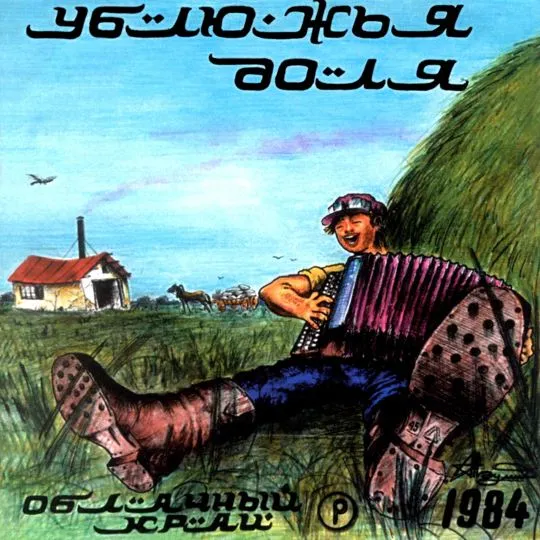
Of course, I couldn't have heard anything like this in Arkhangelsk — if any of our local performers had taken to the stage and sang "I am me, the people have chosen me, so blah blah blah fuck you in the mouth" in the style of the Moscow band "DK" — they would inevitably have been "shot on the spot." I had the impression that I had visited some other country. The realization that the closer you got to the center, the more freedom there was, was absolutely staggering. In Moscow, the capital, where the Politburo and the Central Committee were right next door... there was also "DK". In a way, listening to "DK" at that moment really loosened me up, and our lyrics became harsher. And since I always compose everything directly "on the machine" — during recording — this influence already made itself felt on the song "Camel's Share" (*Ubluzhya dolya*).
I didn't want to sleep at all; I wanted to grab the guitars right then and there and start recording something. However, by about seven o'clock, Alexey made up a bed for me in the spacious bedroom, and I spent a long time trying to fall asleep. The overwhelming impressions of my first day in Leningrad chased away my slumber, but when I finally managed to drift off into nothingness — I dreamt something muddled, chaotic, and impossible to describe.
Waking up closer to noon, I went out to the kitchen, where the next knockout blow of fate awaited me — there stood a few bottles of beer on the counter, which for Arkhangelsk was absolutely extraordinary. The hospitable host had already managed to run to the store that morning, and by the time I woke up, something was already sizzling in his frying pan. And although I didn't have a bad hangover, it was still very nice that the day started with such emotions. And then Tropillo called — he said the horn was calling, and I started getting ready.
I began packing my guitars — a "Ural" from the Sverdlovsk Musical Instrument Factory, and a homemade three-string bass that I had built myself, sawing the necessary parts at the factory. It only had three strings because either I had chosen material that was too flimsy, or I simply miscalculated — when I strung the fourth string, the neck would bend into an arch, and the instrument would take the shape of a bow. It could still somehow hold three strings, which was quite enough for me. In the recording, no one would notice anyway, because, as they say — our little houses aren't crooked for that reason — and with a certain level of skill, you could play practically any bass part quite decently on three strings, which is exactly what I did. In addition to these guitars, I brought my fuzz pedal unit, which I had soldered together myself back in 1980 and hadn't traded for anything else since, because it was thanks to this specific piece of equipment that we had such a unique, unparalleled guitar sound.
With all this baggage, I headed to the studio. There were already a few musicians there from the bands "Piknik" and "Tamburin". When I unpacked my entire collection of instruments, the rockers surrounded my gear in a semicircle and started laughing hysterically, pointing their fingers. To the question, "How can you play music on such firewood?" I didn't answer, thinking to myself, "You have to know how to play, that's all"... After a while, Tropillo kicked out all the extra people, loaded a wide reel of tape the size of an LP record onto an AMPEX tape recorder the size of a refrigerator, and we began recording.
I didn't have a drummer with me, since I had come alone without a band, so it was decided to use a method of recording to a metronome that was hitherto unknown to me. Andrey had a Soviet "Lel" drum machine; its sound was absolutely vile, but it could be used as a metronome, although its own noise was barely quieter than the sound itself. We chose a tempo, recorded the metronome onto the first outermost track, and that was how I began to sequentially record all the material — song after song, as always, finalizing the parts in my head at the very moment of recording. I spent two hours recording the rhythm guitar and bass for the first song — I was very nervous and getting used to the tape machine. After that, things went a bit faster.
I liked multi-track recording so much; I realized that all our experiments with consumer tape recorders were irrevocably a thing of the past, and new horizons lay ahead. My admiration for Andrey Tropillo grew — after all, the man, risking his job, had managed to build such an operation with his own hands in these partisan, underground conditions... Against the backdrop of all this euphoria, I was overcome with a fierce regret that my friends — Kolya and Oleg — couldn't see all of this.
While I was recording the guitars during the first week, Tropillo was looking for a drummer, which turned out to be no simple task, as music of this style was played rather rarely. Finally, once the guitars and bass were already recorded, the drummer from the band "Tamburin", Sasha Petelin, showed up. We knew nothing about each other, but he responded to Andrey's offer to play in the studio.
After listening to the material, he perked up — "Psh, what's there to play? It's easier than steamed turnips. I thought it was going to be something actually complex..." But here, I must say, he got a little ahead of himself, because after a few trial takes, it turned out that he had never played this kind of music before, and that it was a bit more difficult than what he played in the band "Tamburin": he played on a few songs, of which only one made it onto the album — "Suck on it" — he played really well on that one, so we kept it. But that evening, listening back to the recorded material, we decided that Petelin wasn't quite right for our project and that we needed to find someone else — someone harder, more technical, aggressive, and energetic.
Tropillo remembered that he had a drummer who could handle such a task — moreover, I already knew him — Zhenya Guberman. He had come to Arkhangelsk with Aquarium, which I had already written about. When Zhenya sat down and started playing right off the bat, I was simply blown away. I had never interacted with musicians of this caliber before; besides, I really love drums, they are one of my favorite musical instruments. And when I heard how such drum kit sound, with such technique and imagination, was layered over my guitar music — I was simply overwhelmed with delight, with surprise, and with all the emotions that washed over me! Moreover, Zhenya turned out to be such a simple, pleasant person to talk to, which was very surprising — it was flattering that a true professional musician, unlike us backyard amateurs, and such a musician at that, had agreed to play with us. Another thing that surprised me was that Zhenya never drank at all, ever — horror of horrors — no wine, no vodka, and he even ignored beer, which to me was something from the realm of unattainable heights. Nevertheless, it was true.
(To be continued)
Recorded from the author's words by Alexey Vishnya.
Source: Memories of Sergey Bogayev specially for Spetsialnoye Radio.